
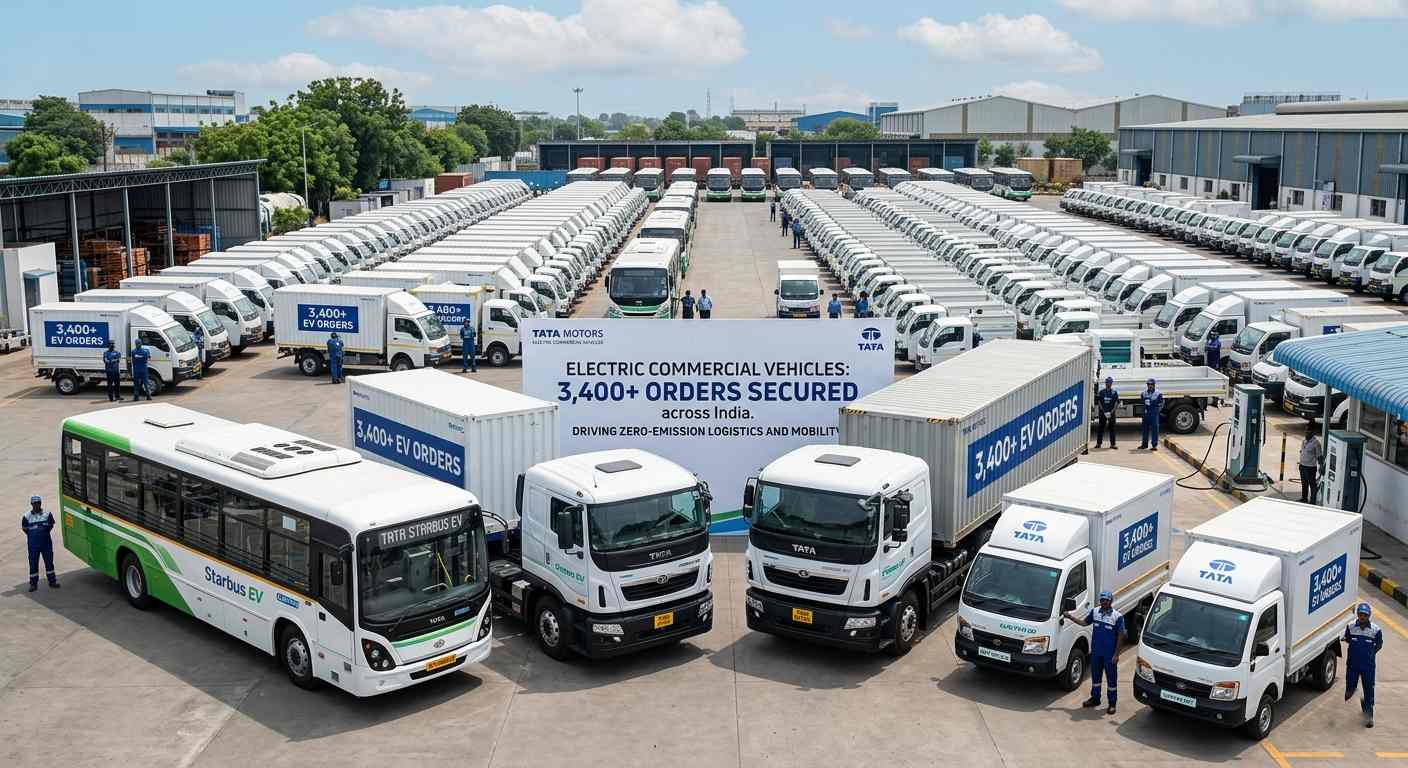
The Indian commercial automobile landscape is witnessing a massive tectonic shift toward sustainable energy, and market leader Tata Motors is comfortably driving the transformation. Tata Motors electric commercial vehicles have officially crossed a significant milestone, locking in a colossal order book of over 3,400 units spanning multiple segments. Announcing the development on Sunday, June 21, 2026, the country’s largest commercial vehicle manufacturer signaled that zero-emission logistics and public transport operations are no longer just future concepts—they are actively scaling up across Indian industries.
Following the blockbuster announcement, the market responded with notable optimism. In early trade on Monday, June 22, 2026, shares of Tata Motors Ltd gained as much as 2%, climbing to ₹410.45 apiece on the National Stock Exchange (NSE). Investors and industry insiders alike view this massive influx of orders as a definitive inflection point for green vehicular logistics in India.
Tata Motors Electric Commercial Vehicles Breaking Down the 3,400+ EV Order Vault
The sheer scale of this order book showcases how deeply electrification is penetrating different sectors of the Indian economy. Rather than relying on a single dominant segment, the 3,400+ unit order is strategically distributed across light, medium, and heavy-duty applications.
1. Small Commercial Vehicles (SCVs) and Pick-ups
Volume: Approximately 2,000 units
Primary Application: Last-mile urban delivery, e-commerce fulfillment, FMCG distribution, and fresh produce logistics.
Key Models Involved: Ace Pro EV, Ace EV, and Intra EV.
2. Electric Trucks (M&HCV)
Volume: Nearly 900 units
Primary Application: Heavy industrial transport, intra-city bulk freight, and mining operations.
Key Models Involved: Ultra EV range (7–12 tonnes), Prima EV 28-tonne tipper, and Prima EV 55-tonne tractor.
3. Electric Buses
Volume: Approximately 500 units
Primary Application: Municipal public transport, inter-city corporate travel, and airport tarmac operations.
Key Models Involved: Starbus EV and Ultra EV passenger buses.
Moving Beyond Pilot Projects to Scaled Integration
For years, the adoption of electric vehicles in the commercial space was limited to small-scale pilot programs. Fleet operators would buy five or ten vehicles to test battery degradation, range limits, and charging infrastructure constraints under real-world conditions.
According to Tata Motors’ statement to the stock exchanges, this massive 3,400-unit bulk order signals a decisive departure from those cautious trials. Major businesses, corporate logistics entities, and public transport operators are now completely confident in the economic and operational viability of electric fleets.
[Traditional Logistics Hubs] ──> [Small Pilot Trials] ──> [Massive 3,400+ Unit Scaled Deployment]
This massive deployment covers a remarkably diverse operational matrix, including:
Fast-Moving Consumer Goods (FMCG): Rapid distribution cycles requiring high uptime.
Fast-Moving Consumer Durables (FMCD): Moving electronics and appliances safely into dense urban spaces.
Heavy Industries: Crucial sectors like cement factories, steel manufacturing plants, and active mining operations where vehicles face punishing duty cycles.
Passenger Transport: Clean, quiet intra-city public bus networks and inter-city commutes.
A Closer Look at Tata’s Diversified EV Portfolio
Tata Motors’ ability to capture such a massive chunk of the market stems directly from its aggressive product development strategy over the past 12 months. The auto giant has significantly strengthened its portfolio to offer tailor-made solutions for varied duty cycles and localized operating conditions across India.
The Last-Mile Masters: SCVs and Pick-Ups
The iconic “Chhota Hathi” has gone fully electric, and Indian businesses are loving it. The Ace EV and the high-performance Ace Pro EV, alongside the larger Intra EV, are quickly becoming the default choices for last-mile and intra-city logistics hubs.
With e-commerce giants facing strict corporate net-zero mandates, these compact electric workhorses allow companies to enter restricted urban zones seamlessly, dodging emission penalties while drastically slashing per-kilometer operating costs.
The Heavy Lifters: Industrial Electric Trucks
Perhaps the most surprising acceleration is happening in the Medium and Heavy Commercial Vehicle (M&HCV) categories. Tata Motors has disrupted this space with its highly versatile Ultra EV range, covering the crucial 7-to-12-tonne market.
For heavy industrial applications, the company’s flagship clean-energy offerings include:
Prima EV 28-Tonne Tipper: Engineered specifically for the brutal terrains of Indian mines and construction sites.
Prima EV 55-Tonne Tractor: Designed for long-haul hub-to-hub freight movement, proving that heavy loads do not require a diesel engine to move efficiently.
Public Transport & Aviation: Starbus and Ultra EV Buses
On the passenger front, Tata Motors continues to dominate urban transit. The Starbus EV and Ultra EV bus models are built to tackle high-capacity commuter routes. Beyond city roads, these vehicles are finding a home in corporate transit fleets and specialized airport tarmac operations, keeping passenger transport quiet, smooth, and entirely emissions-free.
Ground Reality: Millions of Kilometers Already Clocked
While a 3,400-unit order book points toward an incredibly bright future, Tata Motors already boasts an unrivaled operational track record on Indian roads. This existing footprint gives large fleet operators the real-world data points they need to sign massive multi-million dollar procurement deals.
| Vehicle Segment | Active Fleet in India | Key Milestone Achieved |
| Electric Buses | More than 3,800 units | Over 550 million kilometers clocked |
| Small Commercial Vehicles (SCVs) | More than 17,000 units | Driving nationwide urban last-mile delivery |
With more than 17,000 electric SCVs active nationwide and buses operating across major metros, Tata Motors has accumulated millions of gigabytes of battery health, thermal performance, and regenerative braking data. This unparalleled data advantage allows them to optimize their newer generations of vehicles perfectly for local conditions.
Why Fleet Operators are Pivoting to Tata EV Solutions
The sudden surge in commercial EV adoption is driven by a mix of corporate responsibility, environmental necessity, and clear financial benefits.
Drastic Reduction in TCO (Total Cost of Ownership): While the initial acquisition cost of an electric truck or bus remains higher than its diesel counterpart, the running costs are dramatically lower. Electricity as a fuel source is far more stable and cost-efficient than fluctuating diesel prices.
Simplified Maintenance Cycles: Electric drivetrains have a fraction of the moving parts found in traditional internal combustion engines. No oil changes, no complex exhaust after-treatment systems (like SCR or DPF), and less brake wear due to regenerative braking mean vehicles spend less time in workshops and more time generating revenue.
Strict Corporate ESG Mandates: Global e-commerce companies, international conglomerates, and top-tier Indian industrial houses are under intense pressure from stakeholders to decarbonize their supply chains. Transitioning their logistics contracts entirely to electric fleets is the fastest way to hit these targets.
The Path Ahead for India’s Green Commercial Fleet
Securing 3,400 orders is an incredible milestone, but it also underscores the urgent need for a robust corporate and public charging infrastructure. As hundreds of new electric trucks and buses hit the road simultaneously, the focus will naturally shift toward high-capacity megawatt charging stations along major freight corridors and dedicated industrial charging hubs.
Tata Motors’ continuous ecosystem expansion—often working in tandem with group companies like Tata Power to establish charging networks—positions it uniquely to solve these infrastructure puzzles for its clients.
As the order book transitions into active deliveries over the coming quarters, expect to see a cleaner, quieter, and far more profitable logistics ecosystem take shape across India. The green revolution on Indian roads isn’t coming tomorrow—thanks to these major corporate commitments, it’s already here.
Disclaimer : Any stock prices, market data, or financial details shared here are for information only. We do not provide investment or financial advice. Please talk to a certified professional before making any financial decisions.