
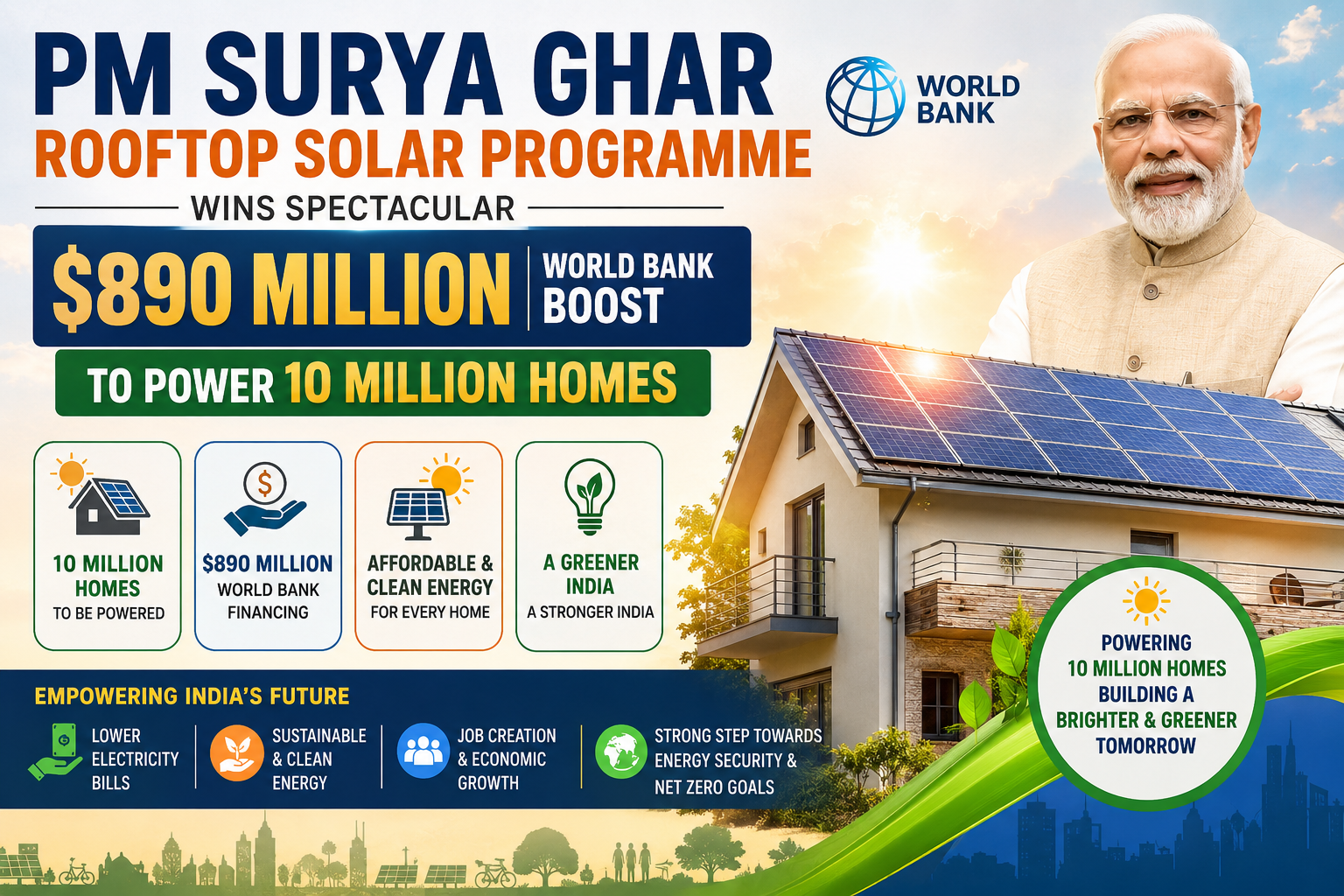
The PM Surya Ghar Rooftop Solar Programme is officially getting a massive global boost. In a monumental move aimed at shifting India’s residential clean energy landscape into overdrive, the World Bank has formally approved a spectacular $890 million (approximately ₹7,400 crore to ₹8,500 crore) financing package. This mega injection of multilateral capital is specifically designed to supercharge the Government of India’s flagship residential rooftop solar initiative—the PM Surya Ghar: Muft Bijli Yojana.
By removing deep-rooted financial barriers for regular homeowners, this massive funding package is projected to act as a catalyst, unlocking an additional $4.2 billion in private commercial investment. Beyond putting solar panels on the roofs of millions of middle-class and rural Indian homes, this historic international backing is set to revolutionize the domestic manufacturing supply chain, transform local power distribution networks, and create an astonishing 1.7 million sustainable green jobs across the country.
Breaking Down the $890 Million Multi-Tiered Financial Package
The financing approved by the World Bank’s Board of Executive Directors isn’t just a standard lump-sum loan. Instead, it is a highly strategic, blended financing framework structured to maximize economic efficiency and leverage private commercial capital.
The $890 million total package is split into three distinct, specialized components:
$820 Million IBRD Loan: The core of the package consists of an $820 million direct loan from the International Bank for Reconstruction and Development (IBRD). This provides the heavy financial muscle required to scale the programme’s infrastructure nationwide.
$60 Million Concessional Loan: Sourced from the global Clean Technology Fund (CTF), this highly favorable, low-interest loan lowers the overall cost of capital, making the massive deployment of resources economically viable.
$10 Million IBRD Livable Planet Fund Grant: A dedicated $10 million grant aimed at capacity building, technical assistance, and ensuring the environmental sustainability of the roll-out.
       ┌────────────────────────────────────────────────────────┐
       │             TOTAL WORLD BANK FINANCING                 │
       │                    $890 Million                        │
       └──────────────────────────┬─────────────────────────────┘
                                  │
         ┌────────────────────────┼────────────────────────┐
         ▼                        ▼                        ▼
  $820 Million IBRD        $60 Million CTF         $10 Million LPF
    Standard Loan        Concessional Loan              Grant
The Multiplier Effect: Unlocking $4.2 Billion in Private Capital
What makes this World Bank intervention a true game-changer is its ability to mobilize private enterprise. The initial $890 million public investment is explicitly structured to de-risk the sector, effectively paving the way for an estimated $4.2 billion in private financing via commercial bank lending.
For years, commercial banks have been hesitant to offer affordable, widespread financing for residential rooftop solar installations due to perceived risks and a lack of collateral from everyday consumers. This blended package acts as a financial shock absorber, giving local banks the confidence to extend affordable, competitive loans to millions of everyday citizens looking to make the green switch.
What is the PM Surya Ghar: Muft Bijli Yojana?
Launched by the Government of India, the PM Surya Ghar: Muft Bijli Yojana is arguably one of the most ambitious residential clean energy initiatives ever attempted anywhere in the world. The core target is breathtaking in its scale: installing rooftop solar systems on 10 million (1 crore) households across both urban and rural India.
The immediate, tangible benefit for the participating households is direct relief from escalating utility costs. Under the scheme’s guidelines, the integration of rooftop solar panels is designed to provide up to 300 units of free electricity every single month to each household. In a country where electricity bills constitute a significant chunk of the monthly middle-class and low-income budget, this zero-cost power allocation represents a monumental shift in household economics.
Bridging the Great Solar Divide: Utility-Scale vs. Residential Growth
To truly appreciate why this funding is so crucial, one must look at the structural imbalance in India’s renewable energy journey over the past decade.
India has been a global poster child for rapid solar expansion. The nation’s total installed solar capacity has skyrocketed from a modest 500 MW to a massive 27 GW. However, an overwhelming majority of this growth has taken place in massive, utility-scale solar parks—vast deserts of solar panels managed by large corporations feeding directly into the national grid.
In stark contrast, the residential rooftop solar segment has lagged dramatically behind. Everyday homeowners have faced steep uphill battles, including:
High Upfront Capital Outlay: Installing a reliable residential solar setup typically requires an immediate cash investment that most Indian families simply cannot afford out-of-pocket.
Collateral Bottlenecks: Traditional bank loans for home improvement often require extensive collateral, property documents, and high credit scores, locking out millions of potential rural and semi-urban applicants.
Fragmented Vendor Ecosystems: A lack of standardized installers, unreliable component quality, and complex local approval processes have historically deterred consumers.
The World Bank-backed framework directly addresses these core pain points. By enabling collateral-free financing, the programme democratizes access to clean tech. Regular families can now bypass the paralyzing requirement of pledging assets just to put clean energy generation systems on their own roofs.
Economic Impact: 1.7 Million New Green Jobs
The ripple effects of this $890 million financial package extend far beyond the clean energy grid. According to detailed World Bank estimates, the nationwide scaling of the rooftop solar sector is set to become a massive engine for domestic employment, supporting approximately 1.7 million jobs.
Unlike large-scale solar farms that require relatively minimal staff once constructed, residential rooftop solar is incredibly labor-intensive across its entire lifecycle. This massive employment boom will be distributed across several key sectors:
Domestic Manufacturing: Producing solar photovoltaic (PV) modules, smart inverters, mounting structures, and electrical wiring within India, aligning perfectly with national self-reliance goals.
Engineering and Installation: A massive surge in demand for localized technicians, roof surveyors, electricians, and construction crews to physically install systems across 10 million distinct homes.
Operations & Maintenance (O&M): The creation of long-term, decentralized service roles tasked with the periodic cleaning, repairing, and optimizing of residential panels over their 25-year lifespans.
Financial & Retail Services: Specialized roles within regional banks, micro-finance institutions, and solar distribution dealerships to manage the massive influx of consumer loans and equipment sales.
Strengthening the Ecosystem: DISCOMs and Digital Integration
A critical, often overlooked aspect of the World Bank’s funding is its focus on capacity building for India’s Electricity Distribution Companies (DISCOMs).
Historically, residential rooftop solar has been viewed as a disruptive challenge by local power utilities. As millions of high-paying residential consumers start generating their own electricity, DISCOMs face potential revenue drops. Furthermore, managing thousands of decentralized points feeding power back into the regional grid requires sophisticated technology.
┌────────────────────────┐      Clean Energy      ┌────────────────────────┐
│  10 Million Rooftops   ├───────────────────────>│ Local DISCOM Grid      │
│  (Decentralized Power) │                        │ (Smart Infrastructure) │
└────────────────────────┘                        └───────────┬────────────┘
            ▲                                                 │
            └─────────────────────────────────────────────────┘
                              Bidirectional Flow
A significant portion of the new funding will go toward modernizing these distribution networks. The goal is to transform DISCOMs from passive electricity sellers into active managers of a dynamic, bidirectional smart grid. By training personnel, upgrading local grid infrastructure, and streamlining the billing systems for net-metering (where homeowners sell excess solar power back to the grid), the programme ensures that local utilities become willing, enthusiastic partners in India’s green transition.
Leadership Insights: Direct from the Experts
Global leaders and project directors have voiced immense optimism regarding the transformative potential of this financial injection.
“The World Bank has been supporting India’s solar rooftop sector for over a decade, mobilising more than $2 billion to catalyse market growth from 500 MW to over 27 GW of installed capacity,” stated Paul Proccee, the World Bank Acting Country Director for India. “This new financing will help India scale up residential solar, while creating job opportunities across the supply chain and installation ecosystem.”
Complementing this perspective, Moez Cherif, the World Bank’s Task Team Leader for the program, emphasized how the initiative alters the day-to-day reality of the average citizen:
“The program will transform the residential solar market by removing financial barriers and building the capacity of distribution companies, banks, and vendors to deliver integrated service solutions. Through collateral-free financing, households can install solar power and significantly reduce their monthly electricity bills.”
The Grand Vision: Path to Net Zero 2070
This massive financial development is a vital building block in India’s larger, long-term climate commitments on the world stage. India has officially pledged to reach ‘Net Zero’ greenhouse gas emissions by 2070. Additionally, the country has set an aggressive mid-term milestone: increasing non-fossil-fuel-based energy sources to account for 60 percent of its total electricity mix by 2035.
Achieving these monumental targets is practically impossible by relying solely on corporate solar parks. It requires a true democratization of energy production. By converting ten million residential roofs into mini green power plants, India is turning its vast population into active participants in the climate fight, rather than mere consumers of fossil-fuel energy.
The Bottom Line for Indian Homeowners
For the average citizen, the collaboration between the Indian Government and the World Bank means that making the switch to clean energy is no longer a luxury reserved exclusively for the wealthy.
With the imminent rollout of streamlined, collateral-free commercial loans, simplified subsidy distributions, and a highly trained network of certified local vendors, setting up a home solar system will soon be as straightforward as buying a major home appliance. The end result? Lower carbon footprints, millions of stable local jobs, a resilient national grid, and—most importantly for families—up to 300 units of free, clean electricity cutting down household expenses month after month.
Quick Facts: World Bank Funding for PM Surya Ghar Scheme
| Feature | Key Program Detail |
| Total World Bank Package | $890 Million (IBRD Loan, Concessional Loan & Grant) |
| Private Capital Target | $4.2 Billion in commercial lending |
| Household Impact Goal | 10 Million (1 Crore) rural and urban homes |
| Key Consumer Benefit | Up to 300 units of free electricity per month |
| Job Creation Potential | 1.7 Million jobs across manufacturing & maintenance |
| National Climate Target | Contribution to 60% non-fossil fuel electricity by 2035 |