
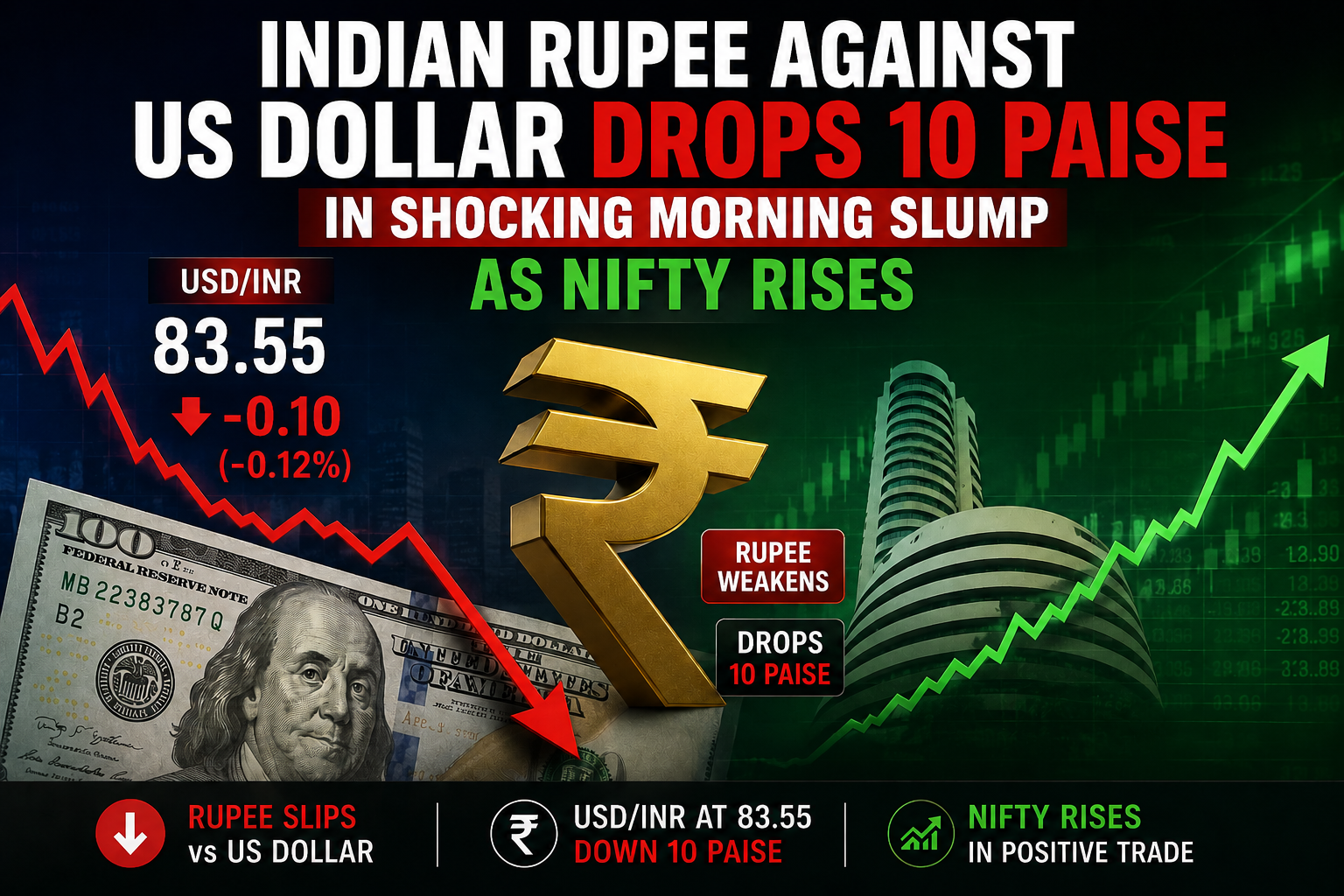
The Indian Rupee against US Dollar experienced a bumpy opening in early morning trade on Monday, July 6, 2026, slipping by 10 paise to touch 95.28 at the interbank foreign exchange market. This sudden soft patch comes despite a roaring, optimistic opening on Dalal Street, where both the benchmark BSE Sensex and the NSE Nifty 50 posted robust opening gains. The divergent movement between India’s domestic equity markets and its local currency highlights a complex tug-of-war playing out behind the scenes of global finance—driven by an aggressively resilient greenback, lingering corporate importer demand, and the strategic positioning of the Reserve Bank of India (RBI).
For retail investors and macroscopic market watchers alike, this mixed bag of market signals can feel a bit counterintuitive. Usually, a soaring stock market signals a massive rush of global confidence, which traditionally boosts the local currency. However, today’s early trading session proved that the global currency ecosystem operates under its own distinct set of gravity rules.
Below is an instant snapshot of how India’s vital financial indicators looked during the early hours of Monday’s trading session.
Morning Market Dashboard
| Financial Asset | Current Level / Rate | Absolute Change | Percentage / Paise Change | Market Sentiment |
| USD/INR | 95.28 | +0.10 | Down 10 paise (Rupee depreciation) | Bearish for Rupee |
| BSE Sensex | 78,051.03 | +281.40 points | Up 0.36% | Bullish |
| NSE Nifty 50 | 24,347.05 | +74.60 points | Up 0.31% | Bullish |
| Brent Crude Oil | $71.88 / barrel | -$0.24 | Down 0.33% | Soft / Easing |
| US Dollar Index (DXY) | 100.90 | Unchanged | Flat at two-week lows | Consolidating |
Dissecting the Rupee’s Early Morning Slip
The currency market opened for the week with the Indian Rupee against US Dollar starting flatly at 95.23 before quickly sliding down to the 95.28 mark. This minor collapse effectively wiped out a portion of the hard-earned gains registered during the previous Friday session (July 3), where the local unit had put on a stellar performance, appreciating by 17 paise to wrap up the week at 95.18.
So, what exactly triggered this immediate morning reversal? Forex desks point to a few highly specific catalysts:
The Federal Reserve Specter: Despite the US Dollar Index hovering near a two-week low globally around the 100.9 mark, broader underlying expectations regarding American interest rate trajectories remain rigid. Any lingering fears that the US Federal Reserve might hold interest rates higher for longer—or potentially push through an additional hike down the line—tends to give the greenback a systemic yield advantage over emerging market assets.
Arbitrage and Routine Corporate Buying: Last week, the rupee took a near 1% hit across the board. Forex dealers noted that this was heavily exacerbated by arbitrage-related plays and routine dollar-buying pipelines by large domestic importers. When corporations need to clear their month-end or early-month import bills (especially defense and capital infrastructure goods), they create a massive localized demand for dollars, forcing the rupee down regardless of global index trends.
The Re-balancing Dynamic: Post-weekend market reopenings often see a backlog of corporate settlement demands hitting the clearing desks simultaneously between 9:00 AM and 10:00 AM, creating temporary structural volatility.
The Invisible Guardrail: RBI’s Forex Reserve Strategy
One of the most fascinating takeaways from recent currency desk briefs is the changing strategic playbook of the Reserve Bank of India. In traditional economic textbooks, a central bank’s primary goal during currency volatility is simply to prevent its currency from crashing. However, in the current macroeconomic climate, the RBI is playing a far more nuanced, multi-layered game.
Market analysts and prominent foreign exchange advisors point out that even when fresh foreign institutional inflows pour into Indian equities, the central bank isn’t necessarily letting the rupee run wild on the upside. Instead, the central bank appears to be using these capital influx windows as golden opportunities to absorb excess dollars and rebuild India’s national foreign exchange reserves.
“Whenever fresh foreign inflows enter the country, the central bank is highly likely to use the opportunity to aggressively buy dollars to shore up its defense chest rather than allowing the rupee to strengthen past structural boundaries,” remarked a senior analyst from Finrex Treasury Advisors.
By keeping the rupee comfortably bounded within a predictable corridor—currently projected between 94.80 and 95.50—the RBI manages to achieve two critical goals simultaneously:
It insulates the domestic economy from sudden external capital shocks.
It ensures that Indian exporters do not lose their global competitive edge due to an artificially overvalued currency.
Dalal Street Stands Tall: Sensex and Nifty Break Higher
While the currency traders were dealing with a minor dollar squeeze, the mood over at the Bombay Stock Exchange (BSE) and National Stock Exchange (NSE) was decidedly cheerful.
The BSE Sensex surged past the opening bell, picking up 281.40 points to trade comfortably at 78,051.03. Simultaneously, the broader NSE Nifty 50 index added a healthy 74.60 points, scaling up to 24,347.05. This equity market resilience indicates that domestic institutional investors and retail mutual fund pipelines remain structurally robust, ignoring the localized currency fluctuations.
The primary driver behind this equity optimism is the easing of global commodity pressures, paired with steady domestic corporate earnings data. Sectors like banking, financial services, and information technology saw immediate defensive buying from the opening bell. When domestic manufacturing and services show strong forward visibility, international capital continues to view Indian equities as a structurally sound oasis, even if the underlying exchange rate experiences short-term macro adjustments.
The Oil Cushion: Brent Drifts Below $72
For an economy like India, which relies heavily on imports to satisfy over 80% of its domestic fossil fuel needs, oil prices act as the ultimate swing factor for both inflation and currency stability. Fortunately, Monday morning brought some welcome relief on this front.
Brent crude futures fell by 24 cents, or 0.33%, cooling off down to $71.88 a barrel during early trade, effectively canceling out the modest 0.45% bump seen on Friday. This downward drift in global crude benchmarks is a massive relief for India’s trade deficit math.
The primary catalyst for this softening stance was the latest supply agreement from the OPEC+ alliance, which has agreed to systematically raise oil output targets starting in August 2026. Furthermore, supply shipping lanes through the critical Strait of Hormuz have continued their steady operational recovery. This double-whammy of increased production targets and smoother logistical channels has successfully taken the speculative premium out of energy markets, providing a reliable cushion that prevents the rupee from sliding significantly deeper into negative territory.
Global Context: A Mixed Bag Across Asian Markets
To truly understand the movement of the Indian Rupee against US Dollar, it is crucial to evaluate it through a regional lens. India was far from alone in experiencing mixed trading conditions on Monday morning; the entire Asian currency landscape showed highly fragmented, localized behavior against the greenback.
The Gainers
South Korean Won (KRW): Emerged as the undisputed regional heavyweight champion of the morning session, strengthening by an impressive 0.198% against the US dollar.
Indonesian Rupiah (IDR): Followed closely behind the Won, printing a neat 0.178% advance.
Chinese Renminbi (RMB): Logged a comfortable 0.074% upward adjustment.
Malaysian Ringgit (MYR): Expanded slightly by 0.037%.
Thai Baht & Singapore Dollar: Both posted nominal gains, creeping up by 0.018% and 0.015% respectively.
The Laggards
Japanese Yen (JPY): Reappeared as the worst-performing currency across the Asian time zone, declining by 0.136% against the dollar. The Yen remains heavily pinned down near a staggering 40-year low of 161.57 per US dollar, leaving global macro funds incredibly jittery about a potential direct market intervention by Tokyo’s Ministry of Finance.
Philippine Peso (PHP): Shaved off 0.114% during early transactional matching.
Taiwan Dollar (TWD): Edged lower by roughly 0.081%.
This highly fragmented regional performance demonstrates that global currency investors are evaluating each emerging market based on its specific domestic metrics, rather than initiating a blanket sell-off of Asian assets.
Tactical Playbook: What Should Corporate Treasuries Do Now?
With the rupee expected to dance within a tightly defined sandbox over the next few sessions, treasury heads and independent currency advisory desks have issued clear operational parameters for businesses engaged in international trade.
For Exporters
With the Indian Rupee against US Dollar encountering temporary resistance and finding soft support around the 95.28 to 95.40 bands, exporters are sitting in an advantageous position. Financial advisors recommend that exporters utilize these near-term dips to lock in forward contracts. Selling near-term export receivables around the 95.40 to 95.50 levels offers an excellent yield protection window before the RBI decides to step in and flatten out the upside.
For Importers
Importers, who were caught on the back foot by last week’s sudden 1% rupee depreciation, need to exercise patient execution. Rather than chasing the dollar out of panic at 95.30 or higher, the optimal strategy involves waiting out the morning corporate clearing rushes and buying the dips. Any retracement of the exchange pair toward the 94.80 or 95.00 zone should be aggressively utilized to cover immediate import obligations and raw material liabilities, particularly since crude oil prices remain highly favorable.
Looking Ahead: The Near-Term Horizon
As the trading week unfolds, the trajectory of the Indian currency will likely be dictated by how well the domestic market digests the upcoming macro data points out of Washington and Brussels. The Euro is currently holding firm at $1.1435, while Sterling is sitting tight at $1.3351, showing that while the US dollar is potent against select Asian units like the Yen and the Rupee, it isn’t experiencing an unstoppable global bull run.
For India, the fundamental economic engine remains remarkably clean. With crude oil safely anchored below the $72 threshold, localized stock indices pushing higher, and a central bank that possesses more than enough dollar ammunition to eliminate speculative runs, today’s 10-paise drop is best viewed as a standard, healthy mechanical adjustment rather than a structural cause for alarm.
Disclaimer: The information provided above is for educational purposes only. We strongly advise investors to consult with SEBI-certified financial experts before making any investment decisions.