
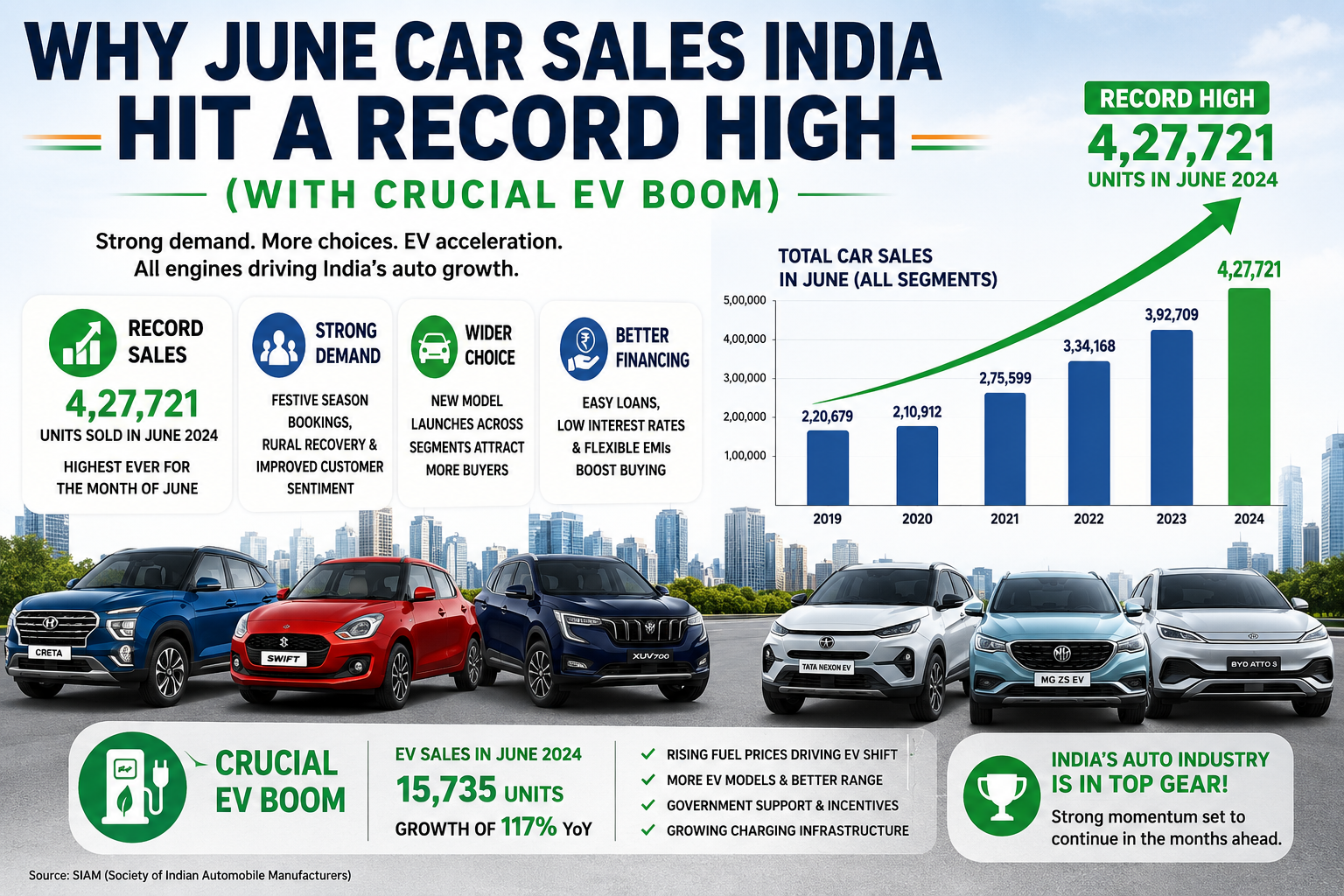
June Car Sales India market saw a huge jump in sales this June. Total vehicle sales rose by over 21% to reach a massive 2.55 million units. Passenger cars led the way, with sales spiking nearly 29% compared to last year.
The biggest news, however, was a massive shift in what people are buying. Cars running on alternative fuels—like Electric Vehicles (EVs), hybrids, and CNG—made up a record 40.35% of all car sales in June.
Why Are Buyers Switching?
The sudden jump comes after a rise in global tension (the Iran war) caused petrol and diesel prices to spike in May. To beat the high cost of daily commuting, buyers quickly switched to cheaper options.
CNG Cars: Took the biggest slice, making up 24.3% of total sales. Market leader Maruti Suzuki reported a 40% jump in CNG bookings.
Hybrids: Captured 8.3% of the market.
Electric Vehicles (EVs): Accounted for 7.8% of car sales. Meanwhile, electric scooters hit a major milestone, making up 10.6% of all two-wheeler sales for the first time.
“We need to watch whether this is a quick, emotional reaction from customers or if this growth is here to stay,” said C.S. Vigneshwar, President of the Federation of Automobile Dealers Associations (FADA).
Good News for the Auto Industry
Aside from fuel prices, other positive factors helped boost sales:
Good Monsoons: Healthy rainfall has improved rural income and boosted buyers’ confidence.
Easy Loans: Great financing offers made it easier for people to buy new vehicles.
New Launches: Exciting new car models brought more people into showrooms.
Top Stock Picks
Global brokerage firm Nomura reported that auto companies with strong EV and alternative fuel line-ups are winning the market. Their top preferred companies include Mahindra & Mahindra (M&M), Hyundai India, and electric scooter maker Ather Energy. Experts warn that companies focusing only on traditional petrol and diesel cars face risks if they don’t adapt quickly.
1. The Geopolitical Catalyst: Fuel Price Hikes Fueling Alternative Powertrains
The geopolitical friction in the Middle East, specifically the fallout from the Iran war, sent shockwaves through global energy markets. The immediate consequence on home soil was a series of successive upward revisions in domestic petrol and diesel prices throughout May. Faced with the daunting prospect of escalating daily commuting costs, Indian car buyers rapidly pivoted toward vehicles offering significantly lower running expenses.
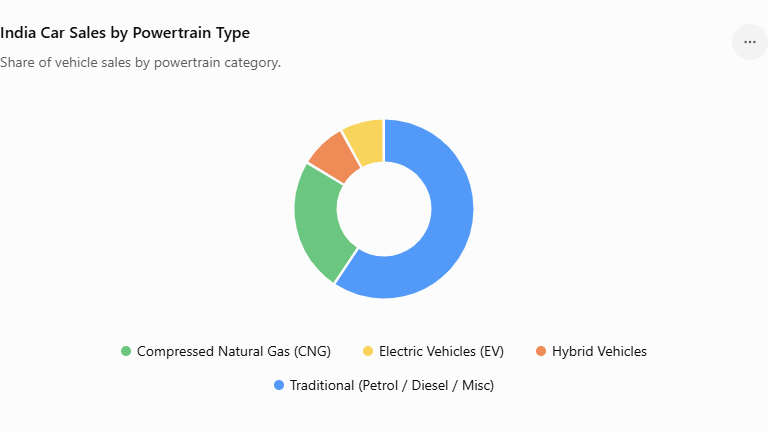
This sudden, aggressive shift resulted in alternative-fuel vehicles accounting for a record-breaking 40.35 percent of all passenger vehicle retail sales, marking a sharp jump from the 38 percent market penetration recorded just a month prior.
FADA President C.S. Vigneshwar weighed in on this unprecedented trend, stating, “We need to watch whether this is an emotional knee-jerk reaction from customers or whether this growth is here to stay.” While the immediate shockwave of crude oil price spikes appears to be moderating, FADA suggests that a return to absolute normalcy across manufacturing and supply networks might take a few quarters, leaving a lingering cost footprint on the industry.
2. The Clean Energy Inflection Point: EVs and Hybrids Scale New Peaks
For the longest time, critics argued that mainstream adoption of electric vehicles in India was a distant dream due to infrastructure deficits and high initial acquisition costs. The latest performance metrics have firmly debunked this notion, indicating that the market has arrived at a critical tipping point.
The Electric Evolution
Electric vehicle penetration in the passenger vehicle domain reached a highly respectable 7.8 percent. Even more impressive was the performance of the electric two-wheeler segment. For the first time in Indian automotive history, the share of electric scooters and motorcycles crossed into double-digit territory, capturing 10.6 percent of the total two-wheeler market retail sales.
The Hybrid and CNG Surge
As buyers sought a middle ground between traditional internal combustion engines (ICE) and pure battery electric vehicles (BEVs), hybrid technology emerged as a massive beneficiary, securing an 8.3 percent market share.
Concurrently, factory-fitted CNG models solidified their position as the primary alternative for budget-conscious buyers, commanding 24.3 percent of the entire passenger vehicle sales pie. Market leader Maruti Suzuki India confirmed this massive structural shift, revealing that booking volumes for its CNG-powered lineup experienced a phenomenal 40 percent surge immediately following the fuel price hikes.
3. Macroeconomic Tailwinds: Monsoons, Rural Sentiment, and Festive Financing
Beyond the fuel price dynamics, a combination of favorable macroeconomic factors acted as a powerful tailwind for the entire dealer network.
Healthy Monsoon Progression: The timely arrival and steady advancement of the monsoon across major agricultural belts have radically rejuvenated rural economic sentiment. Improved crop prospects directly translate to higher disposable income in rural and semi-urban pockets, sparking a strong revival in demand for entry-level two-wheelers, tractors, and commercial vehicles.
Attractive Financing Ecosystem: Financial institutions and non-banking financial companies (NBFCs) introduced highly competitive, flexible, and attractive retail financing schemes. Lower down-payment options, extended loan tenures, and swift digital clearances lowered the barrier to entry for first-time buyers.
New Product Offensives: Major original equipment manufacturers (OEMs) capitalized on the positive market mood by executing strategically timed new model launches and special edition rollouts, generating high footfalls across dealerships nationwide.
4. Segment-by-Segment Retail Performance Analysis
To understand the sheer scale of the market expansion, it is essential to look at how different product categories fared in the retail market during this high-octane month.
Year-on-Year Retail Sales Growth Chart by Segment:
====================================================================
Passenger Vehicles:   █████████████████████████████ 28.63%
Two-Wheelers:         █████████████████████ 21.22%
Three-Wheelers:       ████████████████ 16.20%
Overall Market:       ██████████████████████ 21.83%
====================================================================
Passenger Vehicles
With retail numbers touching 410,853 units, this segment recorded a sequential growth of 2.05 percent over the previous month, alongside its massive 28.63 percent year-on-year jump. The demand was primarily steered by a structural shift toward compact and mid-size Sports Utility Vehicles (SUVs).
Two-Wheelers
The two-wheeler ecosystem registered a robust 21.22 percent year-on-year growth, delivering 18.28 lakh units to customers. Although the segment witnessed a marginal sequential contraction of 0.89 percent compared to the previous month, the massive volumes emphasize that urban commuting and rural utility demands remain fundamentally sound.
Three-Wheelers and Commercial Ecosystems
Three-wheeler sales maintained an upward trend, rising 16.20 percent year-on-year and expanding 8.40 percent sequentially to hit 1.20 lakh units. This consistent growth highlights the aggressive pace of last-mile connectivity electrification in tier-1 and tier-2 cities.
5. Corporate Performance and Brokerage Outlook: Nomura’s Top Picks
The stellar retail show was backed by an equally encouraging wholesale performance, prompting leading global brokerage firm Nomura to issue a highly optimistic commentary on the Indian automotive landscape.
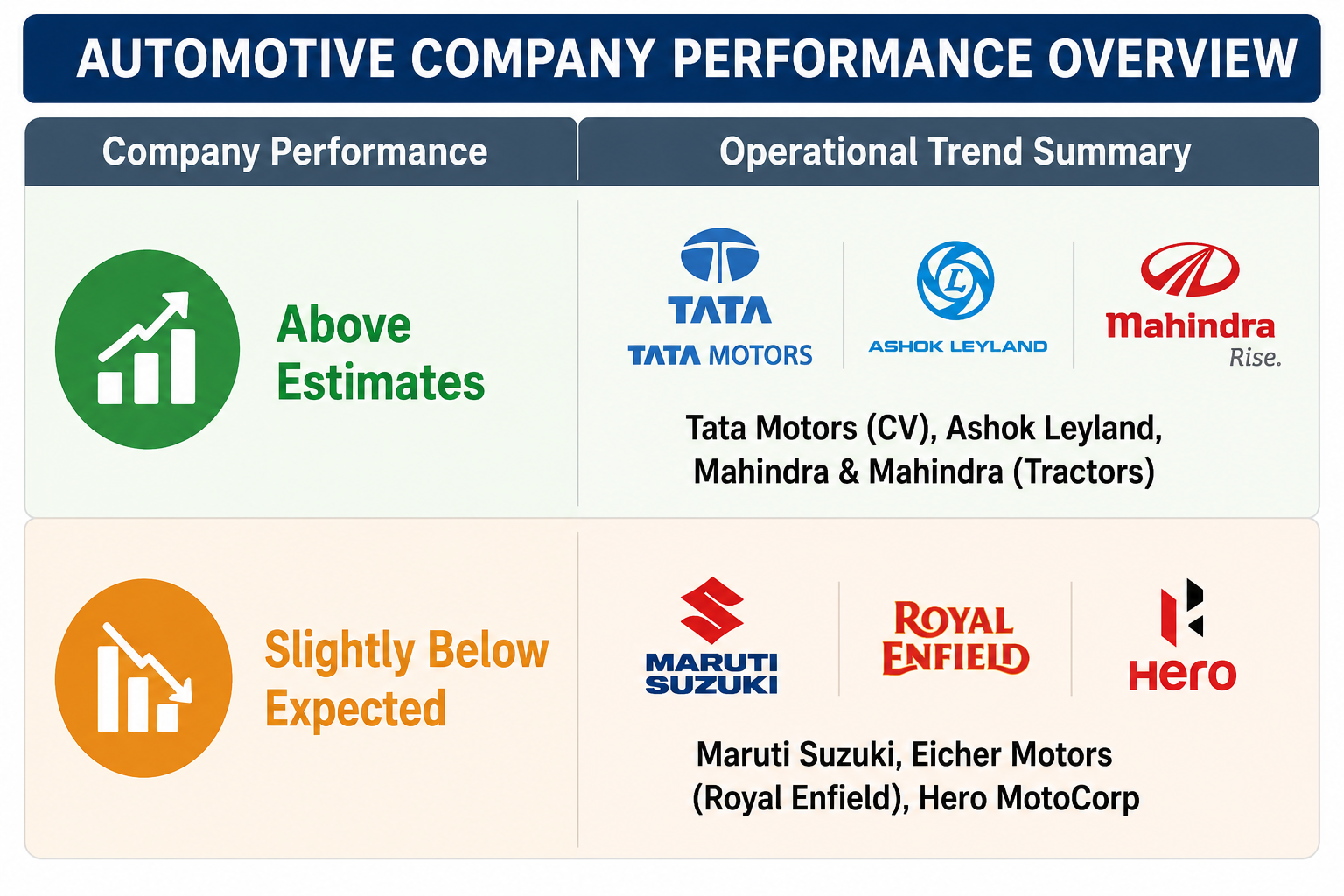
Nomura highlighted that demand momentum remained exceptionally healthy across almost all major segments. Medium and Heavy Commercial Vehicle (MHCV) wholesale volumes, for instance, grew by an impressive 24 percent year-on-year, vastly outpacing the brokerage’s initial projections of 12 percent. Similarly, tractor wholesale dispatches exceeded expectations, rising 14 percent year-on-year against an estimated 7 percent forecast.
Strategic Market Winners
In light of these structural shifts, Nomura reiterated its clear preference for OEMs boasting robust, future-ready alternative powertrain portfolios. The brokerage strongly cautioned that traditional ICE-dominant manufacturers who lack a well-defined, aggressive EV road map run a severe risk of valuation de-rating in the capital markets.
Mahindra & Mahindra (M&M): Benefiting from a dominant position in the SUV space and a strong tractor pipeline, M&M’s shares reacted positively, gaining 1.14 percent to close at Rs 3,172.70 on the National Stock Exchange (NSE).
Ather Energy: Positioned squarely at the center of the electric two-wheeler revolution, the recently listed EV pure-play gained 0.74 percent, trading higher at Rs 1,138.40.
Hyundai Motor India: Retained as a top long-term pick by the brokerage due to its premiumization strategy and upcoming EV pipeline, despite its shares experiencing a marginal, transient correction of 0.35 percent to settle at Rs 1,986.50.
Sona BLW Precision Forgings (Sonacoms): Highly favored due to its deep integration into the global and domestic EV component supply chain.
Margin and Input Cost Outlook
From a financial health perspective, easing geopolitical tensions toward the end of the month have started to moderate global commodity prices across critical automotive metals. Nomura notes that while raw material input cost pressures have eased down to approximately 2.3 percent for passenger vehicles and 3.4 percent for two-wheelers, corporate profit margins are likely to remain under pressure for the June quarter before expanding later in the fiscal year.
The Road Ahead
The historic sales data compiled by FADA underscores the remarkable resilience and adaptability of the Indian consumer. What began as an immediate reaction to geopolitical energy shocks has effectively accelerated a deeper structural shift toward sustainable, cost-effective mobility.
As original equipment manufacturers rapidly scale up production capacities for electric vehicles, plug-in hybrids, and advanced CNG powertrains, the Indian automotive landscape is undergoing a permanent transformation. The coming quarters will be critical in observing whether alternative-fuel vehicles can sustain this near-41 percent market dominance, but one reality is undeniable: the era of uncontested fossil-fuel dominance in the Indian passenger vehicle market is drawing to a close.