
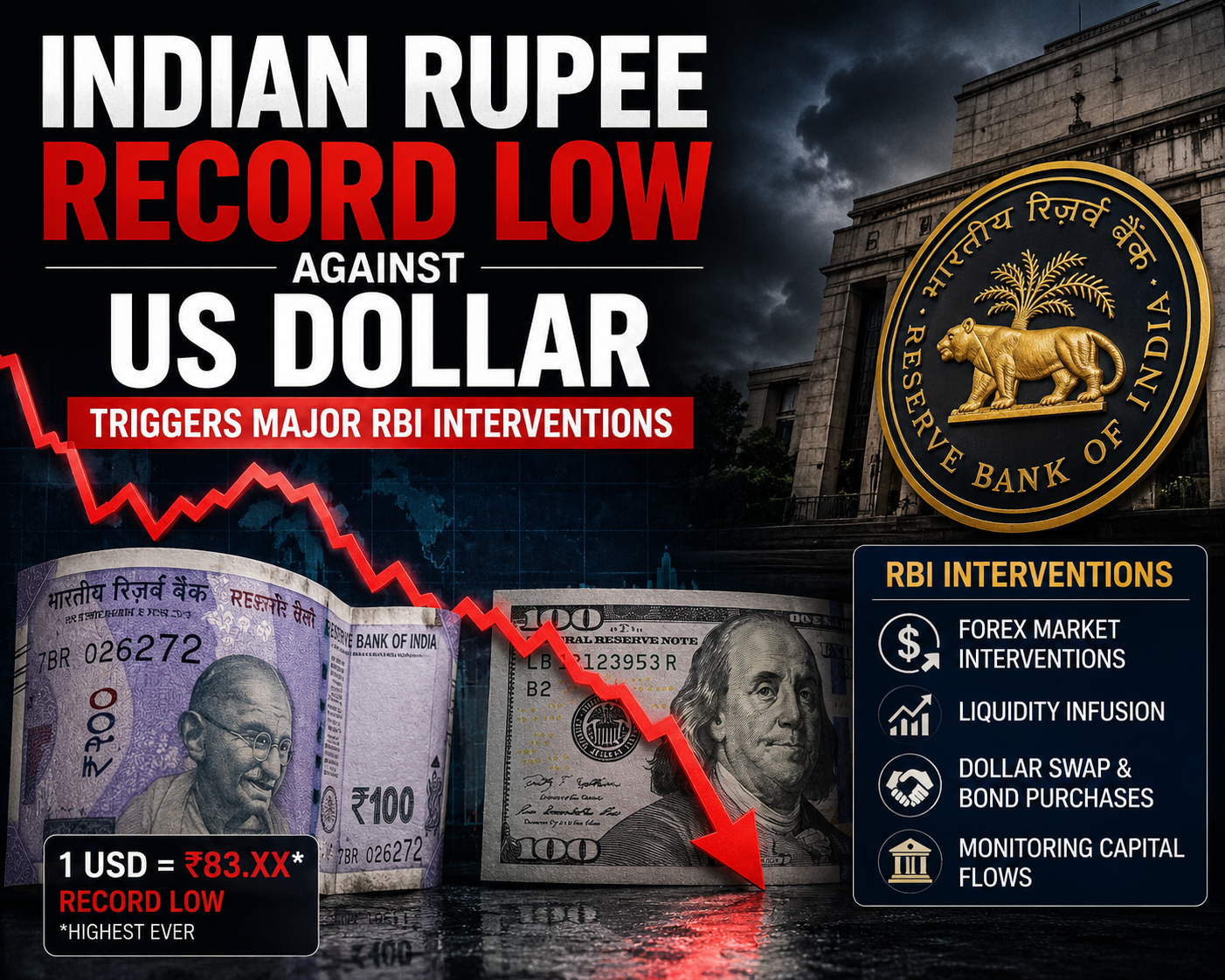
On Monday, May 18, 2026, Indian Rupee Record Low Against US Dollar hit a new record low of 96.20 against the US dollar. Even though it recovered slightly to 96.012 later in the morning, the drop shows that the Indian economy is facing serious pressure from both home and abroad.
This drop is part of a bigger problem. According to Investing.com, the rupee has fallen by 0.87% in just the last five days. A report from Reuters also states that the rupee is now the worst-performing currency in Asia for 2026. Because of the ongoing conflict between the US and Iran, the rupee has lost over 5% of its value against the US dollar this year, making investors and experts very worried.
Key Factors Behind the Decline in the Rupee
Understanding why the Indian rupee is collapsing requires a look at a perfect storm of macroeconomic factors. Currency valuation does not happen in a vacuum; it is the direct reflection of a country’s trade balance, global commodity pricing, and foreign investor sentiment.
1. The Crude Oil Shockwaves
India is a massive net importer of energy, relying on foreign oil to fulfill over 80% of its domestic needs. Because global oil trade is transacted almost exclusively in US dollars, any spike in oil prices forces Indian corporations to buy more dollars, subsequently selling off rupees.
On Monday morning, crude oil prices surged by 1.76%, trading at $111.20 per barrel compared to the previous close of $109.26. This relentless rise in energy costs heavily drains India’s foreign exchange reserves and severely widens the Current Account Deficit (CAD). Every dollar added to the price of a barrel puts immediate, compounding pressure on the local currency.
2. The US-Iran Conflict and Geopolitical Anxiety
The ongoing friction in West Asia has entered its twelfth grueling week since its outbreak in late February. Geopolitical instability naturally drives global investors away from emerging markets like India and toward safer, liquid heavens—primarily the US dollar.
The recent statements from US President Donald Trump, pushing Iranian authorities toward a peace agreement, have done little to soothe the nerves of institutional investors. As long as the threat of supply chain disruptions in the Strait of Hormuz remains active, the market will continue to penalize riskier emerging market assets.
3. A Surging Bloomberg US Dollar Spot Index (DYX)
As capital flees volatile regions, the greenback has strengthened globally. The Bloomberg US Dollar Spot Index (DYX) edged up by 0.04% to 99.321 in early US trading sessions. When the global benchmark dollar grows stronger, it automatically suppresses weaker currencies, leaving the rupee highly vulnerable to automated and speculative sell-offs.
Defensive Countermeasures: How the RBI and Government are Fighting Back
Faced with a historic currency slide, the Indian government and the Reserve Bank of India (RBI) have moved away from passive observation, deploying a series of aggressive, defensive measures designed to curb speculative trading and protect the domestic economy.
| Intervention Date / Type | Policy Action Taken | Target Objective |
| Import Curbs | Tightened restrictions on precious metal imports | Reduce the outflow of US Dollars for non-essential goods |
| April 10 Regulation | Implemented a $100 million cap on Net Open Rupee Positions | Limit forex volatility and insulate banks from systemic risk |
| Derivative Market Ban | Restricted banks from offering Rupee Non-Deliverable Forwards (NDFs) | Prevent offshore speculative trading by resident/non-resident clients |
Stopping the Bleeding via Precious Metal Restrictions
One of the most immediate fiscal levers pulled by the central government involves placing strict import curbs on precious metals, particularly gold. India is one of the world’s largest consumers of gold, an asset class that requires substantial dollar outflows to procure. By artificially slowing down these imports, the government aims to retain more dollars within the country, balancing the supply-demand equation in the forex market.
The $100 Million Bank Position Cap
On April 10, the RBI enacted a crucial regulatory shield by enforcing a $100 million cap on the net open rupee positions that commercial banks can hold in the foreign exchange market. This rule drastically reduces the capacity of large banking institutions to take massive, risky positions on the rupee’s direction, effectively insulating the domestic banking sector if the currency experiences sudden, volatile drops.
Eradicating Speculative Trading via NDF Restrictions
In an additional bid to control volatility, the central bank has cracked down on the Non-Deliverable Forward (NDF) market. The RBI issued fresh directives restricting domestic banks from offering rupee-denominated NDFs to both resident and non-resident clients. By shutting down these speculative avenues, the central bank hopes to keep currency trading grounded in actual trade realities rather than panic-driven Wall Street or London speculation.
What Lies Ahead for the Indian Forex Market?
Despite these multi-layered interventions, market analysts remain cautious, with many revising their long-term forecasts downward due to the sheer velocity of global headwinds.
Current Rupee Level (May 18): 96.20 ──> BofA Year-End Forecast: 98.00
BofA Global Research recently altered its outlook for the Indian currency, predicting that the rupee could hit a low of 98 per US dollar by the end of the calendar year 2026. This revision indicates that institutional analysts believe the structural pressures of high oil and global interest rates will outlast the short-term regulatory fixes implemented by the RBI.
High Global Bond Yields Dampen Risk Appetite
Adding fuel to the fire is the current state of global bond yields. As yields in developed nations rise, international institutional investors find less reason to chase returns in emerging markets like India. The risk-adjusted return on US Treasuries becomes far more attractive, resulting in a steady pull-out of foreign institutional investor (FII) capital from the Indian equity and debt markets.
Expert Perspectives on the Rupee's ResilienceWhile the numbers paint a stark picture, domestic market experts suggest that the structural foundation of the Indian economy remains resilient enough to weather the storm, provided proactive measures continue.
“For now, elevated crude oil prices, global uncertainty, and a stronger dollar continue to remain key risks for the rupee. However, the encouraging sign for markets is that both the government and the RBI have already started taking proactive measures to manage the situation before it becomes more uncomfortable.”
— Amit Pabari, Managing Director of CR Forex Advisors
Pabari’s insights highlight a critical nuance: the current slide is primarily driven by external “push” factors rather than internal economic failure. India’s macroeconomic indicators, outside of oil-induced inflation, show steady domestic growth. The active stance of the RBI ensures that while the rupee may depreciate, it is highly unlikely to fall into an unmanaged, chaotic freefall.
The Macroeconomic Ripple Effects on the Indian Consumer
When a currency hits a record low, its effects eventually travel from the trading desks of Mumbai straight to the household budgets of ordinary citizens.
Imported Inflation: Because India imports electronics, machinery, and fertilizer alongside crude oil, a weaker rupee makes these goods significantly more expensive. This causes a cascading effect, increasing the manufacturing costs of everyday items.
Foreign Education and Travel: For Indian families financing children studying abroad or planning international travel, a rate of 96.20 means tuition fees and living expenses have effectively jumped by nearly 5% in just a matter of months.
Export-Oriented Sectors: On the flip side, industries like Information Technology (IT), pharmaceuticals, and textiles stand to benefit. Because these sectors earn their revenue in US dollars and pay operational costs in rupees, a weaker domestic currency can temporarily expand their profit margins. However, given the global slowdown, these gains might be partially muted.
Conclusion: Balancing Interventions Against Market Realities
The Indian rupee record low established this Monday serves as a reminder of how deeply interconnected modern emerging economies are with global geopolitical flashpoints. The Reserve Bank of India has demonstrated that it possesses a robust toolkit and the willingness to deploy heavy regulations—from NDF bans to import curbs—to protect the local financial system from speculative predators.
However, as long as crude oil trades above the century mark ($100/bbl) and the conflict in West Asia dictates global investor sentiment, the rupee will remain on the defensive. Investors and corporate entities must prepare for a prolonged period of currency volatility, keeping a close eye on the 98.00 psychological threshold as the year progresses.
Disclaimer: This report is for informational purposes only. Please consult a certified financial advisor before making investment decisions based on the Q4 FY26 Earnings Fiesta data