
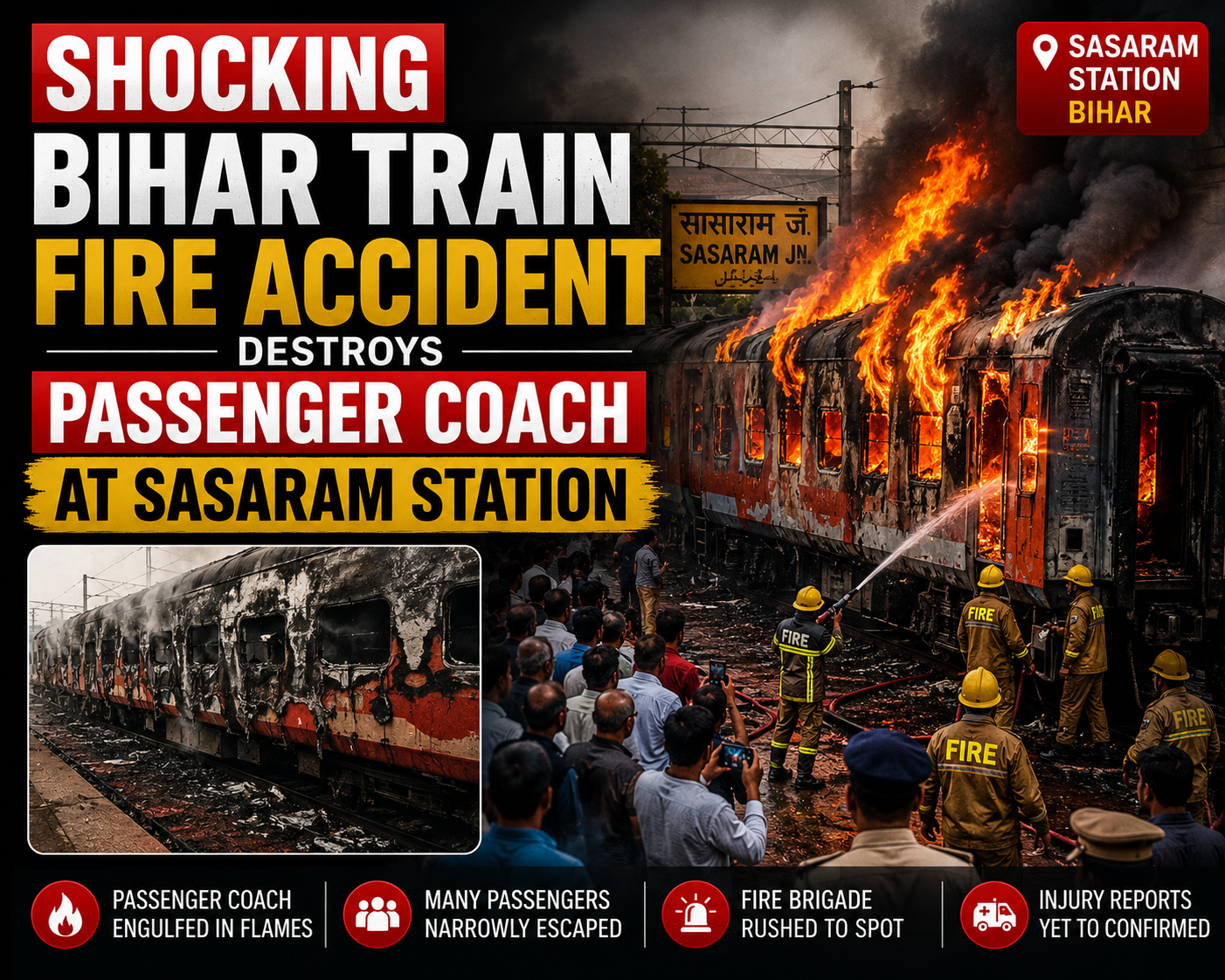
The Bihar train fire accident has sparked massive safety concerns across the Indian Railways network after a devastating blaze completely gutted a coach of the Patna Fast Passenger train on Monday morning. The terrifying incident occurred at the busy Sasaram railway station in Bihar, sending panic through hundreds of commuters. What makes this disaster particularly alarming is that it took place less than twenty-four hours after another dangerous fire incident was reported on the premium Thiruvananthapuram-Hazrat Nizamuddin Rajdhani Express in Madhya Pradesh.
While the rapid succession of these two rail fires has raised serious questions regarding passenger safety, mechanical maintenance protocols, and electrical oversight in transit, officials have confirmed that no casualties or major injuries were reported in either event. However, the sheer scale of the destruction has prompted a high-level review of current safety standards.
Chaos at Sasaram: How the Patna Passenger Coach Caught Fire
According to ground reports from local railway authorities, the Bihar train fire accident unfolded during the early hours of Monday morning at Platform Number 6 of the Sasaram railway station. The Patna Fast Passenger train was stationary at the platform when thick smoke began billowing out from one of the unoccupied passenger coaches. Within minutes, the minor smoke escalated into a massive, uncontrollable blaze, with giant flames wrapping around the entire structure of the coach.
Witnesses at the platform described a scene of absolute chaos as passengers waiting for other trains began running for cover, fearing a potential explosion or the spread of fire to adjacent infrastructure.
“The flames were incredibly high, and the smoke was so thick that visibility on Platform 6 dropped to zero within seconds. It was terrifying because the train was parked right inside the station complex,” shared a local commuter who witnessed the early stages of the fire.
Heroic Interventions Prevent a Major Disaster
Despite the severity of the Bihar train fire accident, a major tragedy was averted due to the exemplary courage and lightning-fast reflexes displayed by the Railway Protection Force (RPF) personnel, station staff, and local residents who happened to be present on the spot.
The Timeline of the Rescue Operations:
Immediate Evaluation: As soon as the smoke was spotted, RPF jawans ran toward the coach to ensure no passengers were trapped inside. Since the train was not fully boarded at that exact moment, they confirmed the coach was clear.
Coach Isolation: Station masters and technical staff acted swiftly to isolate the burning coach from the rest of the train rake, ensuring that the fire did not spread to neighboring bogies.
Community Assistance: Local youths and shopkeepers at the station joined hands with railway staff, utilizing portable fire extinguishers available at the station while waiting for emergency services.
Fire Brigade Arrival: Multiple fire brigade teams rushed to Sasaram station after receiving an emergency alert. Firefighters fought the intense blaze for over an hour before finally bringing it under control.
By the time the fire was completely extinguished, the affected coach was reduced to a charred, metallic skeleton.
Investigation Matrix: Was it a Short Circuit?
Preliminary technical evaluations conducted by structural and electrical engineers of the railways suggest that the Bihar train fire accident was likely triggered by a severe electrical short circuit inside the coach’s internal wiring system.
Over the years, aging electrical infrastructure, substandard maintenance of overhead fans, improper insulation of lights, and unauthorized mobile charging modifications have been frequent culprits behind railway fires in India.
A high-level investigative committee has been set up to dig deeper into the incident. The probe will focus on:
Whether the coach had undergone its scheduled primary and secondary maintenance checks.
The condition of the electrical junction boxes inside the specific coach.
Whether there was any external foul play or negligence by passengers (such as smoking or carrying inflammable materials).
The Twin Crisis: Rajdhani Express Fire Just 24 Hours Prior
The gravity of the Bihar train fire accident is compounded by the fact that it closely follows a remarkably similar scare on Sunday involving one of India’s premier trains—the Thiruvananthapuram-Hazrat Nizamuddin Rajdhani Express (Train Number 12431).
| Train Details & Fire Incident Comparison | |
| Train 1: Patna Fast Passenger | Train 2: Rajdhani Express (12431) |
| Location: Sasaram Station, Bihar | Location: Ratlam District, Madhya Pradesh |
| Timing: Monday Morning | Timing: Sunday, 5:15 AM |
| Coaches Damaged: 1 Passenger Coach | Coaches Damaged: 2 AC Coaches (B-1 heavily hit) |
| Casualties: Zero | Casualties: Zero |
| Probable Cause: Electrical Short Circuit | Probable Cause: Under Investigation |
The Rajdhani Express incident occurred between the Vikramgarh Alot and Lunirichha stations under the Kota railway division. The train was traveling at high speed from Thiruvananthapuram to New Delhi when a fire broke out in the B-1 Air Conditioned coach, which was carrying 68 sleeping passengers at the time.
The fire quickly spread to an adjacent coach, causing severe panic as passengers woke up to choking fumes at 5:15 AM. Thankfully, automatic fire alarms, coupled with the alertness of the train staff who pulled the emergency chain, allowed for a safe evacuation before the flames could breach the passenger seating cabins entirely.
Systemic Concerns: Why Are Indian Trains Catching Fire?
The back-to-back occurrences of the Rajdhani fire and the Bihar train fire accident have brought Indian Railways’ safety parameters under intense public and political scrutiny. Experts point out that while crores of rupees are being spent on modernizing stations and introducing high-speed trains like Vande Bharat, the basic safety maintenance of regular passenger trains and older ICF (Integral Coach Factory) rakes remains a massive vulnerability.
1. Overloaded Electrical Systems
With the increasing dependency of passengers on electronic gadgets, laptops, and smartphones, the power load on a train’s internal circuitry has skyrocketed. If the wiring is old or poorly insulated, continuous high-load charging can overheat the junction boxes, leading to catastrophic short circuits.
2. Maintenance Backlogs
Due to the heavy density of train traffic on routes passing through Bihar, Uttar Pradesh, and Madhya Pradesh, trains often operate on tight turn-around times. This sometimes leaves insufficient windows for detailed mechanical and electrical overhauls at the coaching depots.
3. The Threat of Inflammable Materials
Despite strict laws and heavy fines, passengers occasionally smuggle stoves, gas cylinders, firecrackers, or highly inflammable oils onto trains. While there is no immediate evidence of this in the Sasaram incident, it remains a persistent challenge for the RPF during security checks.
The Way Forward for Indian RailwaysThe recent train fires are a big warning sign. To stop these scary incidents and keep passengers safe, the Ministry of Railways must take two urgent steps:
Upgrade All Coaches: The government needs to quickly replace old, fire-prone coaches with modern LHB coaches for all regional and passenger trains. These new coaches use fire-resistant materials and are much safer during accidents.
Install Better Fire Technology: Trains should be equipped with smart heat sensors and automatic water sprays. Currently, these are only in expensive AC coaches. Putting them in general and sleeper classes will help put out fires instantly without waiting for manual help.
While it is a relief that no one was hurt in the Sasaram and Ratlam accidents, the railway authorities cannot rely on luck. They must investigate these fires honestly, fix the maintenance issues, and win back the public’s trust.