
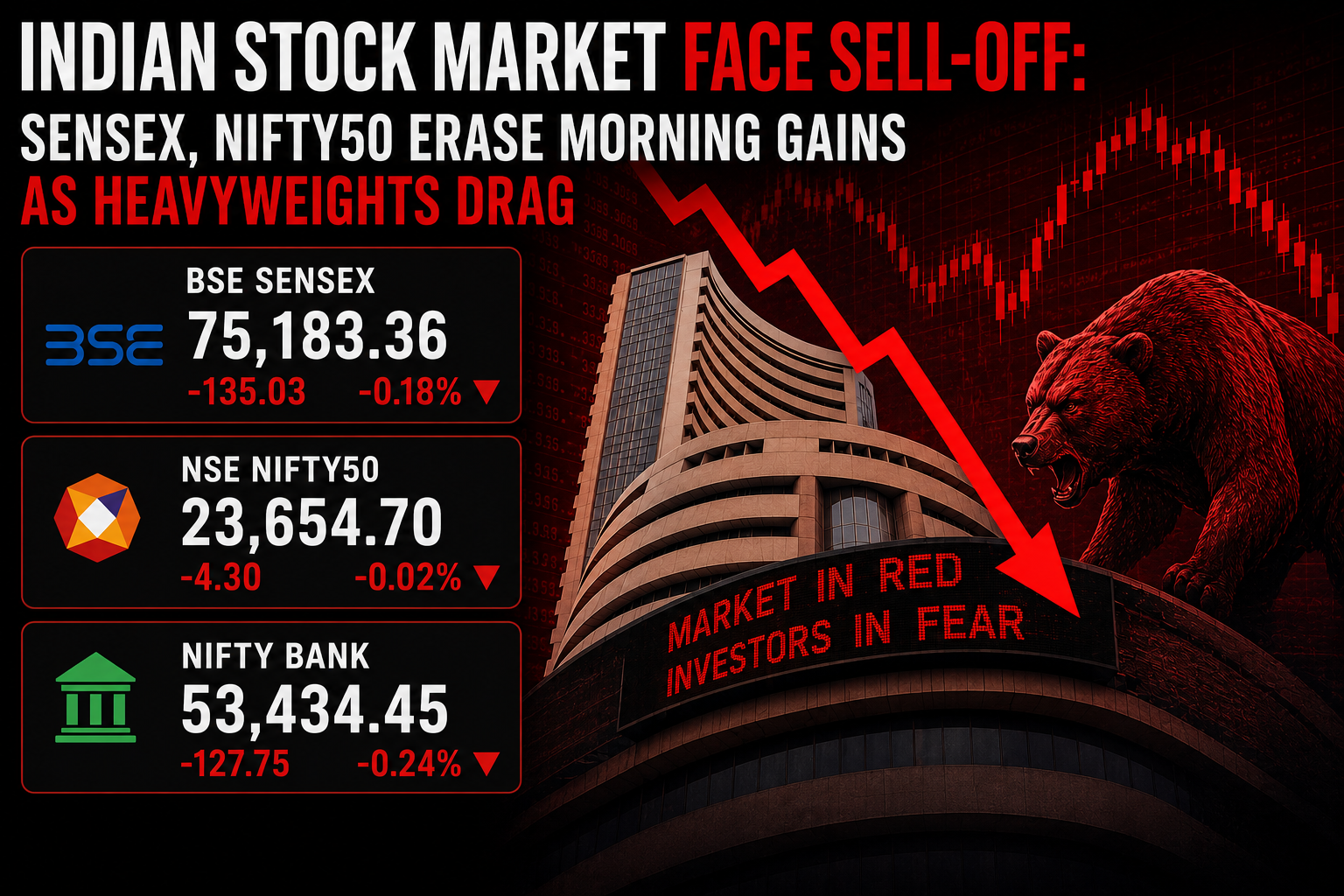
The Indian stock market face sell-off on Thursday, May 21, 2026, as a sudden wave of late-afternoon profit-booking wiped out an exceptionally strong morning rally. Dalal Street initially opened on a bullish note, fueled by positive global cues and a significant cooling of international crude oil prices. However, key heavyweights faced severe selling pressure at higher levels, dragging the headline indices right back into negative territory by the closing bell.
By the end of the volatile trading session, the BSE SENSEX shed 135.03 points, or 0.18%, to settle at 75,183.36. The index had climbed drastically during the morning hours, making the subsequent 949-point crash from its intraday peak a massive disappointment for retail buyers. Similarly, the broader NSE NIFTY50 index gave up its hard-earned territory, dropping 4.30 points to finish virtually flat at 23,654.70, after shifting painfully from an intraday high of 23,860 to a low of 23,596.
Indian Stock Market Face Sell-Off Core Market Indicators Dashboard
The table below displays the final closing metrics across major indices and volatility measures for the May 21 trading session:
| Market Benchmark | Closing Value | Point Change | Percentage Change | Session Trajectory |
| BSE SENSEX | 75,183.36 | -135.03 | -0.18% | Late-Day Reversal |
| NSE NIFTY50 | 23,654.70 | -4.30 | -0.02% | Flat / Minor Losses |
| NIFTY Bank | 53,434.45 | -127.75 | -0.24% | Under Pressure |
| NIFTY Midcap 100 | 61,323.30 | -0.04 | -0.04% | Flat / Horizontal |
| NIFTY Smallcap 100 | 17,987.20 | +116.30 | +0.65% | Strong Outperformance |
| India VIX | 17.89 | -0.55 | -2.97% | Volatility Easing |
Inside the Intraday Volatility: What Triggered the U-Turn?The morning setup promised a blowout day for bulls. United States President Donald Trump issued public comments indicating that the US is entering the “final stages” of talks with Iran. This major diplomatic breakthrough signaled to global energy markets that oil flows through the critical Strait of Hormuz are highly likely to resume normal operations shortly. As an immediate consequence, Brent crude futures collapsed significantly, easing imported inflation concerns for the Indian economy.
Simultaneously, major Asian market peers roared ahead. Japan’s Nikkei index advanced a massive 3.1%, while South Korea’s KOSPI index rocketed by an astonishing 8.4%. The surge in Seoul was electrified by a 6.3% jump in Samsung Electronics and a stunning 9.5% blast in SK Hynix, a primary high-bandwidth memory chip partner for AI giant Nvidia.
Despite this global optimism, the domestic market structure cracked under the weight of localized technical factors:
Weekly Options Expiry: Being a Thursday, intensive options data shuffling triggered rapid position liquidation near the 23,800–23,850 NIFTY resistance block.
Heavyweight Liquidation: The rally’s main engine from the previous day—Reliance Industries—flipped into a primary drag alongside major IT and FMCG entities.
Persistent FII Skepticism: Large foreign institutional desks used the initial morning gap-up to downsize their exposures, keeping the domestic currency under tight check despite a mild intraday recovery.

The Top Gainers
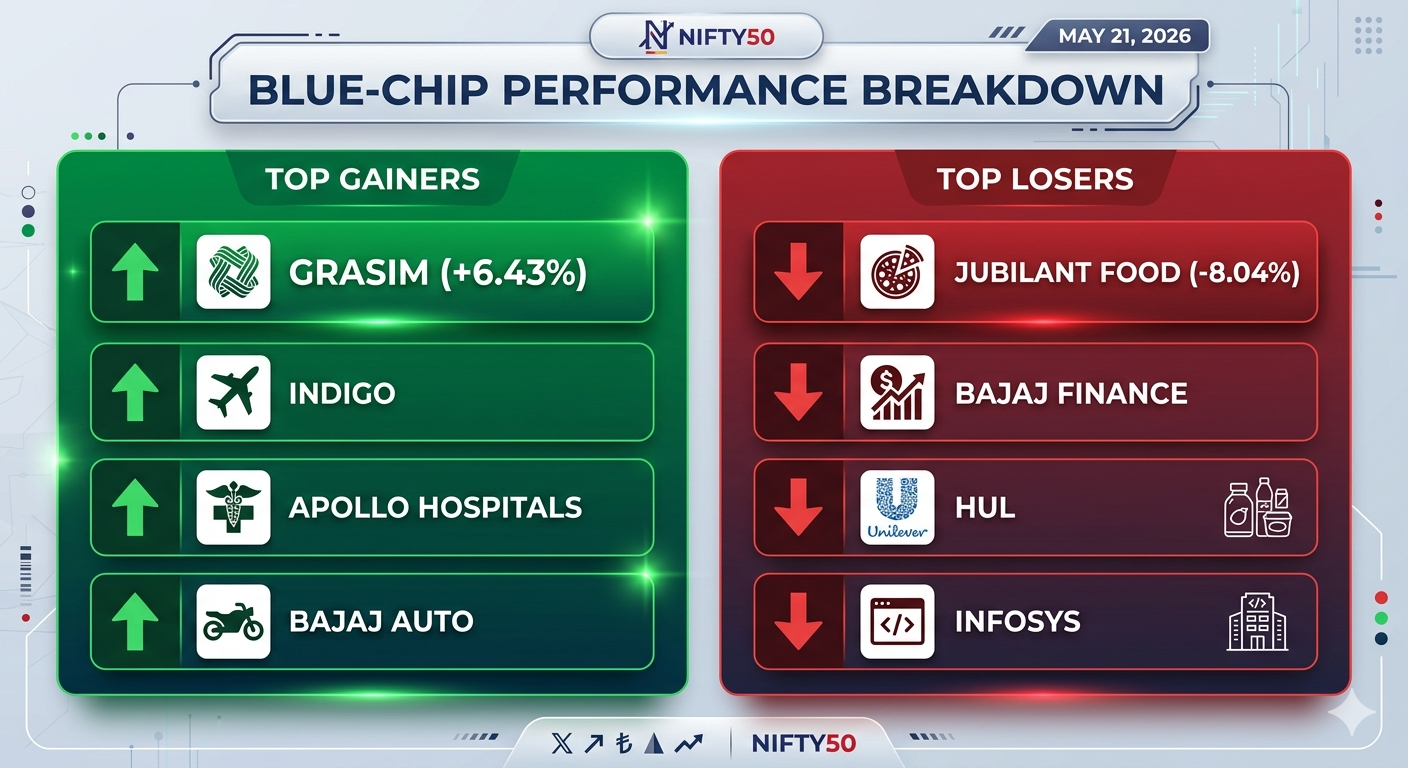
Grasim Industries (+6.43%): The Aditya Birla Group’s flagship business stole the spotlight, closing at ₹3,162 apiece. The company declared its Q4 FY26 earnings, posting a stellar 31% year-on-year jump in consolidated net profit attributable to owners, touching ₹1,957 crore against ₹1,496 crore in the corresponding quarter of the previous fiscal.
Protean eGov Technologies (+20.00%): Moving to the broader marketplace, this population-scale e-governance infrastructure provider hit its 20% upper circuit limit, closing at ₹654.20 on the NSE. The explosive buying followed a spectacular 48.92% increase in its quarterly consolidated profit after tax, which reached ₹30.38 crore against ₹20.40 crore last year.
Defensive Outliers: IndiGo, Apollo Hospitals, Bajaj Auto, Trent, and Bharat Electronics (BEL) managed to resist the broader market cooling, closing firmly in the green zone.
The Top Losers
Jubilant FoodWorks (-8.04%): Shares of India’s leading Domino’s Pizza chain operator plunged severely, hitting an intraday low of ₹434.65. The aggressive selling was triggered by an official shareholder letter disclosing that the company’s same-store sales growth (also referred to as like-for-like or LFL growth) for Domino’s operations slowed down to 6.5% in FY26, dropping from the 7.5% recorded in FY25.
Index Heavyweight Drags: Reliance Industries, Infosys, Bharti Airtel, Bajaj Finance, Hindustan Unilever (HUL), and Kotak Mahindra Bank emerged as the primary anchors slowing down the SENSEX. The tech space was particularly hurt by extended local selling, with Tech Mahindra and Infosys finishing as prominent losers.
Sectoral Matrix: Realty and Metals Stand Firm
The market breadth across individual sectors tells an interesting story of selective accumulation, as nine out of fifteen major sectoral gauges compiled by the NSE actually closed with gains:
NIFTY Realty (+1.00%): Emerging as the clear leader, real estate counters witnessed strong momentum on expectations of steady residential bookings and ongoing premium luxury launches.
NIFTY Metal, Pharma, and Auto: These key cyclical clusters put up a decent fight, scaling up between 0.2% and 0.4% to cushion the benchmark drops.
FMCG, Banking, and IT Drags: The banking basket faced consistent grinding, forcing the NIFTY Bank index down by 127.75 points to end at 53,434.45. High valuation multiples in consumer staples and software exports also triggered defensive profit-taking.
Broader Markets Outperform Benchmarks
Even though the front-line blue chips looked tired by 3:30 PM, the structural health of the broader market remained remarkably healthy. The market breadth on the National Stock Exchange was notably positive, with 1,910 equities registering gains compared to 1,374 shares closing lower.
The NIFTY Smallcap 100 index gained 0.63% to close at 17,987.20, proving that retail and domestic high-net-worth individuals (HNIs) are completely comfortable hunting for alpha in mid-to-mini-cap manufacturing, engineering, and specialty business enterprises. Meanwhile, the NIFTY Midcap 100 moved horizontally, closing just a fraction lower at 61,323.30.
Volatility Dynamics: India VIX Drops Near 17.8“While the index level chart looks like a typical bull trap, the options data shows no structural panic. The dip was a mechanical correction of over-leveraged morning long positions.”
The India VIX dropped by 2.97% to settle comfortably at 17.89. A dropping volatility indicator on a day when the market loses nearly a thousand points from its high indicates that the market correction is not driven by existential fear or macroeconomic panic. Instead, options writers actively used the wider 23,200–23,900 consolidation band to capture premium decays.
Technicians highlight that the NIFTY50 has established a strong short-term base around the 23,500–23,600 territory. Unless this structural cushion is broken with heavy volume, the ongoing consolidation phase should eventually lay the groundwork for a steady, sustainable rally toward the 24,000 mark.
Strategic Playbook for Tomorrow’s Session
The price action observed during Thursday’s session demonstrates that pursuing massive opening gaps can be risky in a highly reactive market environment. For derivative traders, the 23,800 zone has now turned into a solid overhead resistance level that requires sustained buying momentum to be breached.
For cash segment investors, the strategy remains straightforward: avoid chasing sudden vertical spikes, and look to accumulate robust large-cap and mid-cap stocks on corrections. Companies showing tangible corporate growth stories—similar to the strong operational metrics seen in Grasim and Protean eGov—will likely continue to attract institutional backing even during temporary market lulls.
Disclaimer : Financial markets are subject to high risk. Please consult with a certified financial advisor before making any investment decisions.