
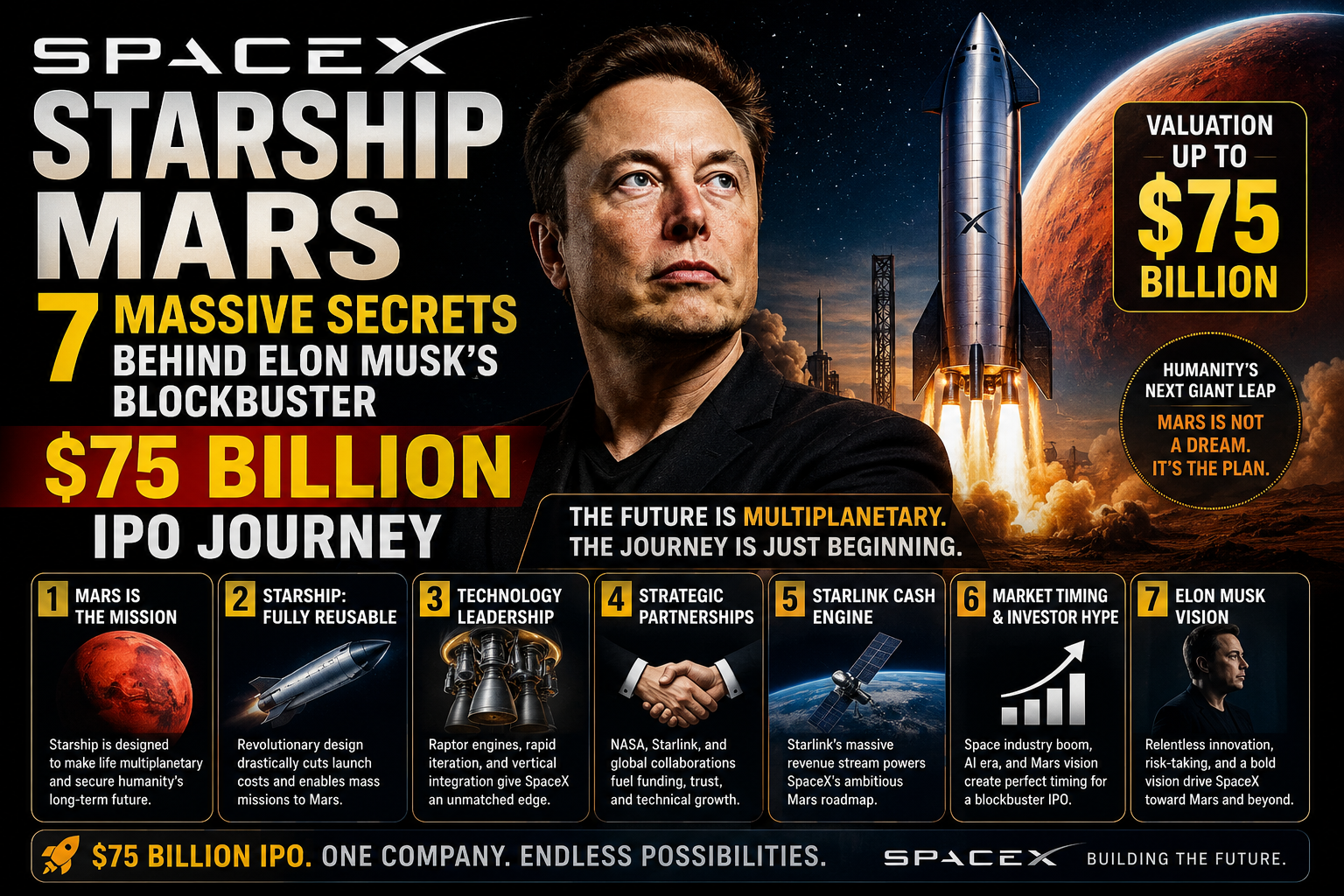
SpaceX Starship Mars development is no longer just an eccentric billionaire’s sci-fi fantasy—it has officially evolved into the primary anchor of what could become the largest initial public offering (IPO) in global financial history. Elon Musk, the serial entrepreneur who famously founded Space Exploration Technologies Corp. in 2002 with the seemingly impossible dream of colonizing the Red Planet, is preparing to take his sprawling space empire to Wall Street.
According to recent regulatory filings and insider reports, SpaceX is laying the groundwork for a blockbuster public debut targeting an unprecedented valuation, seeking to raise up to $75 billion in the stock market. This monumental move comes at a critical juncture where aerospace dominance, artificial intelligence integration, and high-stakes geopolitical contracts collide.
From the upcoming debut of its third-generation launch systems to a surprise corporate merger with xAI, the stakes have never been higher for the world’s most dominant launch provider. Below, we break down the seven massive secrets driving SpaceX’s historic journey toward the public markets, its complicated partnership with NASA, and the shifting dynamics of the 21st-century space race.
1. The Financial Architecture of a $75 Billion Blockbuster IPO
For over two decades, SpaceX has operated as a tightly controlled private entity, relying on private funding rounds, venture capital syndicates, and lucrative government launch contracts to fund its capital-intensive research and development. However, the sheer scale of building an interplanetary transport infrastructure requires an astronomical amount of capital that even the world’s richest man cannot bankroll alone.
By preparing an IPO, Musk is shifting the financial burden of deep-space exploration onto global equity markets. Institutional investors, sovereign wealth funds, and retail traders will soon have the opportunity to buy directly into the future of human spaceflight.
Wall Street analysts indicate that a $75 billion capital raise could value the entire SpaceX enterprise well north of $250 billion, instantly placing it among the most valuable mega-cap corporations on earth. This influx of liquid capital will be explicitly directed toward two expensive, non-negotiable pillars: scaling the Starlink satellite mega-constellation and achieving rapid operational maturity for the Starship launch system.
2. The Starlink Engine: Bankrolling the Interplanetary Vision
While public attention frequently focuses on roaring rocket engines and dramatic launchpad tests, the true financial engine of the SpaceX empire is humming quietly in low Earth orbit (LEO). Starlink, the company’s satellite internet division, has successfully transitioned from an ambitious technical gamble into a cash-generating behemoth.
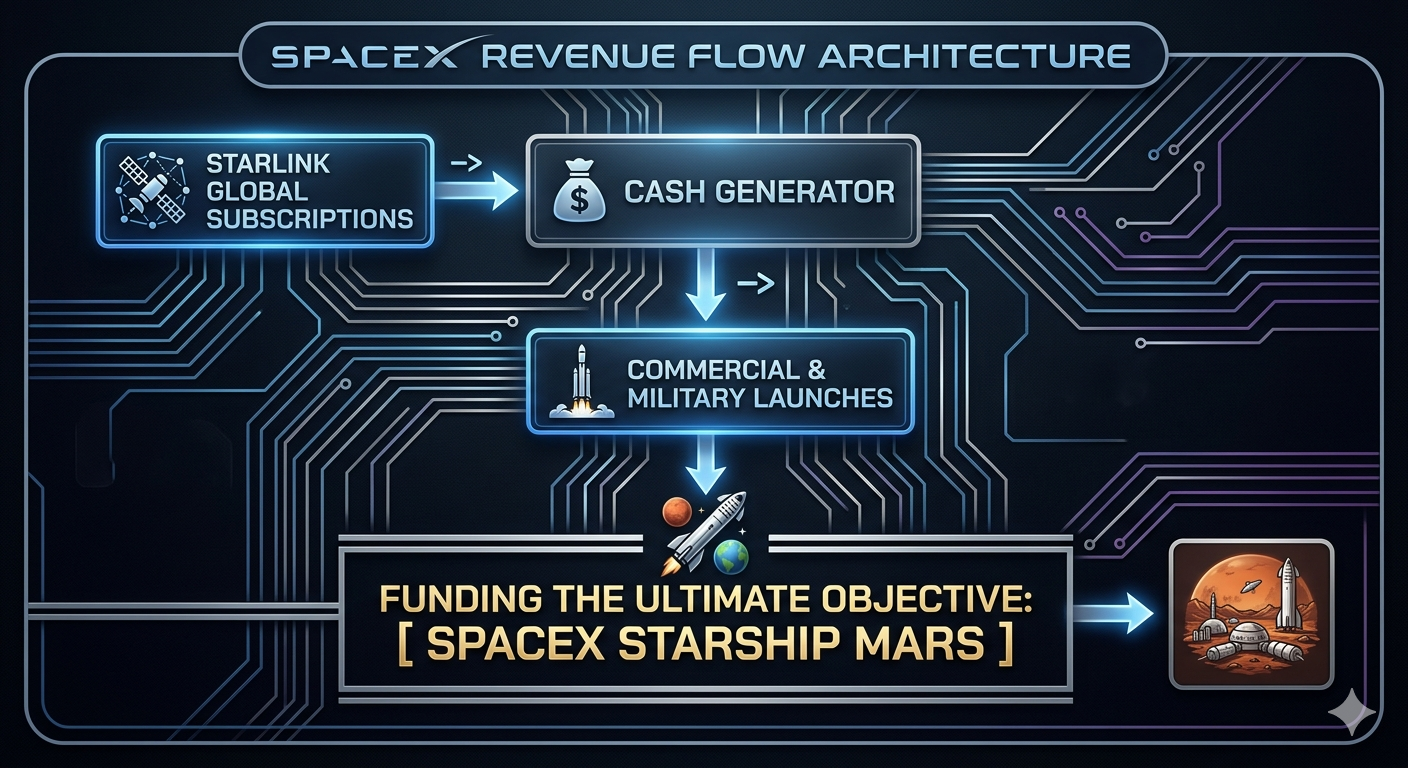
Starlink provides high-speed, low-latency broadband internet across the globe, capturing market share in rural zones, maritime shipping lanes, commercial aviation, and military defense sectors. This recurring consumer and enterprise subscription revenue provides SpaceX with a stable, predictable cash flow profile that traditional aerospace companies can only dream of.
Without the commercial success of Starlink, the development of heavy-lift rocket tech would have ground to a halt years ago. The IPO will allow public investors to value this global utility network, giving SpaceX the financial runway needed to absorb the high failure rates associated with experimental rocketry.
3. The xAI Strategic Merger and the Rise of Space Data Centers
In a brilliant corporate realignment earlier this year, Elon Musk executed a strategic merger that caught both Silicon Valley and Wall Street off guard: integrating his artificial intelligence startup, xAI, directly into the corporate structure of SpaceX. This move was not merely an administrative shuffle; it represents a fundamental bet on the future of space-based edge computing.
By combining xAI’s advanced large language models and neural architecture with SpaceX’s orbital infrastructure, the company is actively racing to build the world’s first network of space data centers.
Why Space-Based AI Compute Matters
Zero-Latency Orbital Processing: Future deep-space missions to the Moon and Mars cannot rely on Earth-bound data centers due to the physics of communication lag. An autonomous AI brain must exist natively in orbit to calculate entry, descent, and landing parameters in real-time.
Geopolitical Sovereignty: Land-based data centers are vulnerable to terrestrial warfare, regulatory crackdowns, and energy grid failures. A decentralized network of supercomputing satellites operating in LEO offers unprecedented security and constant uptime.
Hyperscale Data Interception: Processing Earth-observation imagery, military telemetry, and climate modeling algorithms directly in space eliminates the massive bandwidth bottleneck required to downlink raw data to ground stations.
4. The 12th Test Flight: Inside the Third-Generation Starship
The immediate technical catalyst for the upcoming market debut is the highly anticipated 12th Starship test launch, scheduled to take place from the Starbase facility in Boca Chica, Texas. This flight marks the formal debut mission of SpaceX’s third-generation Starship model—a significantly upgraded, structurally reinforced iteration of the mammoth rocket.
+-----------------------------------------------------------------+
|             STARSHIP GEN-3 TECHNICAL SPECIFICATIONS             |
+-----------------------------------------------------------------+
| Structural Core: High-Grade Premium Stainless Steel Alloy       |
| Propulsion Unit: 33 Liquid Oxygen/Methane Raptor Engines        |
| Key Innovation: Integrated Orbital Refueling Valve System       |
| Primary Mission: Demonstration of Reusable Flight Parameters    |
+-----------------------------------------------------------------+
Constructed from a refined stainless-steel alloy designed to withstand extreme thermal stresses, the Gen-3 vehicle features optimized Raptor engines, improved hot-staging mechanics, and a completely overhauled thermal protection tile system.
Unlike previous models, which were prone to spectacular mid-air disruptions and fiery re-entry disintegrations, the Gen-3 aims to demonstrate full orbital insertion, controlled atmospheric thermal descent, and precision recovery. For Wall Street, a flawless execution of the 12th test flight will serve as the ultimate validation that SpaceX can safely transition from an experimental “fail fast, learn fast” prototype phase into a repeatable, commercial launch cadence.
5. The NASA Lunar Reality Check: High Stakes and Reopened Contracts
Despite its dominance in the commercial launch sector, SpaceX faces intense, compounding pressure from its primary government client: NASA. Under the Artemis program, SpaceX holds a multi-billion-dollar contract to develop a modified, specialized variant of Starship to serve as the Human Landing System (HLS) for the historic Artemis III mission, which aims to return American astronauts to the lunar surface.
However, the clock is ticking loudly, and the original timeline is looking increasingly fragile. NASA expects to execute an intricate in-orbit rendezvous between its own Orion spacecraft and the Starship lunar lander in 2027. To accomplish this, SpaceX must solve a physics problem that has never been attempted in human history: automated, high-volume orbital cryogenic refueling.
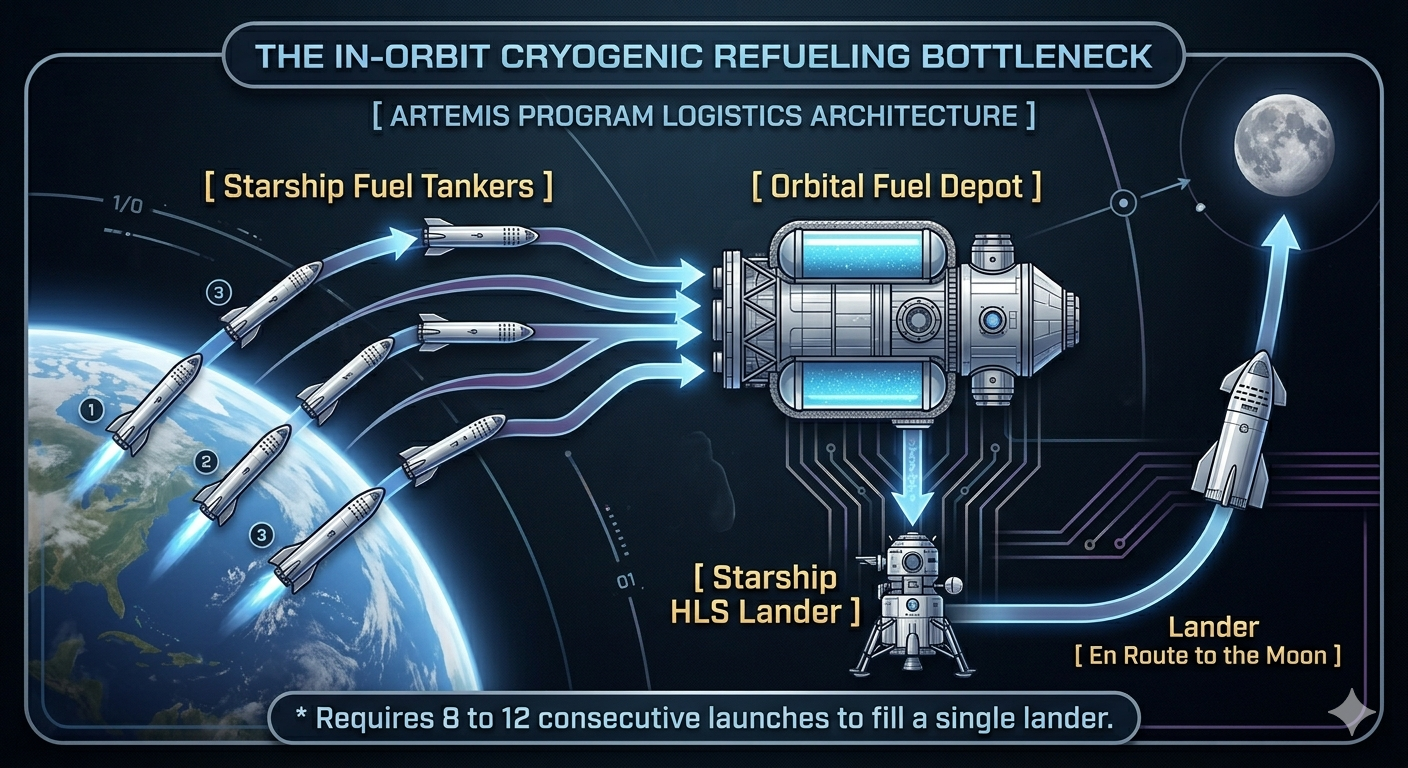
To send a single Starship HLS to the Moon, SpaceX will need to launch multiple consecutive “tanker” variants of Starship into low Earth orbit, transferring tons of supercooled liquid methane and liquid oxygen into a centralized orbital fuel depot before the actual lander can top off its tanks and burn for the Moon.
Alarmed by the sheer technical complexity and chronic delays, senior NASA officials took the unprecedented step last autumn of publicly raising the possibility of reopening the HLS contract framework. The space agency signaled that it may pivot to utilizing a rival lunar lander being developed by Jeff Bezos’s Blue Origin if SpaceX fails to meet critical hardware milestones. This warning sent immediate shockwaves through the aerospace industry, prompting Musk to accelerate timelines and tighten corporate discipline ahead of the public market offering.
6. The Death of ‘Swashbuckling’: Transitioning to Institutional Discipline
For years, the operational mantra at SpaceX was heavily inspired by Silicon Valley’s software culture: Move fast and break things. If a prototype rocket exploded on the Texas coastline, the engineering team swept up the shrapnel, analyzed the telemetry, modified the software, and rolled out a new vehicle within weeks. This swashbuckling ethos allowed SpaceX to outpace traditional, bureaucratic defense giants like Boeing and Lockheed Martin.
But as physicist and former NASA Ames Research Center Director G. Scott Hubbard notes, that casual era of high-altitude pyrotechnics is coming to an end.
“I think swashbuckling, you know ‘move fast and break things,’ has kind of come out of favor. It’s one thing when you’re not risking anybody’s life with spaceflight and you’re doing it on your own nickel, more or less. But when NASA comes into play, it means you’ve got to be very rigorous. If you take risks in the space business, it needs to be an understood and mitigated risk. It can’t be a stupid risk.”
With public equity markets involved and human lives hanging in the balance for the upcoming Artemis missions, institutional investors will demand extreme regulatory compliance, rigid quality control, and predictable flight schedules. The wild, chaotic culture of early Starbase testing must adapt to the sober realities of a publicly traded aerospace utility.
7. Evolution of an Interplanetary Giant: From Zip2 to the Red Planet
To truly appreciate the magnitude of the current corporate expansion, one must look backward at the serial entrepreneurial journey of Elon Musk. When the South African-born founder walked into the aerospace arena in 2002 at just 30 years old, veteran defense contractors openly laughed at him. He was viewed as merely another dot-com millionaire with more money than specialized engineering expertise.
Musk’s initial wealth came from the sale of his software business, Zip2, which was quickly followed by the creation of an online financial services platform that eventually merged into PayPal. When eBay acquired PayPal, Musk found himself flush with liquid capital but profoundly disappointed by the complete lack of visionary ambition within NASA’s post-Apollo roadmap.
+-------------------------------------------------------------+
|                THE ELON MUSK VENTURE TIMELINE               |
+-------------------------------------------------------------+
|                                                             |
|  [ 1995 ] Zip2 Founded ---> Sold for $307M                  |
|                                                             |
|  [ 1999 ] X.com / PayPal ---> Acquired by eBay for $1.5B    |
|                                                             |
|  [ 2002 ] SpaceX Launched ---> Initial Falcon 1 Failures     |
|                                                             |
|  [ 2008 ] First Successful Orbital Launch (Falcon 1)        |
|                                                             |
|  [ 2012 ] First Private Crew/Cargo to the ISS (Dragon)      |
|                                                             |
|  [ 2026 ] xAI Integration, Gen-3 Testing, & $75B IPO Move   |
|                                                             |
+-------------------------------------------------------------+
His initial concept was eccentric and small-scale: he wanted to purchase a refurbished Russian Intercontinental Ballistic Missile (ICBM) to send a miniature, glass-enclosed greenhouse containing seeds to the surface of Mars, hoping to photograph green plants growing against the red Martian soil to re-ignite public enthusiasm for space exploration.
When the Russian arms dealers treated him with hostility and demanded exorbitant prices for their hardware, Musk calculated the raw material costs of aerospace manufacturing on the flight home. He realized that the primary barrier to space exploration wasn’t a lack of interest—it was the astronomical cost of single-use, expendable rockets.
He decided to build a vertical rocket manufacturing company from scratch. The early days were marked by three consecutive launch failures of the tiny Falcon 1 rocket, bringing the company to the absolute brink of total bankruptcy in late 2008.
The fourth launch successfully reached orbit, saving the enterprise and securing a lifeline commercial cargo resupply contract from NASA. From those fragile beginnings, SpaceX developed the Falcon 9—the uncontested workhorse of global aviation—and the reusable Dragon spacecraft, which permanently broke Russia’s monopoly on transporting astronauts to the International Space Station.
Comparative Analysis: The Modern Heavy-Lift Landscape
To understand why the public market is willing to entertain a multi-billion-dollar valuation for SpaceX, one must compare the performance parameters, pricing structures, and developmental statuses of the world’s leading heavy-lift launch vehicles:
| Launch Vehicle Profile | Core Developer / Country | Estimated Cost Per Launch | Payload Capacity to LEO | Reusability Status | Primary Target Market |
| Falcon 9 | SpaceX (USA) | ~$67 Million | 22,800 kg | Fully Reusable First Stage | Commercial Satellites, Crew Transport |
| Starship Gen-3 | SpaceX (USA) | ~$90 Million (Target) | 150,000 kg+ | Intended Full Reusability | Lunar Landings, Mars Colonization, Starlink |
| Space Launch System (SLS) | NASA / Boeing (USA) | ~$2 Billion | 95,000 kg | 100% Expendable | Government Deep Space, Artemis Core |
| New Glenn | Blue Origin (USA) | Undisclosed | 45,000 kg | Reusable First Stage | Commercial Constellations, HLS Alternative |
| Ariane 6 | ArianeGroup (Europe) | ~$115 Million | 21,600 kg | 100% Expendable | European Sovereign Satellites |
The Ultimate Destination: Why Mars Still Matters
Amidst the complex financial spreadsheets, intense regulatory filings, Wall Street board meetings, and high-pressure NASA milestones, it is easy to lose sight of the foundational ideology driving this entire corporate apparatus. For Elon Musk, the $75 billion IPO, the Starlink network, the xAI space computing nodes, and the massive stainless-steel fabrication lines in south Texas are merely stepping stones toward an ultimate goal.
The true destination remains the colonization of Mars. The dream of transforming humanity into a multi-planetary species acts as the core cultural engine inside SpaceX, attracting elite engineering talent from the world’s top universities who are willing to work brutal hours under immense pressure.
+-----------------------------------------------------------------+
|               THE MULTI-PLANETARY MILESTONE PATH                |
+-----------------------------------------------------------------+
|                                                                 |
|   [ PHASE 1 ] Rapid Suborbital & Orbital Gen-3 Starship Testing |
|                                                                 |
|   [ PHASE 2 ] Automated Propellant Transfer Demonstrations      |
|                                                                 |
|   [ PHASE 3 ] Uncrewed Lunar Landing & Artemis III Missions     |
|                                                                 |
|   [ PHASE 4 ] Autonomous Starship Cargo Fleet Dispatched to Mars|
|                                                                 |
|   [ PHASE 5 ] First Crewed Interplanetary Transport Transit     |
|                                                                 |
+-----------------------------------------------------------------+
Whether the public markets will have the patience to endure the long, volatile, and capital-intensive timelines required to build cities on a cold planet millions of miles away remains an open question.
If Starship triumphs during its 12th test flight and successfully wards off the competitive threat from Jeff Bezos’s Blue Origin, Musk will march onto Wall Street with unprecedented leverage. The upcoming IPO will not just be a milestone for the tech industry; it will be a historic market test of humanity’s collective willingness to invest directly in our journey among the stars.