
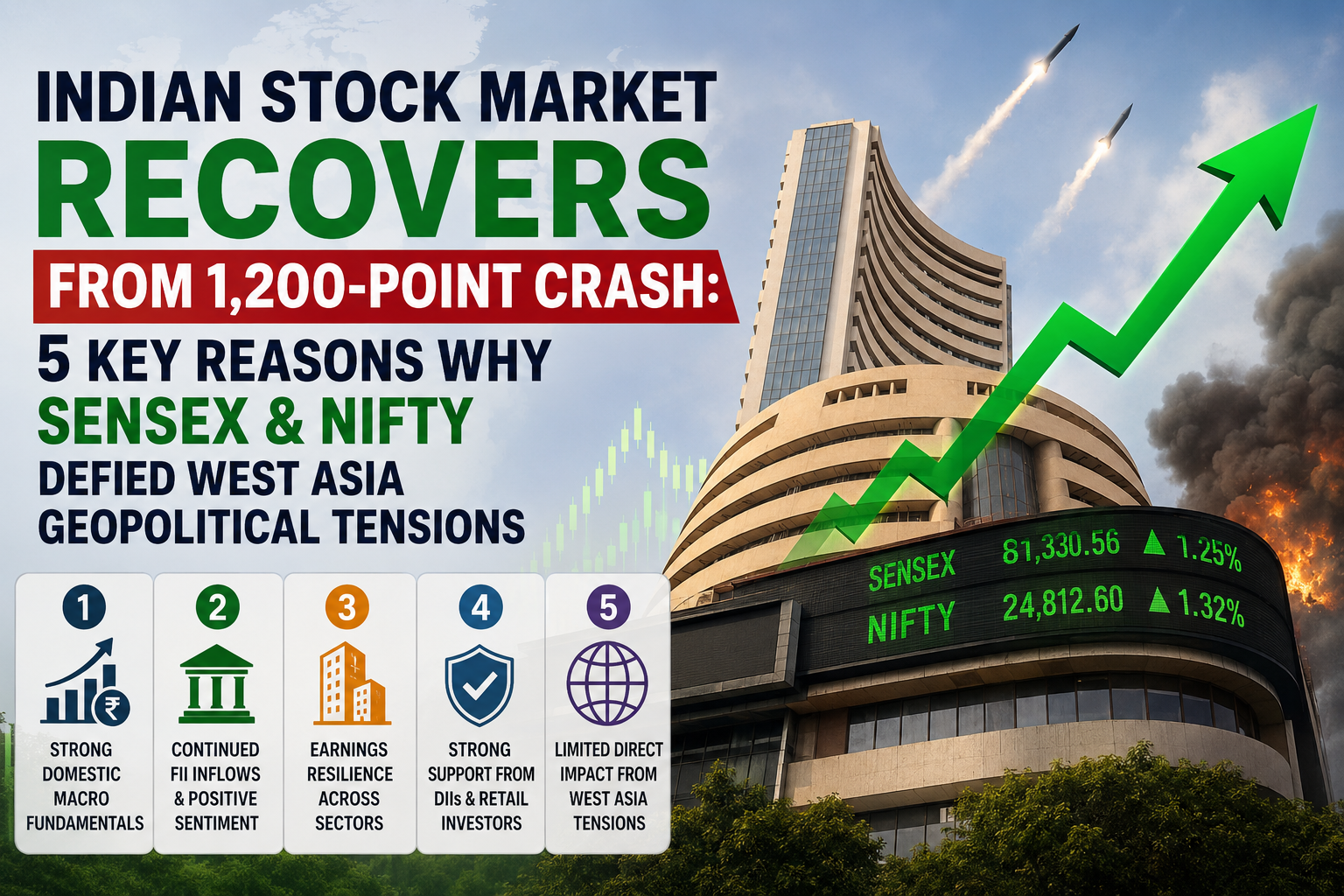
The Indian Stock Market Recovers witnessed a breathtaking roller-coaster ride on Monday, May 18, 2026. Dalal Street looked like a sea of red during early trade as a dangerous mix of surging global crude oil prices, a plunging Indian rupee, and escalating geopolitical tensions in West Asia triggered a massive sell-off. The benchmark BSE Sensex crashed by more than 1,280 points, while the NSE Nifty50 slipped below the critical 23,400 mark, leaving retail investors deeply worried.
However, the final hour of trading brought an unexpected and dramatic turnaround. Led by a spectacular, aggressive rally in mega-cap IT stocks and robust institutional buying, the equity benchmarks staged a phenomenal afternoon recovery. The Sensex erased all its massive losses to end 77 points higher, while the Nifty50 managed to scrape through with a flat-to-positive finish.
The Final Market Numbers
Despite the extreme intraday volatility, the major indices managed to stabilize by the closing bell:
| Index | Closing Price | Change (Points) | Change (%) | Intraday Low | Intraday High |
| BSE SENSEX | 75,315.04 | +77.05 | +0.10% | 74,180.26 | 75,315.04 |
| NSE NIFTY50 | 23,649.95 | +6.45 | +0.03% | 23,317.10 | 23,695.00 |
| NIFTY MIDCAP 100 | 60,473.80 | -93.35 | -0.15% | Weak Opening | Traded Heavy |
| NIFTY SMALLCAP 100 | 17,656.75 | -225.85 | -1.26% | Under Pressure | Under Pressure |
Why Did the Indian Stock Market Crash in Early Trade?
To understand the brilliant afternoon recovery, we first need to break down the severe macro headwinds that knocked down the indices by over 1.4% during the opening bell. Market experts pointed out five distinct triggers behind the morning panic.
1. Shocking Drone Attacks in the UAE and Saudi Arabia
The primary catalyst for the market anxiety was a fresh, dangerous escalation of the conflict in West Asia. Over the weekend, reports confirmed a drone strike targeting the sensitive Barakah nuclear power facility in the United Arab Emirates (UAE). Concurrently, Saudi Arabia reported intercepting three hostile drones over its territory.
This dramatic escalation expanded the geographical footprint of the ongoing regional conflict, severely spooking global financial markets and triggering immediate risk aversion among global fund managers.
2. US President’s Direct Warning to Iran
Adding fuel to the geopolitical fire, US President Donald Trump issued a stern, public warning to Tehran, stating emphatically that the “clock is ticking for Iran” and urging the nation to “get moving, FAST.”
This direct rhetoric signaled growing international impatience regarding backchannel diplomatic negotiations. It revived immediate fears of severe, prolonged disruptions to global shipping lines, especially around the highly sensitive Strait of Hormuz.
3. Brent Crude Oil Spikes Beyond $111
Because of the complete deadlock over the ongoing conflict and an absolute absence of diplomatic initiatives to secure the Strait of Hormuz, global oil benchmark Brent crude surged by 1.79%, aggressively trading above $111.2 per barrel.
Crude Oil Price Shock:
[Previous Range: ~$95-100] ---> [Current Spot: $111.2 per barrel]
Result: Immediate pressure on India's fiscal deficit and domestic inflation.
High crude prices are structural negatives for the Indian economy. Since India imports over 80% of its domestic crude requirements, sustained high prices directly stoke retail inflation, increase import bills, and threaten corporate profit margins across automobile, paint, and specialty chemical sectors.
4. Indian Rupee Hits a Historic Low
As global oil prices climbed and capital moved toward safe-haven assets like the US Dollar, the Indian Rupee faced intense structural pressure, tumbling to a fresh record low against the greenback. A depreciating currency makes imports significantly more expensive, accelerating imported inflation and complicating monetary policy management for the Reserve Bank of India (RBI).
5. Volatility Gauge (India VIX) Surges Over 6%
Reflecting the widespread anxiety on trading floors, India’s premier volatility index, the India VIX, surged by more than 6% to cross 19.92. A sharp spike in the VIX indicates that market participants are expecting aggressive, unpredictable swings in the near term, which naturally forces risk-averse institutional investors to trim their equity exposure.
The Afternoon Miracle: How the Indian Stock Market Recovers
Just when it appeared that the benchmark indices would suffer their worst single-day rout in months, domestic markets displayed remarkable resilience.
Nifty50 Intraday Trajectory:
Morning Low: 23,317.10 ---> Afternoon High: 23,695.00 (A massive 377-point swing)
This monumental turnaround was engineered by three key internal factors:
The Defensive IT Sector Shield
When global economic uncertainty peaks, institutional money traditionally seeks shelter in defensive sectors, particularly Information Technology. Tech Mahindra emerged as the undisputed leader of the day, skyrocketing an impressive 4.85% to close at ₹1,437.
Heavyweight IT peers followed closely, with Infosys gaining 2.38% and Wipro rising 1.31%. The massive sectoral weight of these IT giants provided the essential muscle required to lift the Nifty and Sensex out of the deep morning plunge.
Strong Institutional Support (FII & DII Data)The absolute bedrock of Monday’s recovery was the aggressive, coordinated buying by both Foreign Institutional Investors (FIIs) and Domestic Institutional Investors (DIIs). Instead of panicking over the geopolitical headlines, both blocks view the intraday dips as prime accumulation windows.
According to provisional data from the exchanges, the institutional fund flow for May 18 stood remarkably positive:
Domestic Institutional Investors (DII): Bought equities worth ₹15,546.34 crore against sales of ₹12,860.57 crore, resulting in a net continuous cash inflow of ₹2,685.77 crore.
Foreign Institutional Investors (FII/FPI): Logged gross purchases of ₹16,338.39 crore and gross sales of ₹13,696.22 crore, recording a net positive inflow of ₹2,642.17 crore.
This dual-buying force completely absorbed the retail panic selling, swiftly stabilizing the broader indices.
Sectoral Performance Analysis: Winners and Losers
The underlying market dynamics revealed a massive divergence between specific sectors. While export-driven IT and select defensive healthcare names thrived, core capital-intensive sectors bore the brunt of the global commodity shock.
The Top Nifty50 Gainers
Tech Mahindra: Up 4.85% (Closed at ₹1,437) — Driven by strong deal pipeline visibility and technical short-covering.
Infosys: Up 2.38% (Closed at ₹1,452) — Acted as the primary index stabilizer during afternoon trade.
Bharti Airtel: Up 1.66% — The telecom major experienced an extraordinary session. During intraday trade, its total market capitalization scaled an unprecedented ₹11.90 lakh crore, briefly catapulting Bharti Airtel to become the second-largest listed company by market value in the Indian equity landscape.
Sun Pharmaceutical Industries: Up 1.37% — Benefited from defensive sector reallocation.
The Top Nifty50 Losers
Tata Steel: Down 3.15% (Closed at ₹210) — Emerged as the leading drag on the Nifty index. Although the steel producer reported a 125% year-on-year jump in consolidated net profit to ₹2,926 crore for the March quarter (Q4 FY26), the numbers failed to impress institutional analysts who flagged underlying structural margins.
Power Grid Corporation: Down 2.93% (Closed at ₹296) — Investors reacted negatively to weak operational performance. The utility company’s Q4 FY26 EBITDA plunged 19% to ₹7,501 crore, with its core operating margins contracting sharply by 8.7 percentage points.
NTPC: Down 2.62% — Faced selling pressure due to escalating input fuel cost projections.
State Bank of India (SBI): Down 2.53% — Led the broader correction across the Nifty PSU Bank index, which fell 1.9% overall.
Midcap and Smallcap Carnage
While the front-line indices managed an impressive, headline-grabbing recovery, the broader, high-beta mid-and-small-cap spaces experienced a painful session. Risk aversion was explicitly visible here, as retail investors rushed to trim positions in highly leveraged entities.
The Nifty Midcap 100 closed flat with a negative bias at 60,473.80. Major laggards in this space included defense player Cochin Shipyard, which plunged 4.92%, followed closely by Godfrey Phillips India (-4.57%) and Container Corporation of India (-3.24%).
The Nifty Smallcap 100 suffered an even deeper blow, sliding 1.26% to settle at 17,656.75. Amber Enterprises crashed an astonishing 15.39% to ₹134 crore after its Q4 FY26 earnings call disappointed analysts regarding near-term guidance. Similarly, infrastructure major KEC International dropped 10.68%.
Bucking the small-cap selloff was Gland Pharma, which staged a stunning 15.24% rally to touch its 52-week high. The pharmaceutical company posted an exceptional 96.56% year-on-year increase in its consolidated net profit, reaching ₹366.67 crore for the March quarter.
Technical Outlook: Crucial Nifty Levels to Watch Now
From a purely technical perspective, the long-tail candlestick pattern formed on the daily charts suggests that the structural bull run is far from over, though intermediate volatility will persist.
Nifty Technical Bounds:
[Crucial Support: 23,489] <--- [Current Nifty Close: 23,649.95] ---> [Bullish Target: 23,850+]
Anand James, Chief Market Strategist at Geojit Investments, pointed out that the 23,489 level—which represents the 62% Fibonacci retracement level of the market’s recent upward move—acted as an incredibly robust floor during the morning meltdown.
Market technicians believe that as long as the Nifty50 actively sustains above the 23,489–23,500 zone on a closing basis, the overall structural trend remains constructivly bullish. To completely invalidate the bearish overhang from the West Asia headlines, the index must consistently reclaim and trade above the 23,695–23,750 range. Failure to defend the 23,400 support zone in the coming sessions could potentially open the floodgates for a deeper correction toward the 22,800 mark.
Summary Strategy for Retail Investors
The manic Monday session serves as a reminder that geopolitical events create temporary distortions, but corporate earnings and liquidity eventually dictate the market’s ultimate direction. With the India VIX holding near 20, traders should brace for choppy, two-way movements. For long-term investors, staggered accumulation in high-quality IT, private banking, and pharma names during major intraday panics remains the most prudent wealth-building approach.
Disclaimer: This report is for informational purposes only. Please consult a certified financial advisor before making investment decisions based on the Q4 FY26 Earnings Fiesta data.