
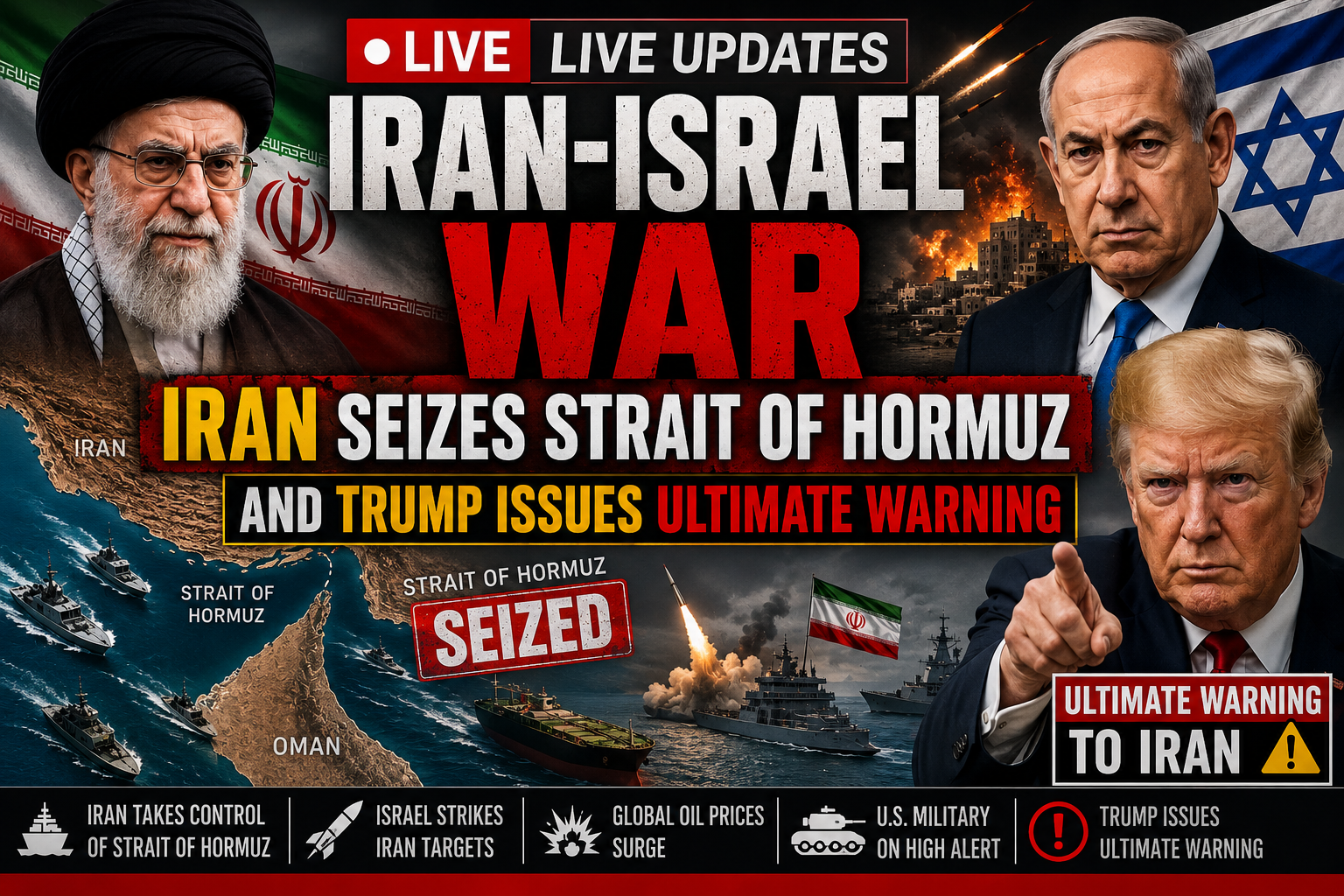
Iran-Israel War Updates : The Middle East is close to a major global disaster. According to the latest news, Iran has taken a dangerous step that could change global trade and sea safety forever. On Monday, May 18, 2026, Iran announced a new official group to control, block, and tax ships traveling through the highly important Strait of Hormuz.
As the war enters its third month, tensions are rising everywhere. Drones have hit a nuclear power plant in the UAE, and heavy Israeli airstrikes are hitting southern Lebanon despite a truce. At the same time, US President Donald Trump gave Iran a final warning, saying “nothing will be left” of the country if they do not make a deal quickly.
Here is a comprehensive breakdown of the breaking developments shaking the globe today.
1. Iran Creates a New Group to Tax Ships in the Strait of Hormuz
Iran has officially taken control of the Strait of Hormuz, one of the world’s most important sea routes for oil. Experts call this a major move in economic warfare. Iran’s government announced a new group called the Persian Gulf Strait Authority (PGSA) to manage and monitor everything happening in the strait. Iran’s military navy immediately backed the decision, showing they are ready to enforce it.
How the New Plan Works
Ebrahim Azizi, a top Iranian official, explained how this new system will work. He stated that traffic will be forced to follow a specific route controlled by Iran.
“Only trading ships and countries that cooperate with Iran will be allowed to use it,” Azizi warned. He also added that ships will have to pay mandatory fees to pass through.
By closing the strait to certain countries and demanding payment, Iran is controlling a huge part of the world’s energy supply. This move has already deeply worried global markets and shipping companies.
2. Donald Trump Warns Iran: “The Clock is Ticking”
As the conflict threatens to spiral into a full-scale third world war, US President Donald Trump did not mince his words over the weekend. Issuing a fierce, direct warning to the Islamic Republic, Trump made it clear that Washington’s patience has completely run out.
“The clock is ticking for Iran,” Trump stated emphatically on Sunday. He warned Tehran to move “FAST, or there won’t be anything left of them.”
The aggressive rhetoric underscores the immense friction behind closed doors. While backchannel diplomacy is actively occurring, the Trump administration appears ready to leverage absolute economic and military pressure to force Iran into a sweeping surrender or a highly restrictive new nuclear and regional treaty.
3. UAE Nuclear Plant Targeted as Regional Proxy Warfare Explodes
The war is no longer contained to immediate border skirmishes. In a terrifying escalation of drone warfare, the United Arab Emirates (UAE) reported a drone strike targeting a nuclear power plant. While local authorities are evaluating the structural integrity and safety parameters of the facility, the mere targeting of a nuclear site marks a dangerous crossing of red lines.
Simultaneously, Saudi Arabia’s air defense systems were forced into action. Riyadh confirmed it successfully intercepted three hostile drones violating its airspace, which were tracked originating from Iraqi territory. These coordinated drone incursions point to a highly organized effort by Iran-backed proxy mobilization networks in Iraq to penalize Gulf nations perceived as aligned with Western or Israeli interests.
4. Secret Peace Talks Through Pakistani Mediators Stalled
Despite the terrifying public rhetoric, diplomatic channels have not completely collapsed—though they are hanging by a thread. Iranian Foreign Ministry spokesman Esmaeil Baqaei confirmed on Monday that Tehran has formally responded to a new US peace proposal aimed at ending the war.
However, the prospects of an immediate breakthrough look incredibly grim. Iranian state media outlets have widely characterized Washington’s terms as “excessive” and unacceptable.
Pakistan’s Critical Role as a Diplomatic Bridge
Pakistan has emerged as the central intermediary trying to prevent a global apocalypse.
The Military Track: Days ago, Pakistan’s highly influential Army Chief, Field Marshal Asim Munir, conducted high-level, quiet meetings in Tehran.
The Civilian Track: Following the army chief’s visit, Pakistan’s Interior Minister arrived in Tehran on Monday to explicitly “facilitate” the stalled negotiations between Washington and Tehran amid a highly fragile, failing ceasefire.
“As we announced yesterday, our concerns were conveyed to the American side,” Baqaei stated during a press briefing, confirming that exchanges are actively continuing through Pakistani diplomatic channels.
5. Israel Rains Airstrikes on Lebanon Despite Truce Extension
The disconnect between diplomatic talk and battlefield reality was made brutally clear in Lebanon. Even though a technical extension of the truce between Israel and Lebanon was supposedly in place, Israel launched a massive, coordinated series of airstrikes across southern Lebanon.
Middle East Conflict Matrix (May 2026)
| Theater of War | Active Military Actions | Diplomatic Status |
| Strait of Hormuz | Iranian PGSA Blockade & Forced Fees | Rejected by US and Allies |
| Southern Lebanon | Heavy Israeli Airstrikes | Truce Extended but Non-Functional |
| UAE & Saudi Arabia | Proxy Drone Strikes on Infrastructure | Air Defenses on High Alert |
| Gaza / Cyprus | Flotilla Interceptions | High Tension between Turkiye & Israel |
The relentless bombardment has completely shattered any remaining confidence the Lebanese population had in international ceasefires. Thousands of civilians who were already driven from their ancestral homes in southern Lebanon are now trapped in a perpetual cycle of displacement, with local humanitarian agencies warning of an imminent collapse of basic infrastructure.
6. Turkiye Blasts Israel Over Flotilla “Piracy” Off Cyprus
Adding fuel to an already raging fire, relations between Turkiye and Israel have plunged to a disastrous new low. On Monday, Ankara issued a scathing denunciation of Israel, accusing its military of committing a “new act of piracy” in international waters.
The diplomatic fury erupted after an international aid flotilla consisting of 50 vessels, which set sail from Turkiye on Thursday bound for the blockaded Gaza Strip, reported that Israeli naval commandos had forcibly intercepted one of their boats off the coast of Cyprus.
“We condemn the intervention by Israeli forces in international waters against the Global Flotilla… which constitutes a new act of piracy,” the Turkish Foreign Ministry said in a harsh public statement.
Ankara’s involvement raises the stakes significantly, as Turkiye is a key NATO member with a powerful military, making its direct rhetorical and potential naval friction with Israel a major concern for Western strategists.
7. Global Economic Fallout: Ryanair Profits Overshadowed by War
The economic shockwaves of the US-Iran war, which erupted in late February 2026, are now visibly denting corporate balance sheets globally. Irish budget airline giant Ryanair released its annual financial results on Monday, and the report perfectly illustrates the corporate anxiety sweeping the globe.
At first glance, Ryanair enjoyed a stellar financial year. The airline reported a staggering 35 percent jump in profit after tax, reaching 2.17 billion euros ($2.52 billion) for the 12 months ending in March. However, the celebratory mood was completely erased by the realities of the ongoing war.
Ryanair Fiscal Performance vs. Future Outlook
- Annual Profit After Tax: 2.17 Billion Euros (+35%)
- Fuel Cost Hedging: 80% secured at $67/barrel through April 2027
- Primary Risk Factor: Open-ended closure of the Strait of Hormuz
- Market Reaction: Shares fell ~3% in Dublin following the announcement
Ryanair Chief Executive Michael O’Leary stated bluntly that it was “far too early” to provide any meaningful profit guidance for the upcoming year due to severe fuel price instability and potential supply chain disruptions.
Why the Strait of Hormuz Matters to Your Flight Ticket
When Iran initiated military actions in late February, global crude oil prices skyrocketed immediately. Because jet fuel is a direct derivative of crude oil, airlines are facing catastrophic spikes in operational costs.
“The conflict in the Middle East has created economic uncertainty and we still don’t know when the Strait of Hormuz will reopen,” O’Leary noted in the earnings statement.
While Ryanair has smartly hedged 80 percent of its fuel needs at $67 a barrel through to April 2027 to protect itself from immediate disaster, it acknowledged that its business remains heavily exposed to further escalations. Spooked by the open-ended nature of the war, investors sent Ryanair’s share price tumbling by roughly three percent in Dublin trading.
Iran-Israel War Updates Summary : What Happens Next?
The world currently stands at a dangerous crossroads. Iran’s establishment of the Persian Gulf Strait Authority (PGSA) is a direct challenge to the foundational principles of international maritime law and freedom of navigation. By attempting to collect taxes and control traffic through an international strait, Tehran is daring the United States and its allies to use military force to clear the shipping lanes.
With President Trump setting a strict timeline, the failure of Pakistan’s mediation efforts could trigger a massive regional war involving direct strikes on mainland Iranian targets. For now, the global economy, international transport lines, and millions of civilian lives remain entirely at the mercy of decisions being made behind closed doors in Washington, Tehran, and Jerusalem.