

India’s first hydrogen train officially hit the tracks today, marking a massive leap forward for the nation’s green transit goals. In a historic move that places the country among an elite group of global nations, Prime Minister Narendra Modi flagged off this indigenously built green locomotive from the Jind railway station in Haryana.
This landmark launch belongs to a massive multi-state development blitz spanning Haryana, Chandigarh, and Punjab. During this high-octane tour, the Prime Minister unveiled a giant basket of infrastructure, healthcare, and connectivity projects worth over ₹25,000 crore. However, the debut of this clean-energy train remains the absolute crown jewel of the tour. It promises to redefine sustainable mobility across the entire Indian Railways network.
Stepping Into the Future: The Jind-Sonipat Hydrogen Route
The debut run of India’s first hydrogen train covers an 89-kilometer stretch connecting Jind and Sonipat. By running this clean-energy passenger service, India officially joins Germany and China as the only three countries in the world to operate hydrogen fuel-cell trains for active commercial passengers.
For the Indian Railways, a network that has relied on loud diesel links and expensive overhead electric wires for decades, this rollout represents a total paradigm shift.
Technical Specifications: Specs and Scale
This train is not just a quick prototype built for media attention. Indian engineers designed this high-capacity, heavy-duty passenger solution to handle real-world commuter rushes on busy regional lines.
Key Specifications of India’s First Hydrogen Train
| Feature | Technical Details & Specifications |
| Route | Jind to Sonipat (Haryana) |
| Total Distance | 89 Kilometers |
| Train Configuration | 10 Coaches (2 Power Cars + 8 Passenger Coaches) |
| Propulsion Capacity | 3,200 HP Total (Two 1,200 kW Traction Power Cars) |
| Primary Byproduct | Pure Water Vapour (Zero Carbon Emissions) |
A Massive 10-Coach Layout
The train boasts an expansive 10-coach layout, which makes it one of the longest hydrogen-powered passenger trainsets in the world. The configuration includes eight standard passenger coaches to maximize seating capacity, flanked by two dedicated driving power cars at each end.
High-Output Propulsion
Equipped with a formidable 3,200 HP propulsion system, the train draws its strength from two 1,200 kW traction power cars. This heavy-duty setup provides the fast acceleration and steady torque that drivers need to maintain strict timetables on crowded local routes.
How Onboard Hydrogen Fuel Cells Work
To understand why this train represents a major engineering milestone, we must look beneath the chassis. Traditional electric trains pull power from a distant electricity grid using an expensive web of overhead wires. Diesel locomotives burn heavy fossil fuels directly inside the engine, pumping out carbon dioxide, soot, and nitrous oxides.
This hydrogen train completely rewrites that formula by acting as its own rolling, self-contained power plant.
The Chemical Process
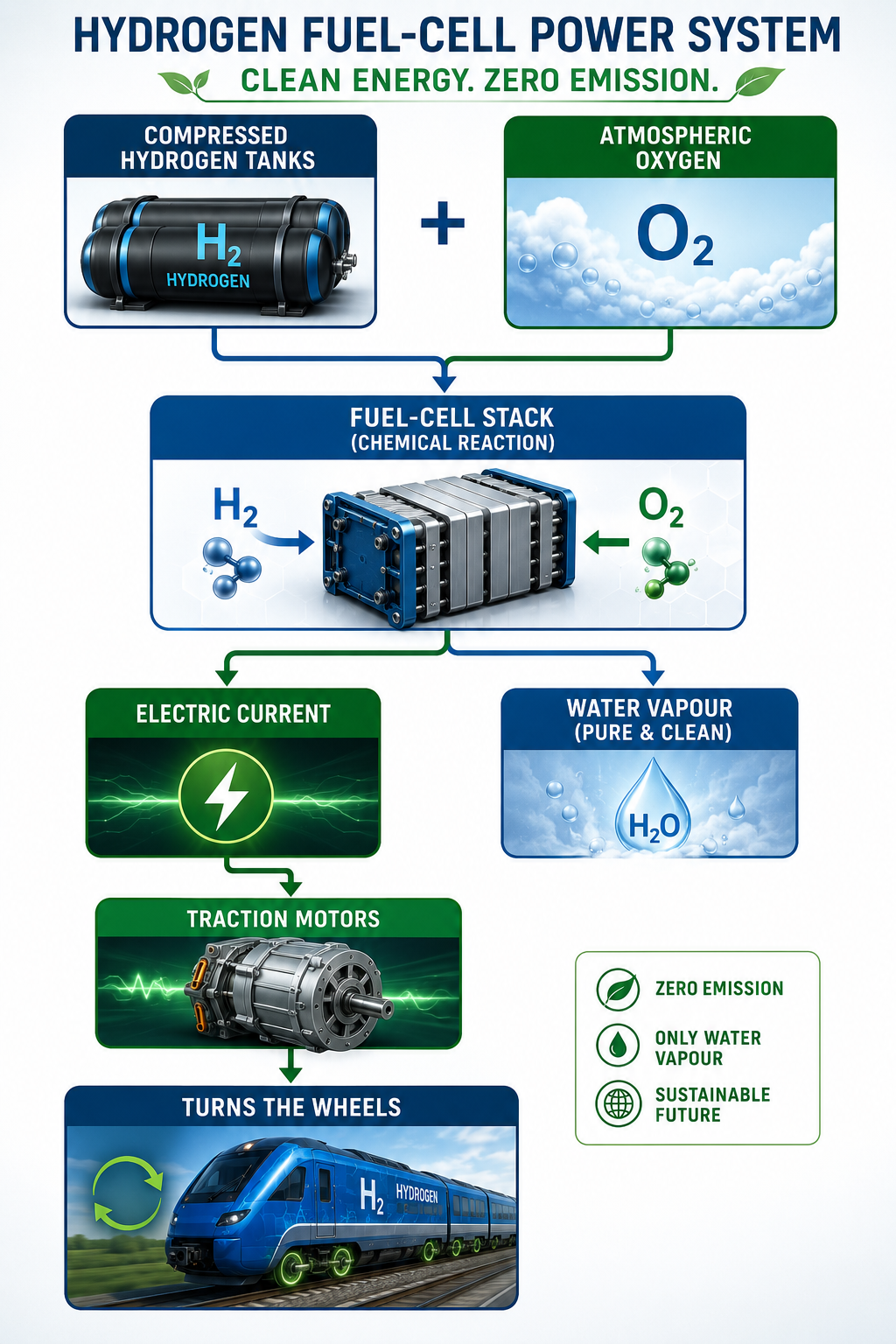
The train generates its own electricity onboard through a controlled chemical reaction. The system mixes stored compressed hydrogen gas with oxygen drawn directly from the surrounding air. When these hydrogen molecules pass through the onboard fuel-cell stack, they strip away electrons to create a steady electric current. This electricity flows straight into the high-torque traction motors to turn the wheels.
Zero Emissions at the Tailpipe
Because this entire power cycle relies on chemistry instead of burning fuel, the process produces zero greenhouse gases. The train releases only pure, clean water vapour into the air. This technology eliminates tailpipe pollutants, cuts ambient noise down to a quiet hum, and reduces India’s dependence on volatile foreign oil imports.
A Triumph for Indian Engineering
While foreign suppliers provided the core fuel-cell stacks, domestic engineers designed, built, and integrated the complex propulsion machinery, advanced electronic control systems, and safety overrides right here in India. This rollout provides a real-world testing ground for Indian teams to study how high-pressure storage systems and fuel cells perform under extreme Indian weather.
The ₹14,700 Crore Mega Infrastructure Wave in Jind
While the green train captured the national spotlight, PM Modi’s stop at the Eklavya Stadium in Jind also brought a massive wave of traditional infrastructure investments to Haryana, totaling roughly ₹14,700 crore. The government dedicated the bulk of these funds to modernizing the regional highway network to speed up travel and freight movement.
1. The Delhi-Amritsar-Katra Expressway (Packages 1 to 5)
The Prime Minister opened the first five critical packages of the highly anticipated Delhi-Amritsar-Katra Expressway. Spanning a length of 157.92 kilometers, this four-lane, fully access-controlled greenfield corridor represents a standalone investment of approximately ₹9,680 crore.
Once workers link up the entire 667-kilometer expressway network, it will slash travel times between Delhi and Katra from 14 hours down to just 6 hours. Travelers moving between Delhi and Amritsar will see their journey times cut in half, dropping from 8 hours to just 4 hours. This new route will clear heavy truck traffic from the congested NH-44, assist pilgrims heading to the Vaishno Devi shrine, and boost local manufacturing hubs along the corridor.
2. The Ambala-Kala Amb Highway (NH-7 and NH-344)
Spanning 33.81 kilometers, this newly opened four-lane, partially access-controlled highway creates a reliable trade connection between Ambala and the industrial belt of Kala Amb on the Himachal border. It lowers logistics costs for factories and makes weekend tourist travel to northern hill stations far safer.
3. The Jind-Gohana Greenfield Highway (NH-352A)
Local commuters received a massive boost with the opening of the 40.60-kilometer Jind-Gohana Greenfield Highway. Previously, navigating the older local roads between these two towns took up to two hours. The new high-speed highway cuts that trip to just 40 minutes, helping local farmers move fresh produce to Delhi-NCR markets quickly.
4. Upgrade for the Hansi-Barwala Highway
Adding to the road upgrades, the Prime Minister laid the foundation stone for the 24.27-kilometer Hansi-Barwala Highway Project. This project will widen and reinforce the existing narrow corridor into a spacious highway complete with paved shoulders, removing dangerous traffic bottlenecks.
Transforming Cities, Healthcare, and Cultural Heritage
Beyond highways and railways, the development program hit several crucial milestones aimed at public health, urban planning, and local history.
The Kurukshetra Elevated Railway Track
In a major win for urban planning, PM Modi officially inaugurated the newly built Elevated Railway Track in Kurukshetra. For years, busy railway crossings cut through the heart of the city, forcing drivers into long waits and delaying trains. Elevating the tracks removes these bottlenecks, separating local automotive traffic from fast-moving trains.
Upgrading Regional Healthcare Systems
To bring specialist healthcare to rural families, the Prime Minister dedicated three major medical institutions to the nation:
Pandit Neki Ram Sharma Government Medical College (Bhiwani)
Maharishi Chyawan Medical College (Narnaul)
Rao Tula Ram Hospital (Koriawas, Narnaul)
These modern medical campuses will expand access to quality healthcare, saving local families from traveling to major metros for complex treatments. They also add dozens of new MBBS seats, training the next generation of doctors right within Haryana.
The Kurukshetra Sikh Museum
Recognizing the deep cultural roots of the region, PM Modi laid the foundation stone for a world-class Sikh Museum in Kurukshetra. This institution will chronicle the history of Sikhism, highlight the spiritual teachings of the Sikh Gurus, and honor the deep sacrifices of the Sikh community throughout Indian history.
Expanding the Blitz: Chandigarh and Punjab
After wrapping up his itinerary in Jind, the Prime Minister traveled to Chandigarh to launch an additional array of development works worth over ₹4,700 crore.
From Chandigarh, the tour continued into Jalandhar, Punjab, where PM Modi rolled out another massive package of infrastructure and connectivity upgrades worth more than ₹5,470 crore. These combined multi-state projects show a coordinated push to elevate the entire northern economic zone simultaneously.
The Path Ahead for Sustainable Rail Transit
The successful launch of India’s first hydrogen train marks a historic starting point. Moving away from fossil fuels requires a long-term commitment and steady supply chain development.
Our Path to Net-Zero:
While setting up dedicated hydrogen fuel networks requires significant initial capital, the environmental payoff of zero-emission rail lines is immense. By reducing reliance on diesel engines, this pilot run sets a clean, self-reliant foundation for the future of Indian transport.