
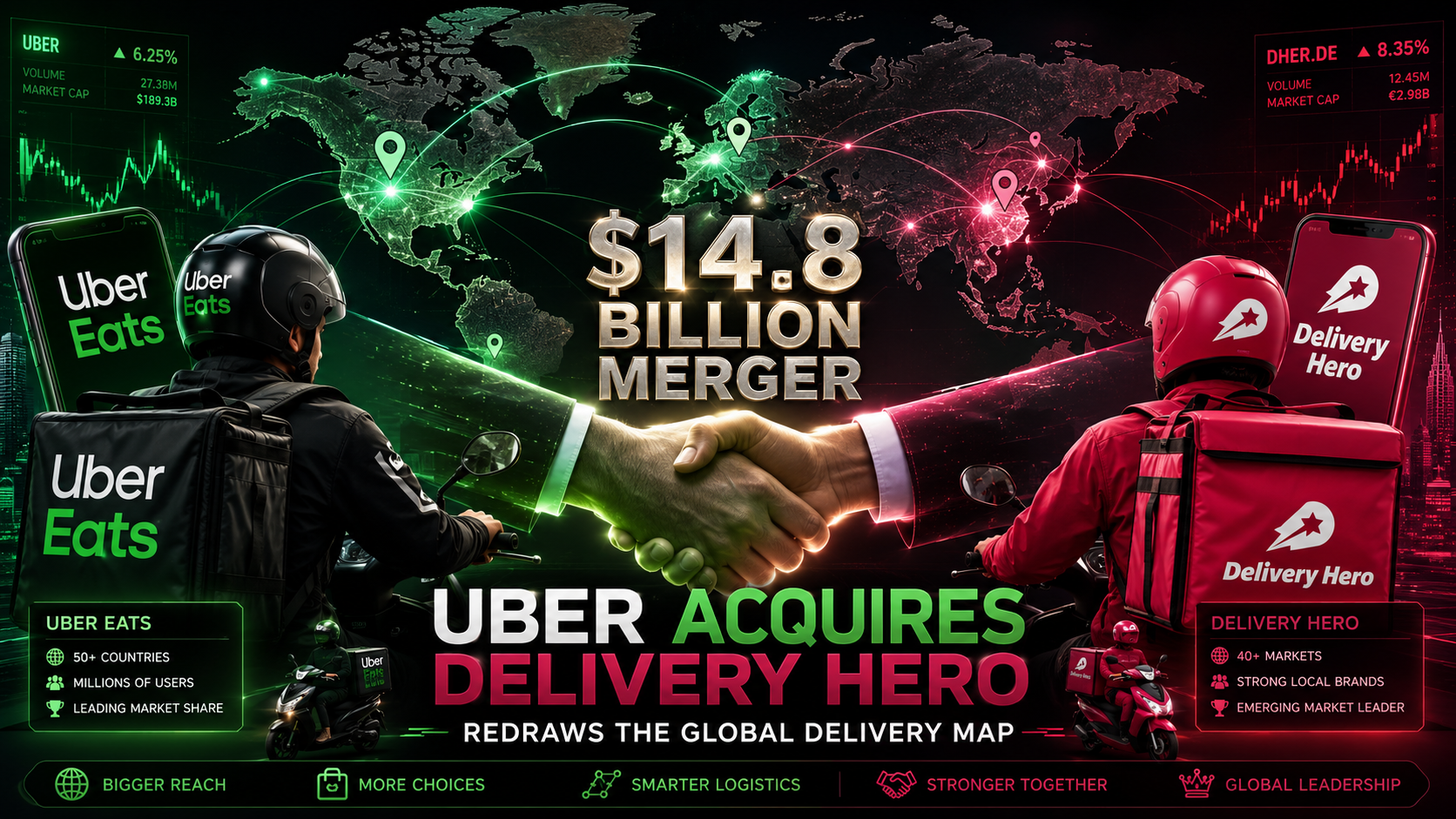
The global food delivery market just witnessed its biggest shakeup in history. Uber Delivery Hero acquisition has officially agreed the majority of Germany’s food delivery giant. This blockbuster deal has an equity value of $14.8 billion (approximately €12.9 billion), making it one of the most ambitious consolidations in the history of consumer technology.
By combining two of the largest food-delivery networks on earth, the deal creates a single, massive powerhouse that will operate across 99 countries. This acquisition is not just about growing bigger. It is a direct and calculated response to crazy competition, changing markets, and a massive industry-wide shift. Delivery companies are no longer focusing on burning cash for quick growth; they now want sustainable, long-term profits.
As food delivery transitions from a scattered battleground into a tightly controlled global market, this deal represents the ultimate play for total dominance.
The Financial Breakdown: Anatomy of the $14.8 Billion Takeover
At the heart of this agreement is a highly lucrative financial offer. Uber designed this bid to win over Delivery Hero’s board and shareholders, who have faced continuous pressure from investors to deliver better financial returns.
Key Transaction Metrics
Total Transaction Value: $14.8 Billion (approx. €12.9 Billion)
Offer Price Per Share: €41.50
Premium on 3-Month Average Price: 34%
Premium on Undisturbed Price: ~40%
Expected Closing Date: Second Half of 2027 (2H27)
Combined 2025 Projected GMV: $236 Billion
Uber’s offer of €41.50 per share represents a huge win for the Berlin-based company. The price is about 34% higher than Delivery Hero’s volume-weighted average share price over the past three months. If you look at the stock price before the official merger talks leaked to the public, the offer boasts a massive premium of nearly 40%.
This successful agreement did not happen overnight. Delivery Hero’s leadership actually rejected an earlier, lower approach from Uber. That previous bid valued the company at roughly €10 billion, or €33 a share. The patience of the German firm’s leadership paid off, forcing Uber to raise its valuation by billions to seal the deal.
To keep the transaction moving forward smoothly without any shareholder drama, Uber has already locked down key commitments. Prosus NV, the Amsterdam-listed tech investment giant and largest Delivery Hero shareholder, has agreed to sell its entire stake of nearly 17%. With Prosus on board and the backing of both companies’ boards, the path to final approval looks mostly clear.
Chasing China’s Meituan: A Battle of Global Scale
To understand the sheer size of this merger, you have to look at the combined numbers. The new combined entity will boast a staggering projected Gross Merchandise Value (GMV) of $236 billion.
This brings the combined Western delivery giant right up behind China’s market leader, Meituan. Meituan recorded a massive platform GMV of approximately $246.5 billion last year. Outside of China’s unique and highly isolated domestic market, the new Uber-Delivery Hero combination will stand alone as the absolute largest food-delivery group on the planet.
Uber CEO Dara Khosrowshahi highlighted the strategic value of this scale, noting that the deal will nearly double the number of global markets where Uber can offer both rideshare and delivery services on a single app.
Why Massive Scale is the Only Way to Survive
The food delivery sector has changed drastically since the wild, venture-capital-funded days of the pandemic. During the lockdowns, dozens of local startups raised billions of dollars to fight for local neighborhoods. They offered massive discounts and free deliveries to attract users, which burnt a lot of cash.
However, as those pandemic-era order spikes went back to normal and global interest rates started rising, the industry faced a harsh reality check. Investors stopped caring about raw order volume and started demanding actual profits, free cash flow, and positive margins. At the same time, platforms around the world have faced costly legal battles and new minimum wage rules for gig workers.
In this tight market, operating at a massive scale is no longer just a luxury—it is a basic requirement to survive. Scale gives companies several major advantages:
Optimized Delivery Routes: Having a higher density of couriers and orders in the same neighborhood reduces travel times and cuts down the cost of every single delivery.
Highly Profitable Subscription Models: Uber can now introduce its successful Uber One subscription program to Delivery Hero’s massive base of roughly 60 million active monthly users. This lets Uber cross-promote its rideshare business to food delivery customers, boosting how much money each user spends over time.
High-Margin App Advertising: With millions of restaurants and local stores on a single, unified network, Uber can scale its fast-growing advertising business. Local eateries will pay good money to bid for prominent placement and banners inside the app.
Redrawing the Map: Expanding into 50 New Countries
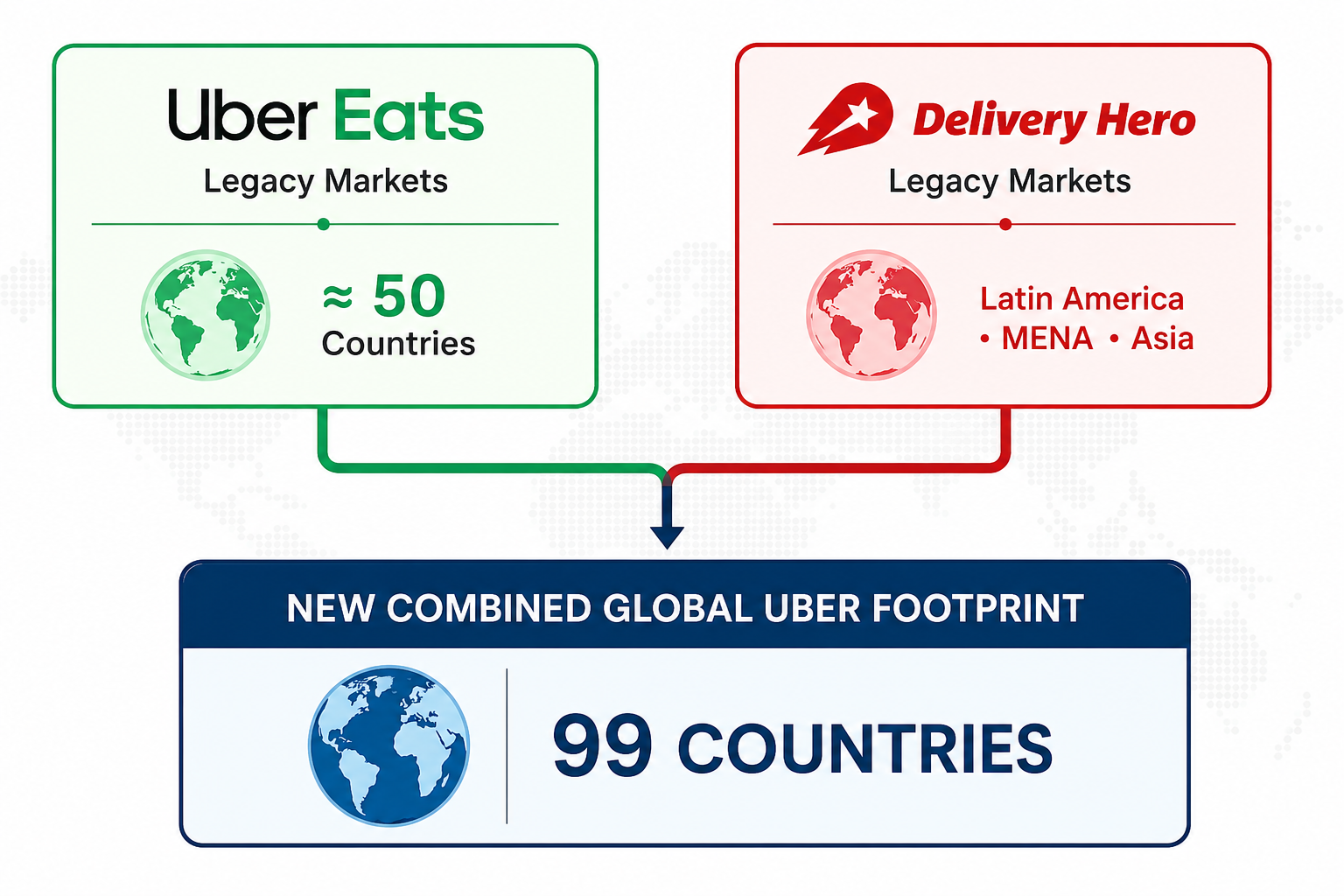
Before this announcement, Uber Eats had strongholds in major Western economies like the US and UK, but its footprint was capped at roughly 50 countries.
By taking over Delivery Hero’s international network—which includes massive regional brands like Talabat in the Middle East and PedidosYa in Latin America—Uber instantly expands its food-delivery operations to 99 countries.

This geographic leap adds approximately $42 billion in gross bookings overnight. It also delivers a major blow to Uber’s main US rival, DoorDash. DoorDash has been aggressively expanding into Europe through its own acquisitions, like buying the Finnish delivery platform Wolt and targeting the UK’s Deliveroo.
For long-term investors, this geographic expansion is highly lucrative. Getting millions of active users across emerging markets gives Uber decades of organic growth. Once these users are in the system, Uber can easily upsell its rideshare services, parcel delivery, and local grocery options.
Solving the Monopoly Problem: The SSW Partners Strategy
A transaction of this scale is guaranteed to trigger warning bells for antitrust watchdogs and competition regulators worldwide. In many European and Latin American cities, the overlap between Uber Eats and local Delivery Hero brands would have created complete monopolies. This would leave local restaurants and everyday consumers with virtually no other choices, driving up prices.
To avoid these regulatory blocks, the deal includes a smart, multi-step workaround:
The 14-Market Cut: Delivery Hero has agreed to carve out and sell its entire business in 14 highly sensitive markets to the US investment firm SSW Partners for approximately $1.6 billion (€1.4 billion).
The Affected Countries: These divested business units include highly scrutinized European markets like Austria, Norway, Spain, and Sweden.
The Exit Plan: SSW Partners will temporarily hold these assets and then sell them off to independent, third-party buyers. This clever step ensures that local competition stays alive.
Even with this proactive move, market analysts warn that a quick integration is highly unlikely. Financial analysts point out that the estimated completion date of late 2027 shows just how long and grueling this regulatory review process will actually be.
Keeping Berlin Happy: Protecting Local Jobs
Because Delivery Hero is one of Germany’s biggest tech success stories—founded in Berlin back in 2011—a massive foreign takeover is a very sensitive political topic locally. To calm down local concerns, Uber has agreed to several major commitments:
A €2 Billion Investment: Uber has committed to investing €2 billion directly into Germany through the year 2031.
Job Protection: The company has pledged to keep Delivery Hero’s iconic Berlin headquarters open and maintain its current local workforce until at least 2029.
Local Management: By keeping the Berlin office running, Uber retains a highly experienced local team that knows how to handle complex European labor laws and regional restaurant relations.
Ten Years of Aggressive Mergers
This blockbuster agreement is the crowning moment of a ten-year wave of consolidation in the delivery space. What was once a scattered group of tiny local startups has now been systematically bought out by a few dominant players:
[Local Startups] ──> [Bought by Regional Brands] ──> [Merged into Uber & DoorDash]
Uber’s Journey: Uber previously bought US rival Postmates to strengthen its home market, and has constantly expanded globally through smart joint ventures.
DoorDash’s Journey: DoorDash bought Wolt to secure an immediate spot in Northern and Eastern Europe, and recently moved to capture the UK market.
Just Eat Takeaway’s Journey: Just Eat merged with Takeaway.com and then bought US-based Grubhub to build a massive transatlantic bridge.
Delivery Hero’s Journey: Delivery Hero itself grew fast by buying platforms like Glovo and food panda, but soon realized that running a standalone business was too expensive in a high-interest-rate world.
Ultimately, this merger leaves the global food delivery landscape outside of China dominated by just two massive players: Uber and Door-Dash. For everyday consumers, this means more unified apps and wider restaurant choices, though it might also lead to higher service fees over time as competition cools down. For local restaurants, dealing with a giant duopoly will require careful planning to keep commission rates fair.
As regulators prepare to inspect this $14.8 billion deal over the next eighteen months, the tech and business worlds will be watching closely. If approved, the combined force of Uber and Delivery Hero will establish an incredibly dominant, historic global delivery giant.