
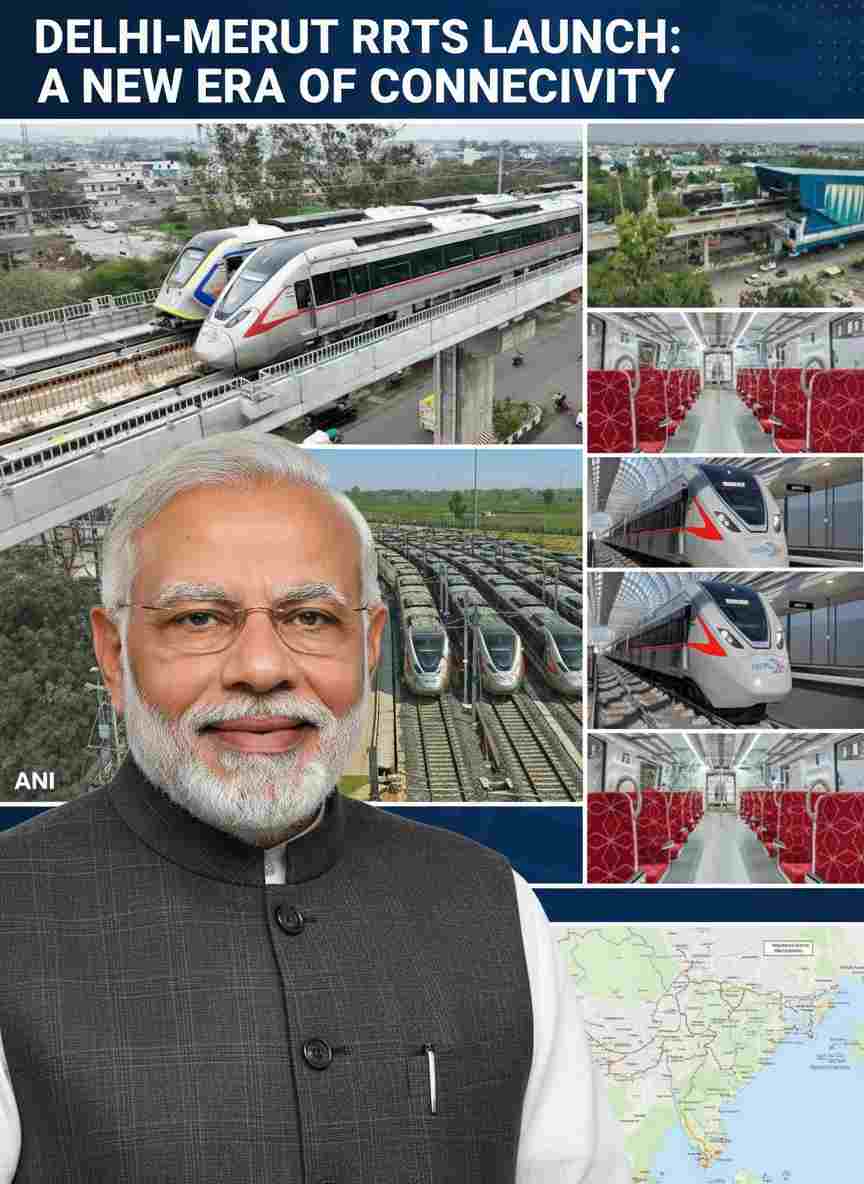
India’s Mobility Milestone:The landscape of Western Uttar Pradesh and the National Capital Region (NCR) is about to change forever. In a landmark event today, Prime Minister Narendra Modi will officially flag off the full 82-km Delhi-Ghaziabad-Meerut Regional Rapid Transit System (RRTS) and the Meerut Metro. This monumental project not only introduces India’s first high-speed regional rail but also gives Meerut the title of hosting the fastest metro system in the country.
At approximately 12:30 pm, the Prime Minister, accompanied by Uttar Pradesh Chief Minister Yogi Adityanath, will inaugurate these services from the Shatabdi Nagar Station. This launch marks the culmination of years of engineering excellence and a massive investment of over ₹12,930 crore in regional infrastructure.
India’s Mobility Milestone: The Dawn of the RRTS Era,What Is Being Commissioned?
The highlight of today’s event is the completion of the entire 82.15-km Namo Bharat corridor. While sections of the track have been operational in phases, today marks the commissioning of the final vital links:
The Delhi Stretch: A 5-km section between Sarai Kale Khan and New Ashok Nagar, bringing high-speed connectivity into the heart of the capital.
The Meerut Extension: A 21-km stretch between Meerut South and Modipuram, completing the northern tip of the corridor.
With these sections live, the Namo Bharat trains will now run seamlessly from Sarai Kale Khan in Delhi to Modipuram in Uttar Pradesh. This corridor is India’s first RRTS, a design intended to bridge the gap between traditional metros and the Indian Railways.
India’s Mobility Milestone Meerut Metro: India’s New Speed King
While the Namo Bharat handles the long-distance regional commute, the Meerut Metro is designed to revolutionize intra-city travel. Spanning 23 km, the Meerut Metro has officially become the fastest metro system in India, boasting a maximum operational speed of 120 kmph.
Infrastructure and Integration
What makes the Meerut Metro unique is its “Integrated Network” approach. In a first for India, the Metro will share tracks and infrastructure with the Namo Bharat RRTS within the Meerut section. This allows for:
Seamless Switching: Passengers can transfer between the local metro and the regional rapid rail without leaving the station premises.
Speedy Commutes: The 21-km city stretch will be covered in just 30 minutes.
Mixed Infrastructure: The 23-km corridor includes 16 km of elevated tracks and 7 km of underground tunneling to navigate the city’s dense geography.
Station Breakdown
The corridor features a total of 13 stations, strategically placed to cover the city’s commercial and residential hubs:
Elevated Stations: Meerut South, Partapur, Rithani, Shatabdi Nagar, Brahmapuri, MES Colony, Daurli, Meerut North, and Modipuram.
Underground Stations: Meerut Central, Bhaisali, and Begumpul.
The Depot: Modipuram Depot serves as an at-grade station.
Notably, four key stations—Meerut South, Shatabdi Nagar, Begumpul, and Modipuram—will serve as interchange hubs for both Namo Bharat and Meerut Metro trains.
Passenger Experience: Luxury Meets Utility
The Namo Bharat and Meerut Metro are not just about speed; they are about a “world-class” passenger experience. The Meerut Metro trains consist of three-coach sets capable of carrying over 700 passengers.
Premium Amenities
Comfort: Coaches are fully air-conditioned with cushioned seats. The layout includes both 2×2 transverse and longitudinal seating.
Technology: Every coach is equipped with USB mobile charging points, dynamic route maps, and CCTV surveillance for 24/7 security.
Safety First: Platform Screen Doors (PSD) are installed at all stations to prevent accidents. These doors are synchronized with the train’s arrival and utilize selective push-button opening to save energy.
Inclusivity: Following the “Universal Access” philosophy, there are dedicated spaces for wheelchairs and medical stretchers. Each train also features reserved seating for women and senior citizens.
Understanding the Difference: Namo Bharat vs. Meerut Metro
While they share the same tracks in Meerut, these two services cater to different needs:
Impact on Logistics and Economy
The socio-economic impact of this project cannot be overstated. By reducing the travel time between Delhi and Meerut to just 55 minutes, the corridor effectively integrates Meerut into the daily economic life of the National Capital.
Decongesting the Highways
The Delhi-Meerut Expressway has long struggled with heavy traffic. This rail corridor is expected to take thousands of private vehicles off the road, significantly reducing carbon emissions and road congestion.
Regional Growth
The project links major urban centers including Sahibabad, Ghaziabad, Modinagar, and Meerut with Delhi. This “orbital” connectivity is expected to trigger a real estate and commercial boom along the corridor, particularly in areas like New Ashok Nagar and Ghaziabad.
Timeline of a Transformation
The journey to this day has been nearly a decade in the making:
2016: The Detailed Project Report (DPR) was prepared by RITES.
2019: Prime Minister Modi laid the foundation stone on March 8, signaling the start of construction.
2025: The first successful trial run took place in January between Meerut South and Meerut Central.
Today (2026): The full 82-km corridor and the Meerut Metro are dedicated to the nation.
Beyond the Tracks: A ₹12,000 Crore Boost
The Prime Minister’s visit isn’t limited to the rail inauguration. Following the flag-off, PM Modi is scheduled to travel to Mohiuddinpur to address a massive public gathering.
During this event, he will lay the foundation stones and inaugurate various other development projects worth ₹12,930 crore. These projects cover sectors like urban infrastructure, housing, and connectivity, reinforcing the government’s commitment to “Viksit Bharat” (Developed India).
Security and Logistics
Chief Minister Yogi Adityanath has personally overseen the arrangements at Shatabdi Nagar and the public meeting venue. A multi-layered security system has been deployed across Meerut, with intensified traffic diversions in place to ensure a smooth flow for the thousands expected to attend the historic launch.
Conclusion: A New Way to Move
The inauguration of the Namo Bharat and Meerut Metro represents a paradigm shift in Indian urban planning. We are moving away from isolated city metros toward Integrated Regional Transit Systems. By combining high-speed regional travel with efficient local metro services, the government is creating a template for future developments in other metropolitan clusters like Mumbai-Pune or Bengaluru-Mysuru.
For the residents of Meerut and Delhi, the distance is no longer measured in kilometers, but in a mere 55 minutes of comfortable, high-speed rail travel.