
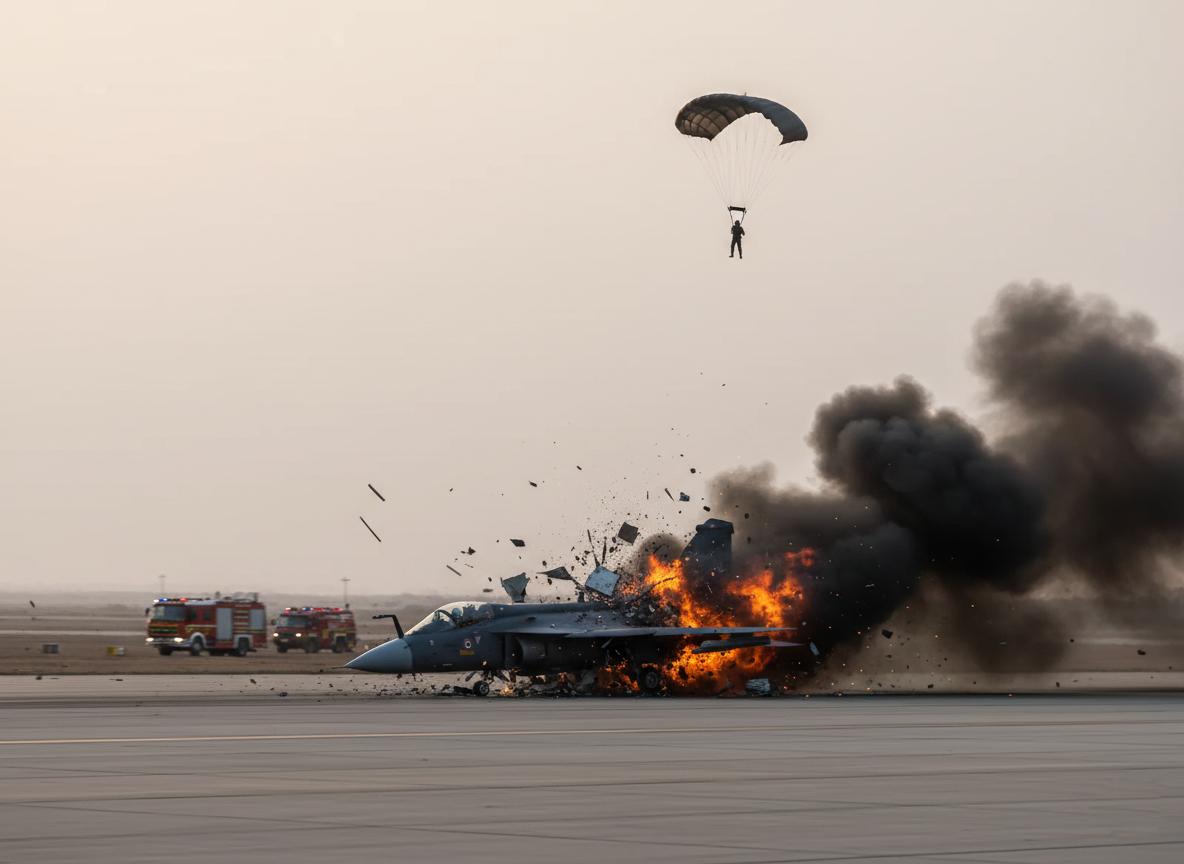
Third HAL Tejas Crash: The Indian Air Force (IAF) has faced a significant setback as a HAL Tejas Light Combat Aircraft (LCA) crashed during a routine training mission. This incident marks the third major crash involving the indigenous fighter jet within a span of three years, raising urgent questions regarding the technical reliability and maintenance protocols of India’s flagship “Aatmanirbhar Bharat” (Self-Reliant India) defense project.
Third HAL Tejas Crash: What Happened at the Airbase?
On Monday, a single-seat Tejas LCA was involved in an accident during the landing phase of a training sortie at a key Indian airbase. According to initial reports, the aircraft experienced a sudden technical malfunction mid-air, leading to a loss of control.
Pilot Safety and Aircraft Damage
The Pilot: In a display of quick thinking and the effectiveness of the aircraft’s escape systems, the pilot ejected safely before the impact. He is reported to be in stable condition with no serious injuries.
The Impact: The impact upon hitting the ground was severe, and the jet reportedly caught fire.
Status of the Jet: Sources indicate the aircraft suffered serious structural damage. The Indian Air Force has deemed the frame unserviceable and it is likely to be written off (scrapped).
A Troubling Timeline: Three Crashes in Three Years
The Tejas program, which long boasted a clean safety record since its first flight in 2001, has seen a cluster of incidents recently. This latest crash is the third occurrence in the aircraft’s history.
| Date | Location/Event | Outcome |
| March 2024 | Near Jaisalmer, Rajasthan | Crashed while returning from a firepower demonstration; pilot ejected safely. |
| November 2025 | Dubai Airshow, UAE | Crashed during an aerobatic display; tragically resulted in the death of Wing Commander Namansh Syal. |
| February 2026 | Undisclosed Airbase (Landing) | Technical fault during landing; pilot safe, aircraft destroyed. |
While the investigations into the November 2025 and February 2026 incidents are still underway or pending official statements, the frequency of these accidents has caused ripples in the defense community.
Technical and Operational Challenges
The aircraft involved in the latest crash was part of the 32 single-seat LCA Mk1 units already delivered by Hindustan Aeronautics Limited (HAL) to the IAF.
The Investigation
The Indian Air Force has immediately constituted a Court of Inquiry to determine the exact cause of the accident. Beyond the specific inquiry, the IAF has initiated a comprehensive inspection of the entire Tejas fleet to identify any systemic or fleet-wide issues that could compromise safety.
Production and Delivery Delays
This crash comes at a sensitive time for HAL. The Indian Air Force has a massive order of 180 LCA Mk1A (the more advanced variant). However, the program is currently plagued by:
Delivery Delays: The advanced Mk1A variant has missed multiple deadlines.
Reliability Questions: Repeated accidents may impact the international perception of the Tejas, which India aims to export to other nations.
Why the Tejas Remains Critical for India
Despite these setbacks, the Tejas remains the cornerstone of India’s aerial defense strategy. It is designed to replace the aging fleet of MiG-21 “Flying Coffins” and reduce India’s dependence on foreign military hardware.
Key Capabilities of the Tejas:
Multi-role Platform: Capable of air combat, ground attacks, and reconnaissance missions.
Advanced Avionics: Equipped with modern radar, electronic warfare suites, and high-performance weaponry.
Indigenous Pride: Developed by HAL, it represents India’s technological leap in aerospace engineering.
The Way Forward: Safety First
The immediate focus for the IAF and HAL will be to strengthen safety protocols. The upcoming weeks will likely see:
Technical Audits: Intense scrutiny of the fly-by-wire systems and landing gear mechanisms.
Maintenance Overhauls: Reviewing the maintenance cycles and spare parts quality provided by HAL.
Pilot Training: While the pilots have successfully used ejection systems in two out of three cases, training for emergency technical failures will be prioritized.
High-performance fighter jets inherently carry risks, but the “unserviceable” loss of another airframe adds pressure to a program already struggling with production speed. For “Aatmanirbhar Bharat” to succeed in the skies, the reliability of the Tejas must be beyond reproach.
Next Steps for Readers:
Would you like me to create a detailed technical comparison between the older Tejas Mk1 (involved in the crash) and the upcoming Mk1A variant to see what safety upgrades have been added?
Disclaimer: This information is based on various inputs from news agency.