
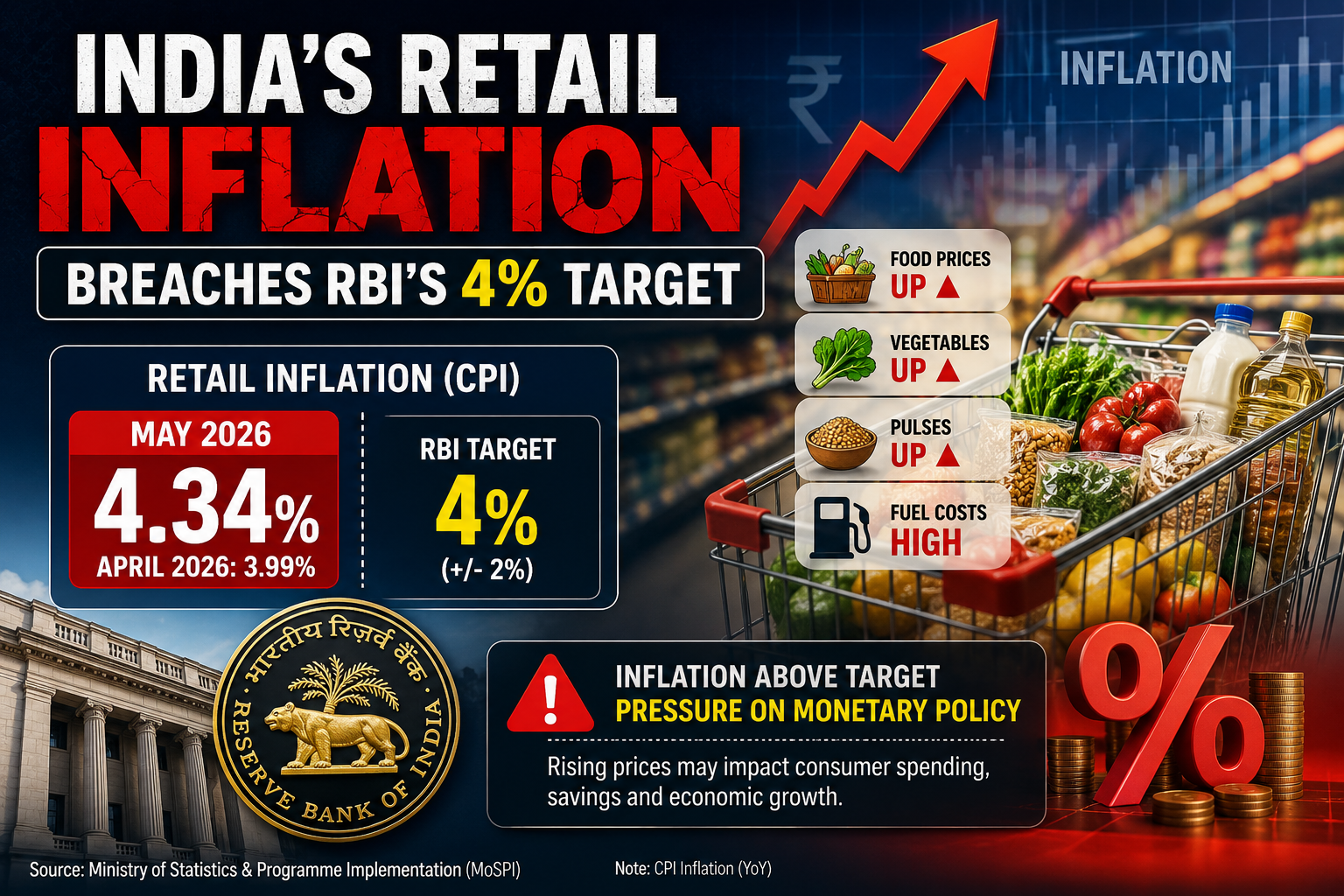
India’s retail inflation took a sharp upward turn in June 2026, hitting an 18-month high of 4.38 percent and crossing the Reserve Bank of India’s (RBI) medium-term target of 4 percent for the first time in 17 months (since December 2024).
According to fresh macro data released by the National Statistical Office (NSO), this sudden spike from May’s 3.93 percent is primarily fueled by accelerating food prices, delayed seasonal rains, and volatile global energy markets.
This print marks a critical structural milestone: it is the very first breach of the 4 percent median mark under the government’s newly introduced Consumer Price Index (CPI) series, which commenced in January with 2024 as its base year. With food prices crossing the 5 percent threshold and international geopolitical tensions escalating, domestic households are feeling the pinch while economists rapidly recalibrate their fiscal models.
The Macro Split: Rural vs. Urban Inflation
While the national headline inflation settled at 4.38 percent, a closer look at the geographical footprint reveals that rural India is bearing an unequal burden due to its direct exposure to agricultural supply shocks.
Rural CPI: Shot up to 4.74 percent (up from 4.25% in May)
Urban CPI: Managed the shock slightly better at 3.92 percent (up from 3.53% in May)
State-by-State Variations (Over 50 Lakh Population)
The inflationary impact was far from uniform across the subcontinent, showcasing heavy regional disparities:
Highest Inflation Zone: Telangana recorded the steepest rate of price rise in the country at a whopping 6.36 percent, followed closely by Andhra Pradesh and Puducherry at 5.39% each.
Lowest Inflation Zone: Mizoram offered a stark structural contrast, recording the lowest inflation rate at just 1.63 percent.
Core Drivers Behind the June Price Surge
The NSO data clearly highlights that the current inflationary wave is concentrated across three critical pillars:
1. The Heat on Food & Beverages (CFPI at 5.32%)
The Consumer Food Price Index (CFPI) jumped significantly to 5.32 percent in June, up from 4.78 percent in May, setting a fresh high for the new CPI series.
The Top Outliers: Kitchen staples and specific agricultural products witnessed severe price hikes. Ginger (+50.41%) and Tomato (+31.92%) along with Raisins/Monacca (+20.52%) were the primary drivers pulling the index upward.
The Deflationary Cushion: On the flip side, major relief came from Potatoes (-20.34%) and Peas (-9.67%), which registered negative inflation, preventing a runaway kitchen crisis.
2. The Fuel & Transport Shock (Accelerated to 4.31%)
June 2026 was the first full month reflecting the four consecutive fuel price hikes implemented by state-owned oil marketing companies in May. As a result, the Transport segment accelerated sharply to 4.31%, compared to a mild 1.75% in May. This pass-through effect is already leaking into non-food sectors, driving up overland commercial logistics costs.
3. Precious Metals & Luxury Basket (Elevated at 16.72%)
The category listed as ‘Personal care, social protection, and miscellaneous goods & services’ clocked a staggering 16.72 percent inflation rate—remaining the highest-inflation expenditure division. This was pushed to extremes by skyrocketing global bullion prices and increased import duties on luxury assets, with Silver Jewellery recording an astronomical 133.21% inflation and Gold/Diamond/Platinum at 36.82%.
Market Scorecard: Winners & Losers in June CPI
  [HIGH INFLATION OUTLIERS] ──► Silver Jewellery (133.21%) | Ginger (50.41%) | Gold/Diamond (36.82%)

[DEFLATIONARY COMFORT] ──► Potato (-20.34%) | Peas (-9.67%) | Motor Cars (-6.89%)| Top 5 High Inflation Items | Inflation Rate (%) | Top 5 Low/Negative Inflation Items | Inflation Rate (%) |
| Silver Jewellery | +133.21% | Potato | -20.34% |
| Ginger | +50.41% | Peas | -9.67% |
| Gold/Diamond/Platinum | +36.82% | Motor Cars & Jeeps | -6.89% |
| Tomato | +31.92% | Cumin (Jeera) | -3.75% |
| Raisins (Kishmish) & Monacca | +20.52% | Motorcycles & Scooters | -3.49% |
Projections: What Lies Ahead for July and Beyond?
Top economic research firms believe that retail prices will continue their upward trajectory through the next quarter, putting the central bank on high alert.
ICRA: Food Pressures to Intensify
Aditi Nayar, Chief Economist at ICRA, points out that early tracking data for July 2026 shows no signs of cooling down:
“In addition to food items, the non-food component may also exert pressure on the headline CPI print in the month, partly owing to the passthrough of higher fuel prices into prices of other items.”
India Ratings (Ind-Ra): July Heading Toward 4.9%
Megha Arora, Director at India Ratings and Research, expects headline inflation to hit 4.9 percent in July 2026. She warned that ongoing geopolitical friction in West Asia and lingering El Niño/monsoon delays pose substantial upside risks.
Crisil: Broad-Based Firming Up
Dipti Deshpande, Senior Director and Principal Economist at Crisil, emphasized that the temporary disinflationary relief from earlier GST rationalization measures has ended. Crisil projects that headline CPI inflation will average 5.1 percent for the entire fiscal year 2026-27, a massive jump from the historic low averages recorded in the previous fiscal year.
The Reserve Bank of India’s (RBI) Next Move
The RBI operates under a strict parliamentary mandate to maintain CPI inflation at a median of 4 percent, with a flexible tolerance band of 2% to 6%. Having already revised its FY27 inflation projection upward to 5.1% (from 4.6%) in its previous cycle, the central bank faces a complex challenge.
Status Quo Expected at August MPC (Aug 3–5)
No Immediate Rate Cuts: With inflation hitting 4.38% and threatening to cross 4.9% in July, any hopes of immediate interest rate cuts are officially off the table.
Rate Hike Risk on the Horizon: Institutional economists note that if the West Asia conflict creates a prolonged oil supply shock, a backloaded rate hike of 25–50 bps later in the fiscal year cannot be ruled out to protect capital outflows.
Monsoon Watch: The Monetary Policy Committee (MPC) will likely maintain a strict “wait and watch” status quo in August, tracking the distribution of rainfall across agricultural belts.
Summary of Data Quality
The CPI data compiled by the NSO reflects a 100% response rate, pulling real-time price inputs from 1,407 selected urban markets (including modern e-commerce platforms) and 1,465 rural villages spanning all States and UTs, ensuring absolute grassroots accuracy.