
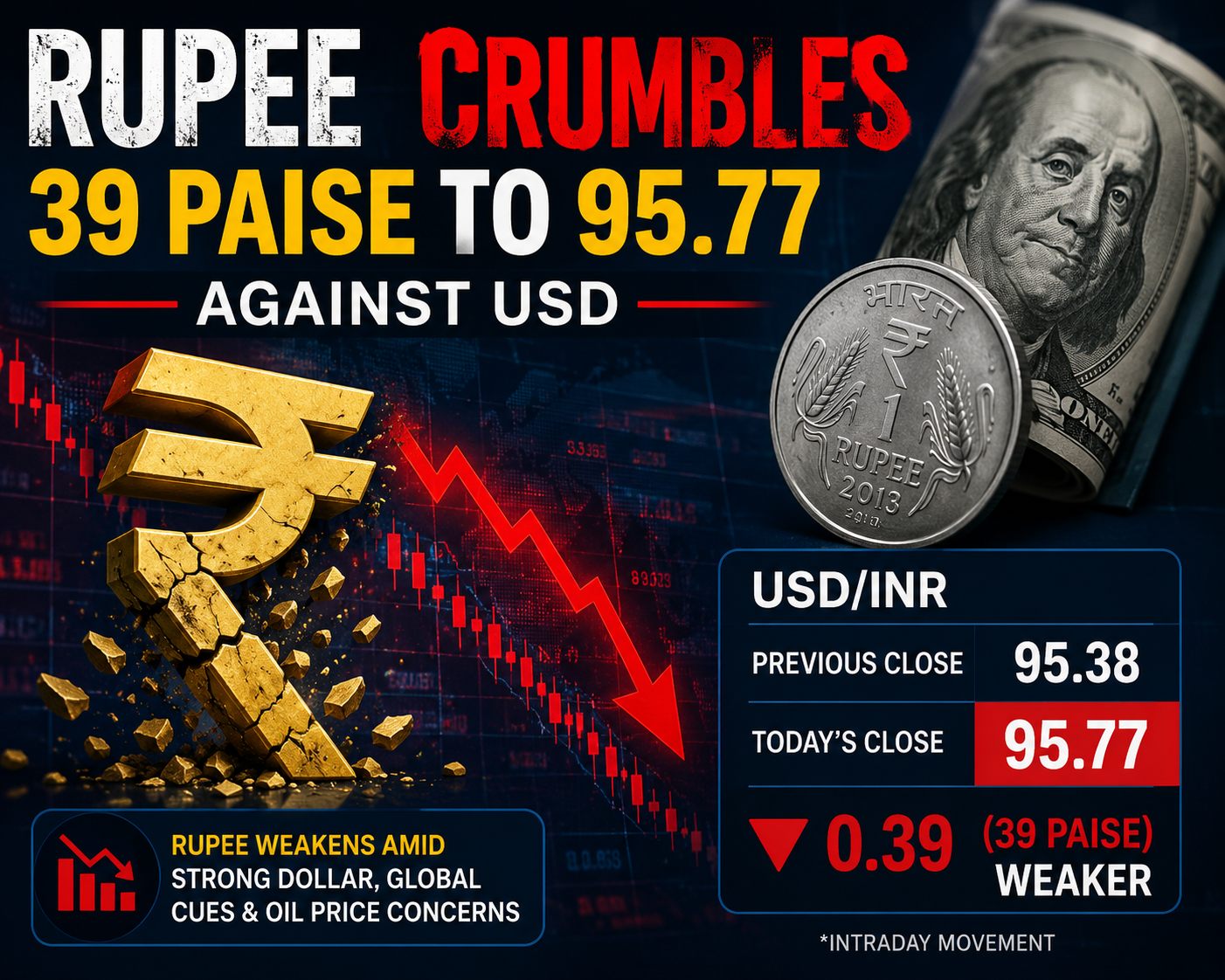
The Indian rupee faced brutal selling pressure on Monday morning (July 13, 2026), plunging heavily during early trading sessions as a major military escalation in the Middle East rattled international financial markets. Geopolitical anxieties peaked over the weekend, triggering a widespread risk-off sentiment across emerging market assets, with the Indian currency bearing the brunt of the impact.
The primary catalyst behind this sudden market collapse was Iran’s official declaration shutting down the highly critical Strait of Hormuz shipping corridor. For India, the world’s third-largest crude consumer, any logistical hurdle in this major maritime energy choke point directly translates to severe macroeconomic turbulence. Monday’s early performance put an immediate end to the modest recovery the domestic unit had recorded at the end of last week.
The Early Trade Breakdown: Tracking the Rupee’s Intraday Drop
On Monday morning, the USD/INR spot rate shed 39 paise in opening sessions, sliding to 95.77 against the American greenback. The interbank market opened on a highly panicked note, reflecting global risk aversion that escalated over Sunday night.
Monday Morning Open: 95.72
Intraday Low (Early Sessions): 95.77
Loss vs. Previous Close: 39 Paise
This sudden decline completely reversed the positive momentum witnessed during the closing hours of last week. On Friday, July 10, 2026, the domestic currency had managed a subtle gain of 9 paise to settle at 95.38 against the US dollar.
While initial market expectations had pegged a weaker opening near the 95.53 levels, aggressive safe-haven dollar buying by corporations and state-run banks quickly pushed the spot rate closer to the 95.80 mark within the first few hours of trade.
Strait of Hormuz Blockade Sends Brent Crude Beyond $79
The geopolitical landscape fractured further over the weekend, driving international energy prices exponentially higher. Brent crude, the global benchmark for oil pricing, spiked by more than 4% on Monday morning, comfortably cruising past the $79 mark to touch an early futures peak of $79.25 per barrel.
[US Air Strikes on Iranian Positions]
                 │
                 ▼ (Retaliation)
[Iran Expands Missile/Drone Waves to Gulf States & UAE]
                 │
                 ▼ (Choke Point Blockade)
[Official Shutdown of the Strait of Hormuz]
                 │
                 ▼
[Brent Crude Spikes +4.05% to $79.25 / Rupee Drops 39 Paise]
The underlying drivers of this alarming energy spike stem from aggressive military moves in the Persian Gulf region:
The Shipping Blockade: Tehran’s announcement to completely block the Strait of Hormuz has raised fears of total maritime gridlock for energy vessels traveling out of the Middle East.
Expanded Missile Attacks: On Sunday, Iranian forces widened their military scope, deploying a wave of missile and drone strikes targeting strategic assets across various Gulf states, including the United Arab Emirates (UAE).
The Escalation Loop: This military push was executed as direct retaliation against previous strategic air strikes conducted by the United States military against Iranian positions.
Expert Analysis: “Fears of Major Crude Disruption Are Back”
Financial experts and treasury advisors are warning that a prolonged blockade of the trade corridor could alter standard market pricing systems, hurting major importers like India through sustained capital outflows.
Anil Kumar Bhansali, Head of Treasury and Executive Director at Finrex Treasury Advisors LLP, provided a sharp perspective on the unfolding currency trends this Monday morning:
“The renewed fighting between the US and Iran revived fears of a major disruption to global Crude supplies. Brent oil prices rose by more than 4 per cent this Monday morning rising to USD 79.25 per barrel as Iran announced the closure of the Strait of Hormuz. The latest rally came after Iran on Sunday expanded missile and drone attacks to Gulf states and the UAE in retaliation for US strikes.”
With global oil supplies threatened, international asset managers are swiftly liquidating riskier Asian assets and pivoting toward safe-haven instruments, giving a massive boost to the value of the greenback.
The Double Shock: Dollar Index Rises as Dalal Street Crashes
The currency market did not bleed in isolation. A severe dual-front pressure hit the local financial sector as global dollar strength grew and domestic equity benchmarks fell off a cliff within minutes of the opening bell.
The Dollar Index, which evaluates the greenback’s relative strength against a core basket of six major global currencies, advanced by 0.17%, climbing to a steady 101.12 level.
Simultaneously, panicked institutional liquidations hit blue-chip stocks across energy, banking, and IT sectors on Dalal Street:
| Indian Stock Index | Early Session Drop | Trading Level |
| BSE Sensex | Tanked 616.15 points | 76,946.97 |
| NSE Nifty | Dropped 190.50 points | 24,015.00 |
This aggressive equity crash completely offset the positive sentiment generated on Friday, July 10, when Foreign Institutional Investors (FIIs) acted as net buyers, infusing ₹2,603.72 crore into the domestic capital markets. Sunday’s geopolitical flare-up successfully neutralized that institutional optimism, replacing it with systemic caution.
Silver Lining: India’s Forex War Chest Hits an All-Time High
Despite the immediate currency depreciation and stock market pain, India’s macro stability is backed by a phenomenal financial shield. Fresh data released by the Reserve Bank of India (RBI) provides a major confidence boost regarding the country’s defensive capabilities against speculative currency runs.
On Friday, July 10, 2026, the central bank announced that India’s foreign exchange reserves surged by a massive USD 7.26 billion, lifting the total national forex war chest to an impressive all-time high of USD 674.193 billion for the week ended July 3.
Previous Reporting Week: $666.933 Billion (Dropped $5.654B)
Latest Reporting Week: $674.193 Billion (Gained $7.260B – Historic High)
This strong recovery in national reserves follows a difficult prior week where the kitty had depleted. The current record reserve level gives the RBI immense financial power to actively intervene in the interbank market, allowing it to supply dollars directly to state-run banks if the local currency experiences an unorderly or erratic spiral down toward the 96.00 mark.
Long-Term Economic Impact on Indian Trade
If the blockade at the Strait of Hormuz continues for an extended period, the macroeconomic strain on India will likely show up across three major structural channels:
Widening Current Account Deficit (CAD): Elevated crude oil values drastically inflate India’s import bills, demanding a higher volume of outbound dollars and mechanically keeping the local currency under structural depreciation pressure.
Elevated Domestic Logistics Costs: High oil prices quickly impact local supply chains, raising the baseline costs of commercial freight, shipping, and overland transport. This trend can fuel structural retail inflation.
Speculative Dollar Hoarding: Anticipating further drops in the currency value, corporate importers often accelerate their upcoming dollar bookings while exporters tend to hold onto foreign collections, worsening short-term liquidity on forex desks.
Summary and Outlook
The short-term trend for the Rupee USD exchange rate remains completely dependent on the military and diplomatic developments occurring around the Persian Gulf. While the Reserve Bank of India has built a phenomenal financial cushion with its historic $674 billion foreign exchange reserve kitty, it cannot entirely shield the economy from a sustained global energy shock.
Traders and corporate treasuries are highly advised to avoid unhedged foreign currency exposures over the coming days, as any further aggressive rhetoric from either Washington or Tehran could instantly spark another wave of extreme volatility before the weekend.