
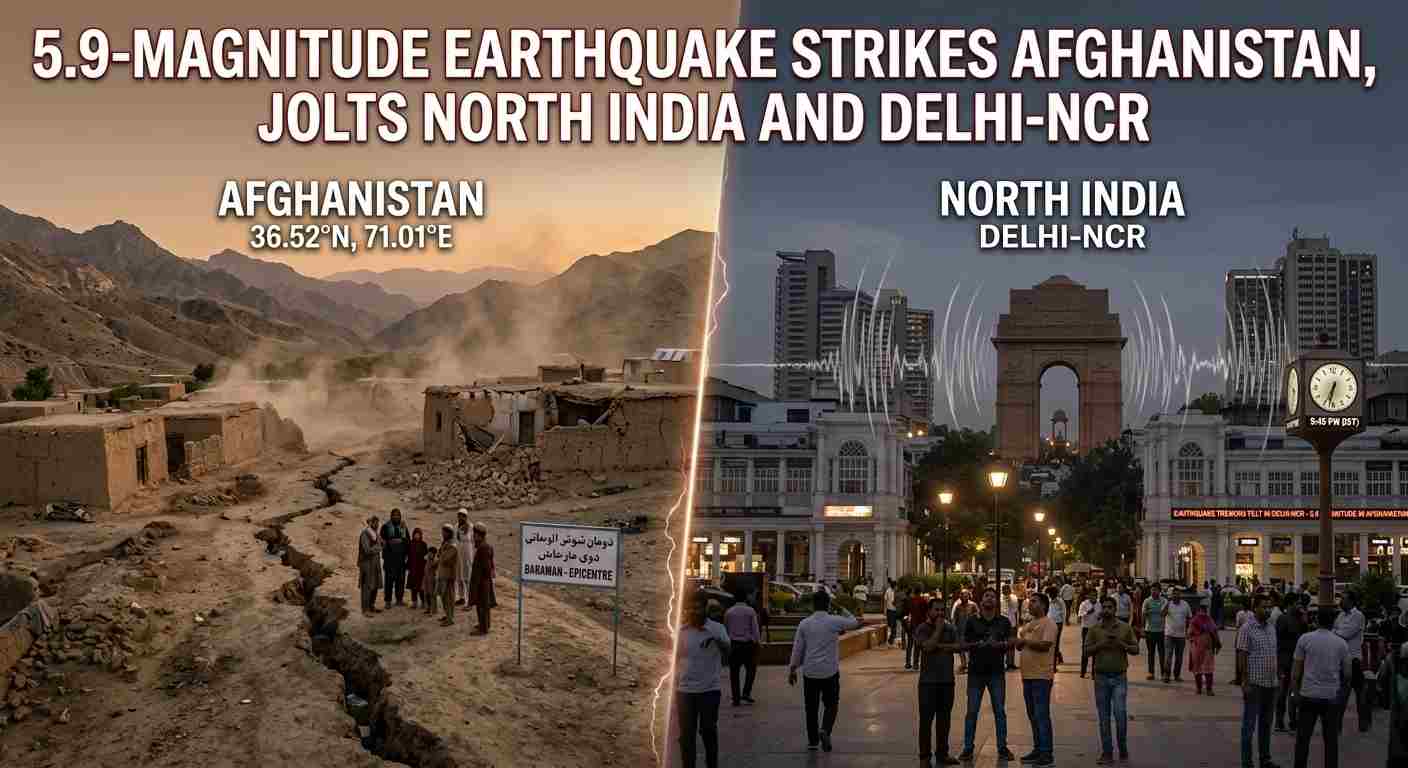
NEW DELHI –Earthquake Strikes: Residents across Northern India were jolted out of their evening routines on Friday, April 3, 2026, as a powerful 5.9-magnitude earthquake struck Afghanistan, sending significant tremors across the Indian subcontinent. The seismic event, which occurred late in the evening, caused brief panic in the Delhi-National Capital Region (NCR), Jammu and Kashmir, Punjab, and Haryana.

According to the National Centre for Seismology (NCS), the earthquake struck at approximately 9:46 PM IST. The epicenter was identified near Darawan, Afghanistan, at a significant depth of 175 kilometers. This depth is a critical factor in why the tremors were felt so far away from the source; deep-seated earthquakes allow seismic waves to travel greater distances with less surface destruction at the immediate epicenter.
The Night of the Shakes: Eyewitness Accounts
Midnight Tremors: 5.9-Magnitude Earthquake Strikes Afghanistan, Jolts North India and Delhi-NCR In the high-rise apartments of Noida and Gurgaon, the tremors were felt acutely. Social media was quickly flooded with videos of swaying chandeliers, rattling ceiling fans, and water rippling in glasses.
Delhi: “I was sitting in my room when I felt the bed shaking. When I looked up, the fan was swaying visibly,” said a resident of South Delhi. “By the time I reached the balcony, I saw neighbors gathering outside, all looking equally startled.”
Chandigarh: Baldev Chand, a resident living on the second floor of a flat, described the sensation as a “strong, singular jolt” that lasted for several seconds.
Punjab: In Zirakpur, residents of an 11-story society considered rushing down the stairs. “The tremors were long enough to make us realize it was an earthquake, but luckily they stopped before we had to start a full-scale evacuation,” reported Ajay Kumar.
In Srinagar, the capital of Jammu and Kashmir, the proximity to the Hindu Kush region meant the shaking was more intense. While no structural damage was immediately reported, the psychological impact was evident as people rushed out into the streets despite the chilly night air.
A Double Whammy: Dust Storms and Seismic Shocks
The earthquake adds to a day of chaotic environmental conditions for the national capital. Earlier on Friday, Delhi-NCR was hit by a massive dust storm followed by light rainfall and thunderstorms. The India Meteorological Department (IMD) had already issued an Orange Alert for several sectors, including New Delhi, South, and Central Delhi.
The sudden shift in weather—characterized by wind speeds reaching up to 70 km/h—had already put the city on edge. The seismic tremors occurring just as the dust settled felt like a cruel “double whammy” for the city’s 30 million residents.
Seismic Analysis: Why Afghanistan?
Afghanistan sits at the complex intersection of the Indian and Eurasian tectonic plates. This region, particularly the Hindu Kush mountain range, is one of the most seismically active zones in the world. The ongoing collision of these plates creates immense pressure that is released periodically in the form of earthquakes.
The “Mild” Trend in 2026
This marks the second notable seismic event felt in the capital this year. In January 2026, a localized 2.8-magnitude earthquake centered in North Delhi caused brief tremors. While that event was minor and shallow (5 km deep), Friday’s quake was far more powerful, though mitigated by its extreme depth in the Afghan soil.
Safety Protocols and Government Response
As of midnight, there have been no reports of casualties or major property damage in India. However, the National Disaster Management Authority (NDMA) has advised residents in high-rise buildings to remain vigilant and review their earthquake safety drills.
Key Safety Tips for High-Rise Residents:
Drop, Cover, and Hold On: Stay away from windows and glass partitions.
Do Not Use Elevators: Always use the stairs during an evacuation.
Check for Gas Leaks: After tremors subside, ensure no gas lines are ruptured before lighting stoves.
The IMD maintains its Yellow Alert for Saturday, predicting continued thunderstorms and lightning, with temperatures expected to hover around a maximum of 33°C.
As the dust literally and figuratively settles on this eventful Friday, the dual reminder of nature’s power—both from the sky and the ground—serves as a wake-up call for the region’s disaster preparedness.