
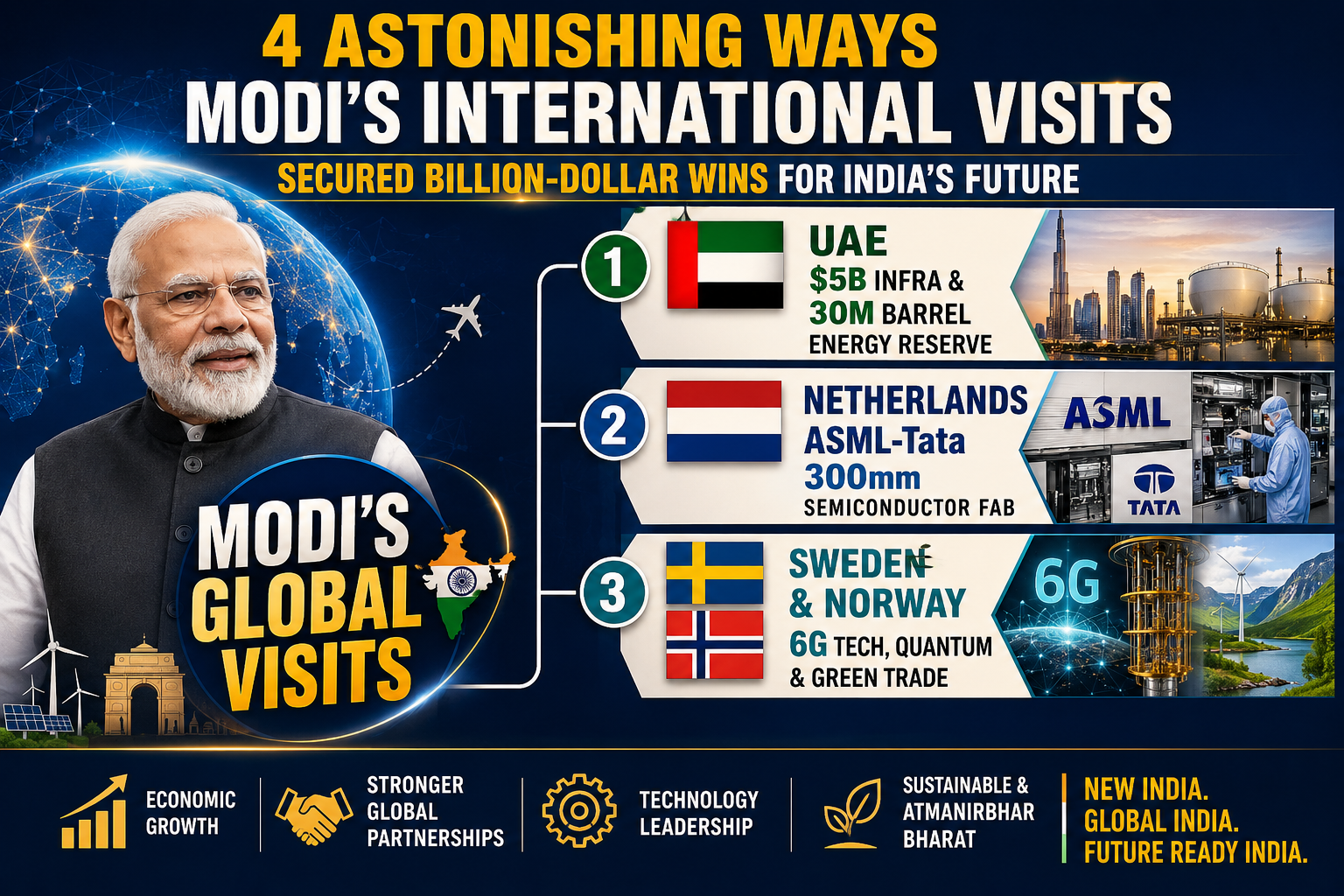
Modi’s international visits have transitioned from standard diplomatic courtesy calls into hyper-efficient economic accelerators for the country. In an increasingly fragmented global landscape, India is positioning itself not just as a participant, but as a primary architect of the new world order. Recent high-profile state visits by Prime Minister Narendra Modi to the United Arab Emirates (UAE), the Netherlands, Sweden, and Japan have yielded a massive wave of high-value outcomes. These trips have unlocked critical technological advancements, brought home billions of dollars in foreign direct investment (FDI), and dramatically elevated India’s geopolitical standing.
From massive semiconductor fabrication setups in Gujarat to strategic oil reserves and elite global honors, these diplomatic tours represent a calculated masterclass in economic statecraft. Here is a deep dive into how these strategic international partnerships are reshaping India’s economic, technological, and cultural trajectory.
1. The UAE Partnership: Fortifying India’s Energy Security and Infrastructure
The relationship between New Delhi and Abu Dhabi has evolved into one of India’s most dependable strategic alliances. During Prime Minister Modi’s recent engagements in the United Arab Emirates, the bilateral talks translated into monumental, concrete agreements aimed at securing India’s core infrastructure and energy needs.
High-Value Infrastructure Influx
The UAE has committed a massive $5 billion infrastructure investment targeted directly at accelerating India’s internal logistical capabilities. This capital injection is designed to modernize ports, build high-speed freight corridors, and optimize supply chains across major Indian industrial zones. By tying UAE sovereign wealth funds directly to Indian infrastructure, the government is ensuring long-term liquid capital backing for nationwide developmental projects.
Establishing the 30-Million-Barrel Strategic Oil Reserve
Energy security remains a primary focus of India’s macroeconomic planning. In an era marked by volatile global crude markets and geopolitical vulnerabilities in eastern Europe and the Middle East, Prime Minister Modi successfully finalized an agreement to establish a 30-million-barrel strategic oil reserve. This project provides India with a critical cushion against supply-chain shocks.
Complementing this reserve are newly signed long-term Liquefied Natural Gas (LNG) supply agreements. These pacts ensure that India’s expanding industrial sector will have a stable, uninterrupted supply of cleaner energy for decades, significantly reducing vulnerability to sudden global price spikes.
2. The Netherlands: Launching India’s Semiconductor Revolution
For decades, India has been a global powerhouse for software development, yet it remained heavily reliant on foreign imports for physical hardware and microchips. Prime Minister Modi’s strategic stop in the Netherlands has systematically altered this dynamic, turning India into an emerging semiconductor powerhouse.
The Historic ASML and Tata Semiconductor Deal
The most technologically significant outcome of the Netherlands tour was the signing of a monumental agreement between Dutch semiconductor giant ASML and India’s Tata Group. ASML holds a near-monopoly on the world’s most advanced lithography machines, which are critical for printing microchips.
| Metric / Feature | Details of the Semiconductor Deal |
| Primary Partners | ASML (Netherlands) & Tata Group (India) |
| Plant Location | Gujarat, India |
| Plant Capacity/Type | First 300mm Semiconductor Fabrication Plant |
| Strategic Goal | Reduce silicon dependency on East Asia; establish global microchip hub |
This agreement paves the way for building India’s first 300mm semiconductor fabrication plant in Gujarat. Rather than merely assembling imported components, India will now possess the capability to manufacture high-end silicon wafers domestically. This move positions the nation as a highly competitive alternative in the global microchip manufacturing landscape, mitigating supply risks linked to East Asian concentration.
The Return of the Chola Dynasty Copper Plates
Beyond deep economic ties, the visit to the Netherlands highlighted a profound element of cultural diplomacy. Through bilateral negotiations, the Dutch government formally returned a set of 11th-century Chola dynasty copper plates to India.
The return of these ancient artifacts was celebrated across India as a significant victory for cultural heritage restoration. It underscores a growing global trend where India’s economic leverage is effectively utilized to reclaim historical treasures lost or displaced during previous centuries.
3. Sweden and Norway: Pioneering Next-Gen Telecommunications and Quantum Research
As Northern Europe becomes an increasingly vital cluster for deep-tech innovation, Prime Minister Modi’s diplomatic focus turned toward Sweden and Norway to secure collaborative breakthroughs in foundational future technologies.
Upgrading 6G and Quantum Capabilities with Sweden
In Sweden, high-level dialogues focused heavily on telecommunication resilience and frontier physics. While India is still scaling its domestic 5G network infrastructure, the government is already looking toward the next decade. The agreements signed in Stockholm establish structured, collaborative frameworks for 6G research and development, ensuring Indian scientists and engineers are co-authoring the global standards for next-generation connectivity.
Furthermore, Sweden and India are expanding joint ventures in quantum technologies. These initiatives will fund cross-border research teams working on quantum computing, secure cryptographic networks, and advanced materials science, keeping Indian tech infrastructure insulated against evolving cyber threats.
Diplomatic Accolade: The Royal Order of the Polar Star
In recognition of his consistent efforts to bridge the geopolitical and economic gaps between India and the Nordic regions, Prime Minister Modi was awarded Sweden’s prestigious ‘Royal Order of the Polar Star, Degree Commander Grand Cross’.
This momentous accolade is a major diplomatic milestone, bringing his overall tally to 31 international honors. Such high-level recognition reflects India’s rising global influence and highlights how foreign capitals view New Delhi as an indispensable partner for future stability.
[Global Honors Tally]
PM Narendra Modi: 31 International Accolades
Meant to signal India's rising geopolitical weight and diplomatic influence.
Expanding Trade with Norway
Parallel to the Swedish engagements, Prime Minister Modi held critical sessions with his Norwegian counterpart, Jonas Gahr Støre. These discussions centered primarily on enhancing bilateral trade, maritime investments, and pioneering sustainable green technologies. Norway’s vast expertise in deep-sea engineering and renewable energy grids provides India with a direct technological roadmap to meet its ambitious climate goals while sustaining high industrial growth.
4. Japan: A $68 Billion Commitment to Infrastructure and Lunar Exploration
The Indo-Pacific region is the heart of 21st-century geopolitics, and the partnership between India and Japan forms its foundational anchor. Prime Minister Modi’s interactions with Japanese leadership have reinforced this alliance with massive financial backing and historic scientific collaboration.
The Decadal $68 Billion Investment Framework
Japan has officially committed an extraordinary $68 billion investment package for India over the next decade. This massive capital layout is strategically earmarked for heavy infrastructure development, urban transformation, and clean energy transitions across India’s industrial corridors.
A substantial portion of this funding continues to drive the iconic Mumbai-Ahmedabad High-Speed Rail Project. This bullet train corridor serves as a testbed for transferring advanced Japanese Shinkansen engineering directly into Indian domestic systems, creating a brand-new ecosystem of skilled engineers and manufacturing sub-industries within India.
To the Moon and Beyond: The Chandrayaan-5 Mission
The India-Japan partnership extends well beyond earth’s atmosphere. Building on the historic success of India’s recent lunar landings, the Indian Space Research Organisation (ISRO) and the Japan Aerospace Exploration Agency (JAXA) have unified their efforts for the upcoming Chandrayaan-5 lunar mission.
This joint scientific venture combines Japan’s advanced rover and landing technologies with India’s highly efficient launch capabilities and payload engineering. Chandrayaan-5 aims to explore the ultra-complex, permanently shadowed regions near the lunar south pole, searching for volatile water ice and charting critical data for future deep-space human colonization.
The Strategic Anatomy of Modern Indian DiplomacyWhen analyzing these visits together, a distinct pattern emerges. Indian foreign policy under Prime Minister Modi has evolved away from ideological non-alignment toward pragmatic, multi-aligned strategic partnerships.
                       ┌──► UAE ($5B Infra & 30M Barrel Energy Reserve)
                       │
                       ├──► NETHERLANDS (ASML-Tata 300mm Semiconductor Fab)
MODI'S GLOBAL VISITS ──┤
                       ├──► SWEDEN & NORWAY (6G Tech, Quantum & Green Trade)
Instead of relying on a single superpower or geopolitical bloc, India is deliberately weaving a complex web of global dependencies that benefit its domestic economy:
It secures capital from the liquidity-rich Middle East (UAE).
It acquires manufacturing secrets from Western Europe’s tech leaders (The Netherlands).
It co-develops future communication architectures with the Nordic states (Sweden).
It locks down deep-tech manufacturing and space exploration infrastructure with key Asian allies (Japan).
This multi-faceted approach ensures that regardless of shifts in global political alignments, India maintains access to capital, energy, and technology.
Conclusion: Driving Tangible Outcomes for Everyday Progress
The true success of modern international relations is measured by how effectively foreign policy translates into domestic economic progress. Through Modi’s international visits, India has successfully turned diplomatic alignment into high-paying manufacturing jobs, robust energy security networks, and generational technological leaps.
From the creation of the upcoming semiconductor hub in Gujarat to deep-space exploration and billions in infrastructure funding, these high-value outcomes lay a solid foundation for India’s long-term growth. As these international agreements take physical shape over the coming decade, they will continue to elevate India’s position, securing its place as an undeniable global economic superpower.
Disclaimer: This information is based on various inputs from news agency.