
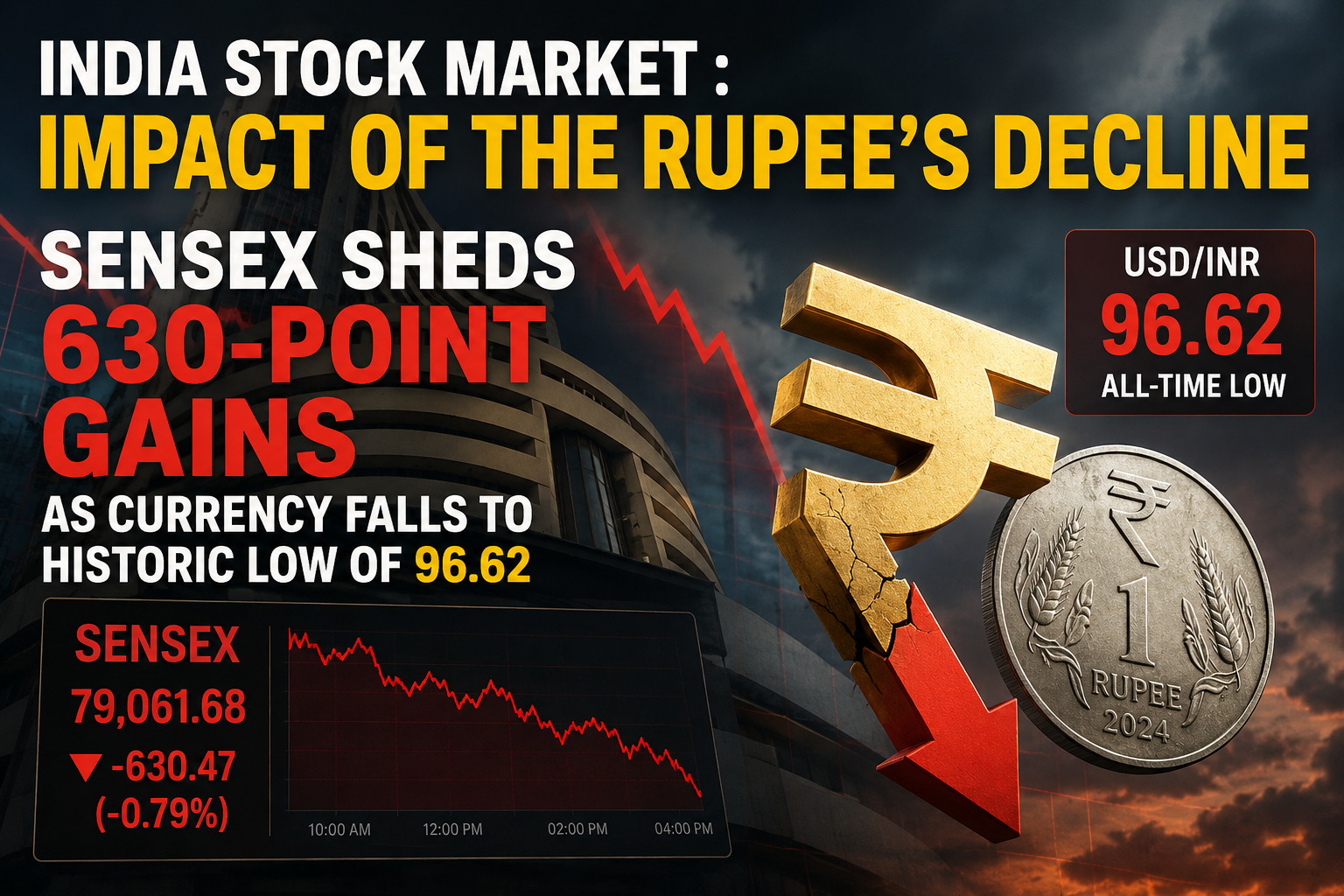
The India Stock Market equity benchmarks suffered a sudden and dramatic reversal during afternoon trade on Tuesday, May 19, 2026. What initially looked like a comprehensive market rally transformed into a cautionary tale of macroeconomic pressures. The benchmark BSE Sensex collapsed by more than 630 points from its intraday peak, while the NSE Nifty50 gave up its crucial psychological defenses to settle in negative territory.
The primary culprit behind this abrupt afternoon U-turn was the intense currency market volatility, as the Indian Rupee plunged to a historic intraday low against the US Dollar. Coupled with stubbornly elevated global crude oil prices and lingering geopolitical uncertainties in West Asia, the sudden currency depreciation completely spooked domestic institutional investors, prompting a massive wave of risk-off selling across interest-rate-sensitive banking and financial services shares.
The Closing Market Scorecard
Despite a highly positive opening session where heavy buying in export-driven software stocks pushed the indices near record territories, the final hour of trading locked down a negative close across front-line indices.
| Index / Gauge | Final Closing Value | Absolute Point Change | Percentage Change | Intraday High | Intraday Low |
| BSE SENSEX | 75,200.85 | 🔻 -114.19 | -0.15% | 75,746.27 | 75,116.00 |
| NSE NIFTY50 | 23,618.00 | 🔻 -31.95 | -0.14% | 23,782.30 | 23,587.00 |
| NIFTY BANK | 50,890.40 | 🔻 -284.10 | -0.55% | Firm Morning | Late Session Drag |
| NIFTY PRIVATE BANK | 24,112.15 | 🔻 -179.80 | -0.74% | Sector Laggard | Under Pressure |
| NIFTY MIDCAP 100 | 61,022.00 | 📈 +548.20 | +0.91% | Outperformed | Positive Breadth |
| NIFTY SMALLCAP 100 | 17,863.55 | 📈 +206.80 | +1.17% | Robust Buying | Positive Breadth |
Analysis of Intraday Reversals Occurring in the Final Phase of the Session
The trading day began on a highly constructive note. Emboldened by a solid three-day compounding rally across technology names, the Nifty50 smoothly climbed to an intraday high of 23,782.30, while the Sensex scaled up to 75,746.27, gaining well over 0.5%.
Nifty50 Intraday Volatility Curve:
Morning High: 23,782.30 ---> Afternoon Low: 23,587.00 (A sharp 195-point slide)
However, as European markets opened to mixed cues and domestic currency dealers reported unprecedented structural weakness in the interbank forex market, the positive momentum vanished. The Sensex aggressively shed 630 points from its high water mark, testing an intraday low near 75,116 before ending the session flat with a distinct negative bias.
Three Key Macro Triggers Behind the Market Sell-Off
Market analysts and treasury heads highlighted three interconnected global and domestic factors that abruptly altered the market’s trajectory in the second half of the session.
1. The Rupee Becomes Asia’s Worst-Performing Currency
The single biggest shockwave came from the currency desk. The Indian Rupee fell off a cliff in afternoon trade, tumbling to an unprecedented historic intraday low of 96.62 against the US Dollar.
Rupee Depreciation Metric (May 2026):
[Month-to-Date Drop: 1.5%] ---> [Year-to-Date Depreciation: Over 7%]
Result: Historic low of 96.62/$ establishing the Rupee as Asia's lagging currency.
A variety of factors—including a widening trade deficit, aggressive defensive greenback hedging by oil importing companies, and global fund managers reallocating capital to safe-haven dollar assets—have combined to make the Rupee Asia’s worst-performing currency in 2026.
2. Crude Oil Shock Tightens Fiscal Margins
Sustained geopolitical vulnerabilities and drone strikes targeting critical energy infrastructure in the Middle East have kept global Brent crude oil prices highly elevated. For an economy like India, which structurally relies on imports for more than 80% of its national fossil fuel consumption, a weaker currency combined with high oil prices is a double whammy. It drives imported inflation higher and threatens to delay anticipated monetary easing cycles by the Reserve Bank of India (RBI).
3. The Sudden Volatility Spike (India VIX)
Reflecting the afternoon anxiety on institutional trading floors, the market’s core volatility gauge, India VIX, edged higher during the reversal, hovering around the 19.80 mark. This persistent elevation shows that while retail investors remain active in broader markets, institutional traders are actively paying premium rates to hedge their portfolios against sudden downside risks.
Sectoral Tug-of-War: IT Surges While Private Banks Bleed
The underlying data revealed a massive structural divergence between sectors. The market effectively split into two distinct halves: export-driven companies that benefit from a stronger dollar, and domestic financial firms that bear the brunt of local currency depreciation.
The IT Sector Shield: A Natural Forex Hedge
The star performer of the day was undoubtedly the NIFTY IT index, which surged a massive 3.23% to mark its third consecutive session of gains. When the Rupee falls against the greenback, Indian software companies enjoy an immediate translation gain on their balance sheets, since they invoice the vast majority of their global clients in US Dollars.
Infosys led the front-line index contributors, surging 4.57% to settle at the top of the Nifty50 leaderboard.
HCL Technologies advanced strongly by 2.91%.
Tech Mahindra added 2.59% to its market valuation, continuing its post-earnings momentum.
Tata Consultancy Services (TCS) gained 2.05%, providing vital index support that prevented a deeper market correction.
Private Banking and Financials Suffer Deep Cuts
Conversely, banking and credit institutions faced intense institutional offloading. A weakening currency raises fears of tighter systemic liquidity and higher borrowing costs.
The NIFTY Private Bank index slid 0.74%, emerging as the leading drag on the broader market. Banking titan Kotak Mahindra Bank plunged 2.40% to finish as the top loser within the NIFTY50 index. Other heavyweight domestic consumption and banking counters followed suit, with luxury retailer Titan Company shedding 1.79% and cement major UltraTech Cement dropping 1.78%.
markets are challenging the large-cap slowdown.
In a reassuring sign for retail investors, mid-cap and small-cap stocks completely ignored the weakness in the front-line benchmarks, substantially outperforming their larger peers.
The NIFTY Midcap 100 index gained 0.91% to finish at 61,022, supported by strong buying in specialized technology and consumer names like KPIT Technologies (+5.34%) and Coforge (+4.73%). However, pipeline giant Astral Limited corrected sharply by 6.58%, giving up its post-earnings gains due to heavy institutional profit-booking.
The NIFTY Smallcap 100 index advanced by 1.17% to close at 17,863.55. Market breadth remained decisively positive, with 2,152 stocks finishing in the green against 1,109 decliners on the National Stock Exchange.
Major Corporate News Movers
1. Triveni Turbine Rockets 8.6% on Blockbuster Export Revenue
Shares of industrial engineering company Triveni Turbine surged as much as 10% before closing 8.61% higher at ₹655, reacting to an exceptional set of fourth-quarter corporate earnings declared late Monday.
Triveni Turbine Q4 Financial Snapshot:
• Net Profit   : ₹102 Crore (📈 Up 8.5% YoY from ₹94 Crore)
• Core Revenue : ₹680 Crore (🚀 Up 26% YoY — Historical High)
• Export Share : 👑 58% of Total Top-Line Realization (Grew 30.1% YoY)
The company’s performance was supercharged by its massive global footprint, with international exports accounting for 58% of its entire revenue mix. This strong export profile provided an organic shield against domestic currency fluctuations, attracting significant institutional volume.
2. Dhanuka Agritech Surges 14.9% on Share Buyback Announcement
Agrochemical player Dhanuka Agritech witnessed explosive buying interest, with its stock price skyrocketing 14.9% to touch an intraday peak of ₹1,248. The massive price surge was triggered after the company’s board officially approved an aggressive equity share buyback program. This capital return initiative was paired with a fresh dividend recommendation and a resilient set of Q4 FY26 earnings, making it a favorite among high-net-worth individual (HNI) traders.
India Stock Market Technical Outlook: Crucial Nifty Levels to Watch
From a technical perspective, the daily candlestick chart reveals a prominent “shooting star” or long upper shadow pattern. This formation typically indicates substantial selling pressure at higher zones, showing that short-term traders are actively using market extensions to book profits.
Nifty50 Technical Grid for Wednesday:
[Immediate Support: 23,550] <--- [Pivot Close: 23,618] ---> [Overhead Resistance: 23,780 - 23,850]

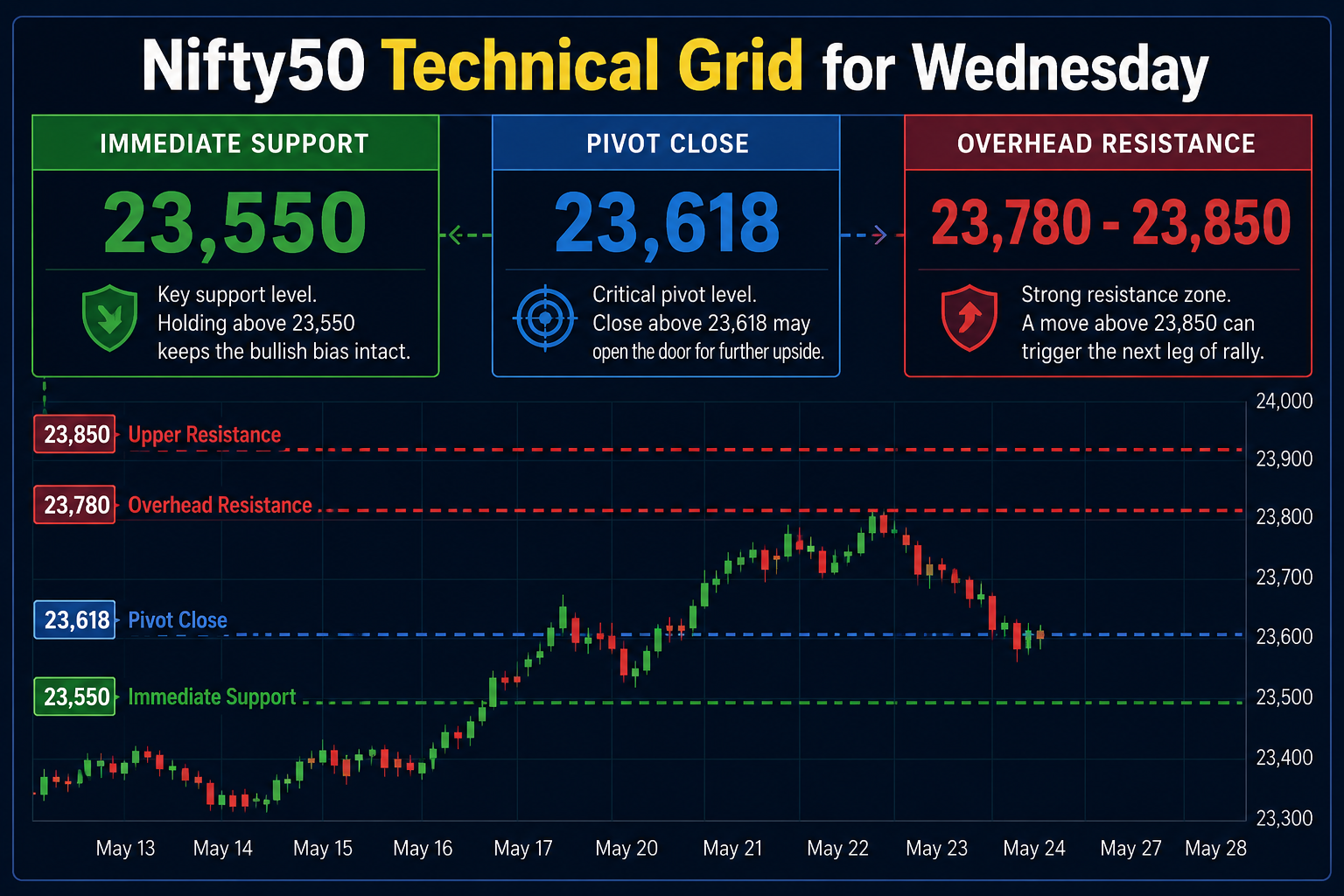
Market technicians point out that the 23,550–23,580 zone will act as the immediate, critical floor for the Nifty50 in the upcoming sessions. If the global dollar index continues to strengthen, forcing the rupee below the 96.70 level, it could trigger a breakdown toward 23,400. On the upside, the index must consistently clear and close above the 23,782 peak to invalidate this bearish intraday reversal pattern and target the next major resistance cluster at 24,000.
Disclaimer : Financial markets are subject to high risk. Please consult with a certified financial advisor before making any investment decisions.