
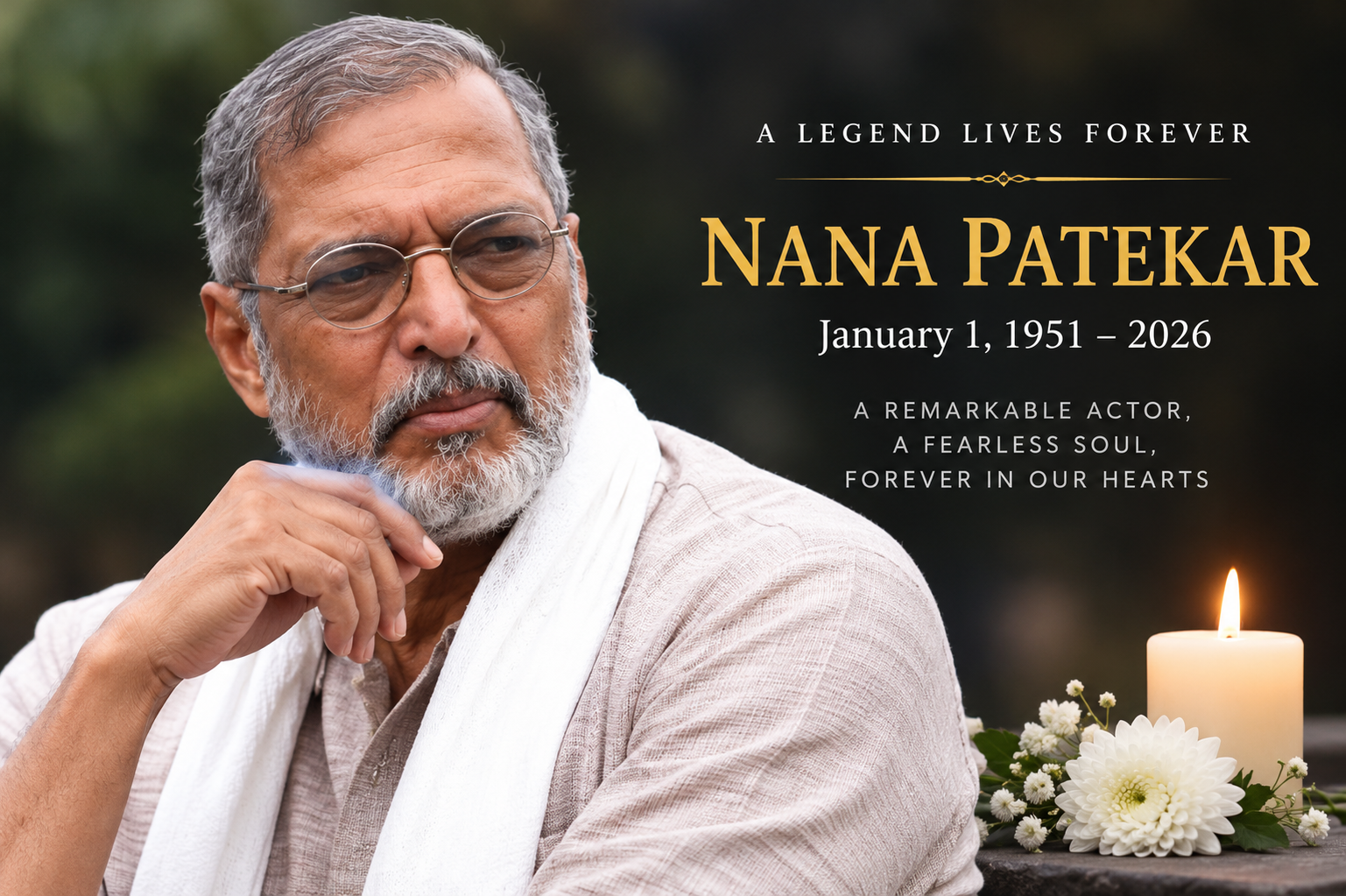
The Nana Patekar death report has brought attention to the final hours of one of Indian cinema’s most distinctive performers. The veteran actor and filmmaker died in Goa on Thursday, October 8, 2026, at the age of 75, following a cardiac arrest, according to reports citing Manipal Hospital and Dr Shekhar Salkar.
One of the troubling details to come out was a message Patekar reportedly sent to a friend around 2:30 am saying he was not feeling well. The friend did not see the message away because it was late at night. Patekar then called him. The friend arrived at his residence around 4 am.
By that time Dr Salkar said, Patekar was already sweating and beginning to lose consciousness. Emergency help was called in. Medical teams rushed to the scene. They tried to revive him with resuscitation efforts.. Despite all their efforts the actor could not be saved.
The story of those hours has highlighted how quickly heart attacks can happen. It has also reminded people how important it’s to recognize early warning signs act fast and know when to seek medical help immediately.
For the film industry the loss of Nana Patekar goes far beyond the way he died. He built a career that spanned theatre, Marathi cinema and Hindi films. He earned a reputation, for performances that were intense deeply emotional and often unforgettable. His work left a mark that will not be easily erased.
Nana Patekar’s Final Hours: What Happened in Goa?
I read that according to statements attributed to Dr Shekhar Salkar, Chief of the Department of Oncology at Manipal Hospital in Goa the sequence of events began during the hours of Thursday.
Patekar reportedly contacted a friend at 2:30 am to say that Patekar was feeling unwell. The message was not noticed immediately. Patekar later called the friend, who arrived at Patekars home at around 4 am.
The doctor said Patekar was sweating and becoming increasingly unconscious by the time assistance reached Patekar.
The caretaker was sent to the hospital to arrange an ambulance. An emergency team. Began life‑saving efforts, after finding Patekar not responding.
Patekar was brought to Manipal Hospital at 4:20–4:30 am according to the account provided by the doctor. Doctors and nurses continued trying to revive Patekar. Patekar could not be brought back.
Patekar was subsequently declared dead in the early morning hours. Media reports have cited different times for the formal declaration with several reports placing it at approximately 5:20–5:30 am.
A legal case was. The body was sent to Goa Medical College for an autopsy according to reports published on Thursday.
These details describe the reported timeline of the emergency. The exact medical steps and any additional findings should be understood in a context of medical and investigative records.
The Message That Raises Difficult Questions
One detail has stayed at the center of attention: Patekars reported message to his friend before the emergency.
A text sent during the night might seem normal on its own.. In this situation it became a significant part of the story about the actor’s final hours. That’s because it was followed by a phone call, a visit to his home and an emergency response.
Still it’s important not to turn this into a tale of blame. The account shows that the friend did not see the message because it came late at night. Later Patekar called him directly. There is no evidence the friend ignored the message on purpose or knew how serious things were at that moment.
Instead the event points to an issue with medical emergencies. Symptoms can get worse when people are alone.. Those around them might not realize how bad the situation is right away.
Someone may say they feel unwell in a way they don’t understand. It could be something.. Sudden or extreme symptoms can also mean a life-threatening condition. The challenge is knowing when to act
The key lesson is not that every late-night message means someone is in danger. It is that severe or strange symptoms should never be ignored—especially if they come with chest pain, trouble breathing, cold sweat, dizziness or a sudden change, in awareness.
Cardiac Arrest: Why Every Minute Matters
I read about arrest. Cardiac arrest happens when the heart suddenly stops pumping blood. Because of that blood does not reach the brain and other vital organs.
Cardiac arrest is not the same as a heart attack although a heart attack can sometimes trigger arrest. A heart attack normally involves a blockage that stops blood from reaching part of the heart muscle. Cardiac arrest is an mechanical emergency where the heart can no longer keep blood moving.
When a person suddenly collapses and becomes immediate action can be critical. If you see someone, like that you must act fast.
The reported efforts to revive Patekar show how challenging these emergencies can be, even when medical professionals intervene. The doctor said resuscitation attempts went on for 45 minutes to an hour but the actor could not be saved.
What should someone do if a person becomes unresponsive?
If a person suddenly collapses, does not respond and is not breathing normally, bystanders should treat the situation as a medical emergency.
- Call emergency services immediately. In India, dial 112 for emergency assistance.
- Check responsiveness and normal breathing. Do not delay while trying to determine the precise cause.
- Begin CPR if the person is unresponsive and not breathing normally. Follow the emergency dispatcher’s instructions. If you are not trained, hands-only CPR may be appropriate for an adult.
- Use an automated external defibrillator (AED) if one is available. Follow its spoken instructions.
- Continue until professional help takes over or the person shows clear signs of recovery.
These steps are general emergency guidance, not a claim about what caused Patekar’s cardiac arrest. Only qualified medical professionals and relevant investigations can establish the circumstances of an individual case.
Why the Reported Symptoms Should Not Be Ignored
Sweating and a sudden loss of consciousness can happen during medical emergencies.. These signs alone are not enough to tell what is wrong.
Some warning signs that may point to a heart attack or another heart-related emergency include chest pressure or discomfort pain that spreads to the arm, back, neck or jaw trouble breathing, nausea, dizziness and cold sweats. Not everyone has the symptoms. Some people may feel different or less obvious signs and symptoms can vary from person to person.
A sudden cardiac arrest can happen without warning. If someone becomes unresponsive and isn’t breathing normally it’s critical to get help away. Waiting to see if things get better is not safe.
It’s also important not to think that every time someone sweats or feels unwell it must be a heart problem. Symptoms need to be looked at in context. Only medical professionals should make a diagnosis.
In terms people should call for emergency help when symptoms are sudden, severe or seem life-threatening. If someone appears to be having a heart attack waiting for symptoms to go away can be dangerous.
The bigger picture here is the need for public awareness about emergency response. People should know how to act. Access, to CPR training and emergency services is key. These tools can save lives when every second counts.
Nana Patekar’s Journey From Vishwanath Patekar to a Celebrated Actor
While the circumstances of his death have prompted widespread attention, Nana Patekar’s life and work remain central to understanding his contribution to Indian cinema.
Born Vishwanath Patekar in Maharashtra on January 1, 1951, he entered the film industry after developing an interest in acting and theatre. He made his Hindi film debut with Gaman in 1978 and gradually established a reputation for his ability to portray complex, emotionally charged characters.
Unlike performers whose screen identities depend primarily on glamour, Patekar developed a style built around expressive dialogue delivery, intense facial expressions and a willingness to take on difficult roles.
His performances often carried an element of unpredictability. He could play a conflicted individual, a principled officer, a ruthless antagonist or a character struggling with personal and social pressures.
This range helped him build a distinctive identity in an industry where actors are often associated with a particular screen image.
The Films That Established His Reputation
Patekar’s career included films that explored poverty, crime, political conflict, personal sacrifice and moral ambiguity.
Salaam Bombay! brought international attention to a story centred on children living on the streets of Mumbai. His work in serious cinema helped establish his standing as a performer willing to engage with demanding material.
Parinda became an important milestone in his career. The crime drama earned him the National Film Award for Best Supporting Actor and strengthened his reputation for portraying intense characters.
In Prahaar, he explored the world of military discipline and the psychological consequences of violence. The film also reflected his interest in socially conscious storytelling.
His performance in Krantiveer became another defining moment. The film connected his forceful screen presence with a character driven by anger, justice and public accountability.
Patekar also appeared in films such as Agni Sakshi, Khamoshi: The Musical, Ab Tak Chhappan, Apaharan, Welcome and Natsamrat. Together, these projects demonstrated his ability to move between commercial entertainment and emotionally demanding drama.
His work in Marathi cinema and theatre further strengthened his artistic reputation, allowing him to explore roles and stories that differed from mainstream Hindi film conventions.
A Rare Achievement in Filmfare Awards
Patekar’s career was also marked by recognition across different acting categories.
He won the Filmfare Award for Best Supporting Actor for Parinda, Best Actor for Krantiveer and Best Villain for Angaar. He later received another Best Villain award for Apaharan.
These achievements are significant because they reflect his ability to succeed in sharply different kinds of roles. Supporting characters, leading protagonists and antagonists require different approaches to performance, and Patekar earned recognition in each category.
His honours also included the National Film Award for Best Supporting Actor for Parinda and the National Film Award for Best Actor for Parinda‘s contemporary-era counterpart? No such claim should be made without checking the award record. His documented National Film Award recognition includes Best Supporting Actor for Parinda and Best Actor for Krantiveer.
His artistic legacy cannot be reduced to a list of trophies. The lasting impact of his performances lies in the way audiences remember his characters, dialogue and distinctive screen presence.
Medico-Legal Case and Post-Mortem: What Do These Steps Mean?
Reports said a medico-legal case was registered after Patekar’s death. His body was taken to Goa Medical College for a -mortem examination.
The term medico-legal case does not always mean a crime happened. It is used when a death needs documentation or a medical review by authorities. This step is taken when the cause of death is unclear or when the death occurred outside a hospital setting.
A post-mortem examination helps determine the cause of death. It records findings and gives a clear picture of what happened. This process is especially important when the circumstances around a death are not clear.
The hospital treating Patekar said he died from arrest. That explanation came from the doctor in charge.. Any further details about the exact cause or medical factors involved should only be accepted if they come from official reports. Until then speculation should be avoided.
Reporting on a person’s moments must be handled carefully. The public may want answers. Private medical information should not be shared as fact. Only confirmed findings, from sources should be used.
Why Nana Patekar’s Death Resonates Beyond Bollywood
The death of an established actor inevitably becomes a moment of reflection for audiences who have followed his work for decades. Patekar’s career was unusual because he did not depend on conventional leading-man characteristics alone. He built his reputation through the force of his performances and his willingness to inhabit challenging characters.
For viewers, his films provided more than entertainment. Many of his roles examined the relationship between power and responsibility, the cost of violence, social injustice and the struggles of ordinary people.
His performances also demonstrated that a supporting character or antagonist could become the most memorable part of a film. That ability made him a distinctive presence in Hindi cinema.
The reported account of his final hours has added a deeply personal dimension to the news. Yet the circumstances of his death should not overshadow the decades of work that shaped his reputation.
A meaningful tribute would recognise both the artist and the range of stories he helped bring to the screen.
Remembering an Actor Who Defied Easy Labels
The news about Nana Patekars death has drawn attention to a message, to an emergency response in Goa and to the attempts to bring the veteran actor back to life. The timeline that was reported reminds us how fast a medical emergency can happen and why sudden severe symptoms must always be taken seriously.
At the time Nana Patekars life deserves to be remembered for much more than the final hours shown in the news. From Nana Patekars work in *Gaman* to the memorable roles in *Parinda* *Krantiveer* and *Natsamrat* Nana Patekar proved himself as an actor who could command attention in a unique way without following the usual rules.
Nana Patekars career crossed genres, many languages and reached generations of film fans. Nana Patekars contribution to cinema together with Nana Patekars work in social projects makes a big part of Nana Patekars legacy.
As more information comes through sources the focus should stay on accurate reporting on respect for Nana Patekars family and on recognising the work that made Nana Patekar an enduring figure, in Indian cinema.