
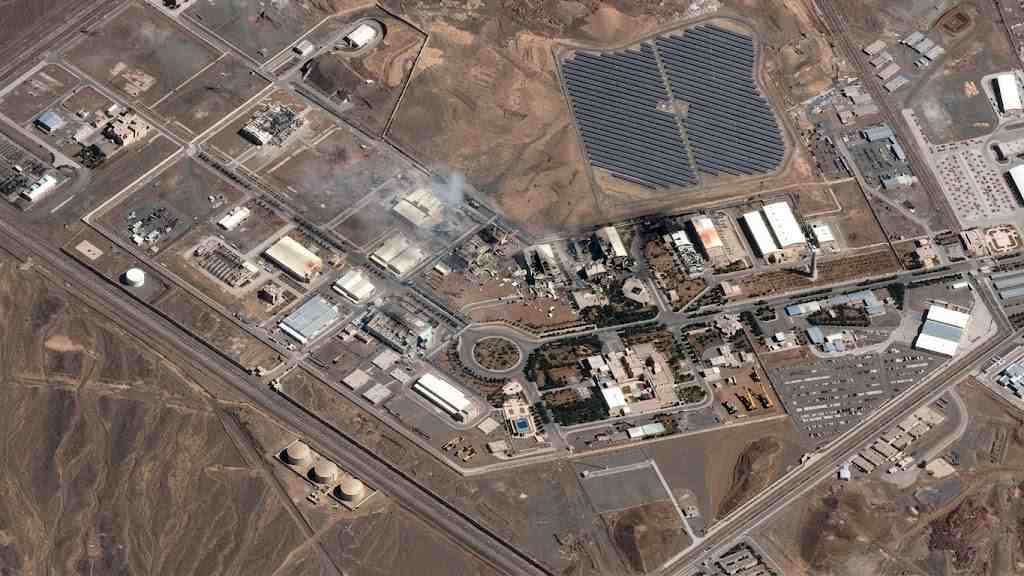
TEHRAN —Escalation in the Middle East: U.S. and Israel Launch In a significant and high-stakes escalation of the ongoing conflict, the Iranian Atomic Energy Organisation (AEOI) confirmed on Saturday, March 21, 2026, that the Natanz nuclear facility was targeted in a joint military strike by the United States and Israel.
The attack on the Shahid Ahmadi Roshan enrichment facility, located approximately 220 kilometers (135 miles) southeast of Tehran, marks a pivotal moment in a war that has now entered its fourth week. While the strike underscores the intensifying military efforts to dismantle Iran’s nuclear capabilities, officials in Tehran were quick to report that the integrity of the site’s containment remained intact.
No Radioactive Leakage Reported Following Airstrikes:
Escalation in the Middle East: U.S. and Israel Launch Major Strike on Iran’s Natanz Nuclear Facility: In a statement released via the Tasnim news agency, the AEOI described the morning’s events as “criminal attacks” carried out by the United States and what it termed the “usurping Zionist regime.” Despite the gravity of the assault, Iranian officials have sought to reassure the public regarding the immediate environmental and health risks.
“Following the criminal attacks… the Natanz enrichment complex was targeted this morning. There was no leakage of radioactive materials reported at the facility, and there is no danger to the population living near the site.” — Iranian Atomic Energy Organisation Statement
The United Nations’ nuclear watchdog, the International Atomic Energy Agency (IAEA), corroborated these initial findings, stating that no increase in off-site radiation levels had been detected. IAEA Director General Rafael Grossi issued a stern reminder to all parties, repeating his “call for military restraint to avoid any risk of a nuclear accident” during the active hostilities.
Strategic Significance of the Natanz Complex
Escalation in the Middle East: U.S. and Israel Launch Major Strike on Iran’s Natanz Nuclear Facility: The Natanz facility is widely considered the crown jewel of Iran’s nuclear program. As the primary site for uranium enrichment, it has long been a focal point of international concern and a recurring target for military and cyber operations.
This is not the first time the site has been caught in the crosshairs:
- June 2025: Targeted by Israel during the 12-day “Summer War.”
- February 2026: Hit during the first week of the current conflict, resulting in visible damage to several surface buildings as confirmed by satellite imagery.
- March 2026: Today’s strike represents a continued effort by the U.S.-Israeli coalition to neutralize the underground enrichment halls.
Al Jazeera’s Ali Hashem, reporting from Tehran, noted that the strike was “expected,” given that the destruction of Iran’s nuclear infrastructure has been a primary stated goal of the Trump administration. He highlighted that Tehran currently holds an estimated 400kg of highly enriched uranium, a stockpile the West fears could be rapidly converted into weapons-grade material.
A War of Mixed Signals: Trump and the “Winding Down” Narrative
The strike comes at a time of deep confusion regarding the U.S. strategy in the Middle East. On Friday, President Donald Trump took to social media to suggest that the United States was “getting very close to meeting our objectives” and was considering “winding down” military efforts.
However, the reality on the ground paints a different picture. Even as the President spoke of a drawdown, the Pentagon was moving to bolster its presence:
- Troop Surge: Roughly 2,500 additional Marines and three amphibious assault ships are currently being deployed to the region.
- Financial Requests: The administration has requested an additional $200 billion from Congress to fund continued operations.
- Regional Presence: These new forces join more than 50,000 U.S. troops already stationed across the Middle East.
Critics argue that the administration is offering shifting rationales for the war, ranging from “regime change” via popular uprising to the surgical elimination of missile and nuclear programs. Despite the heavy bombardment, there have been no public signs of a civilian uprising within Iran.
Global Fallout: Oil Prices and International Condemnation
The economic ripples of the conflict are being felt worldwide. Brent crude oil has surged to approximately $106 per barrel, a massive jump from the $70 mark seen before the outbreak of war on February 28.
In a desperate bid to stabilize soaring fuel prices and calm a plunging U.S. stock market, the Trump administration announced a temporary pause on sanctions for Iranian oil already loaded onto ships. This 30-day “grace period” mirrors a previous move regarding Russian oil, though analysts remain skeptical it will do much to lower prices at the pump given that global production remains stagnant.
Internationally, the strike on Natanz has drawn sharp criticism from Moscow. Russian Foreign Ministry spokeswoman Maria Zakharova condemned the attack as a “blatant violation of international law,” signaling a deepening diplomatic rift between the Kremlin and the White House.
The Human Cost and the Week Ahead
As the war enters its next phase, the toll on human life continues to mount. In Iran, more than 1,300 people have been killed since the end of February. In Israel, 15 people have died from Iranian missile strikes, including a recent incident where missile fragments slammed into an empty kindergarten. At least 13 U.S. military members have been lost in the line of duty.
The violence is also spreading. The Israeli military confirmed a new wave of strikes targeting Hezbollah militants in Beirut’s southern suburbs, displacing over a million people in Lebanon.
Looking forward, the conflict appears set to intensify. Israeli Defense Minister Israel Katz warned that starting Sunday, the “intensity of the strikes to be carried out by the IDF and the U.S. military… will rise significantly.”
With the Supreme Leader Ayatollah Mojtaba Khamenei remaining out of public view and the U.S. doubling down on its military footprint, the strike on Natanz may be the precursor to an even more volatile chapter in Middle Eastern history.