
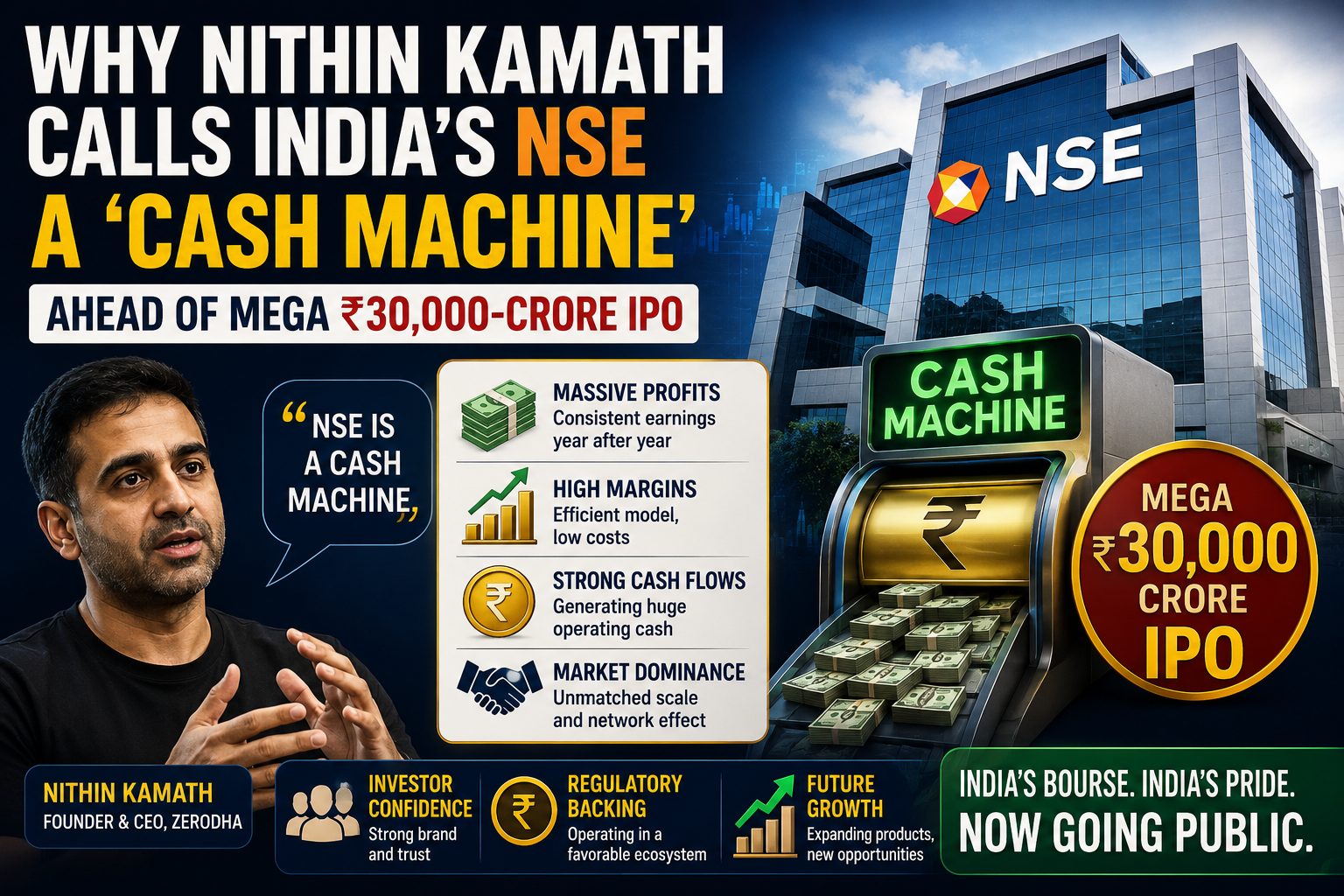
The National Stock Exchange of India (NSE) IPO is currently preparing for what is expected to be the country’s largest-ever initial public offering (IPO), with an estimated issue size of around ₹30,000 crore. As anticipation builds across the Indian financial sector, Zerodha co-founder and CEO Nithin Kamath shared a fascinating perspective on the country’s premier stock exchange.
Taking to the social media platform X, Kamath described the NSE as a rare and phenomenal “cash machine,” shedding light on its unique, capital-light business model and high dividend payout culture. His insights have sparked a broader debate regarding corporate taxation, investment incentives, and the financial sustainability of new-age Indian enterprises.
The Ultimate Cash Generation and Distribution Machine
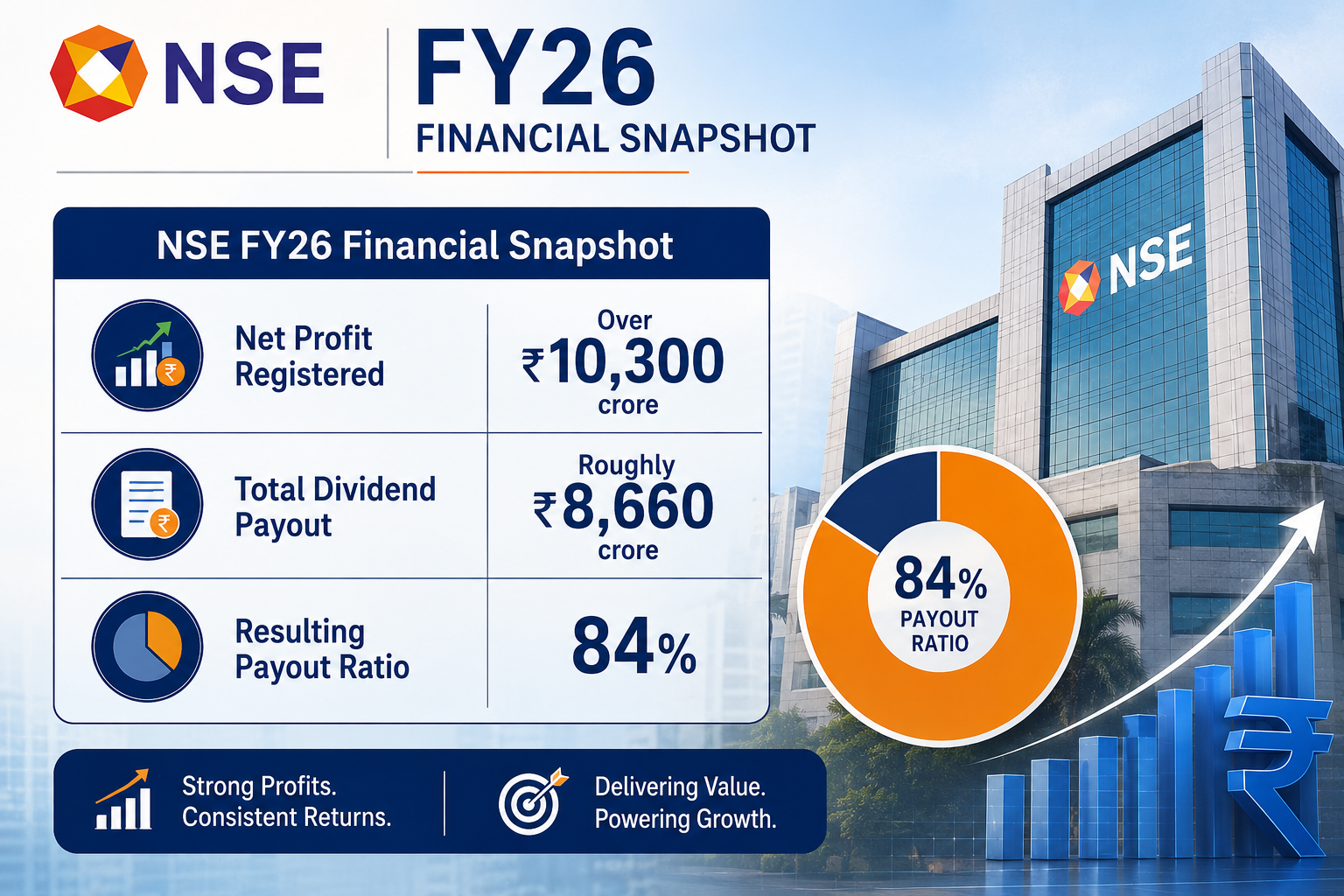
At the core of Kamath’s analysis is the incredible efficiency with which the NSE handles its finances. In the financial year 2025–2026 (FY26) alone, the stock exchange clocked a massive net profit exceeding ₹10,300 crore. Remarkably, out of this profit, the exchange distributed roughly ₹8,660 crore back to its shareholders in the form of dividends. This represents a staggering dividend payout ratio of 84%.
According to the Zerodha chief, this massive cash distribution trend is highly likely to continue even after the exchange makes its official debut on the public trading floors. The reason behind this continuous distribution is simple: the NSE cannot easily deploy or hoard its excess profits into alternative investment avenues.
The Securities and Exchange Board of India (SEBI) enforces strict regulatory frameworks that prohibit stock exchanges from investing their surplus funds into other businesses, whether those companies are publicly listed or privately held. Because the capital cannot be diverted toward corporate acquisitions or non-core business expansions, returning the wealth directly to the equity stakeholders becomes the most logical and regulatory-compliant path forward.
Understanding the Tax Arbitrage: Why Other Companies Retain Cash
The highly generous dividend payout model followed by the NSE stands out as an extreme rarity within the Indian corporate ecosystem. Kamath used this context to explain why so few commercial entities choose to replicate this framework. It ultimately comes down to a deep tax disadvantage known as tax arbitrage, which heavily disincentivizes companies from paying out cash dividends to their investors.
To illustrate how this double taxation works in reality, the online brokerage pioneer broke down a simple mathematical scenario:
The Corporate Tax Level: If a profitable Indian enterprise earns a revenue-minus-cost profit of ₹100, it must first pay an average corporate tax rate of around 25%. This immediate deduction leaves the business with a net sum of ₹75.
The Personal Dividend Tax Level: If the corporate board decides to distribute this remaining ₹75 directly to its shareholders as a dividend, the money is hit with a second layer of taxation. Individual investors must pay income tax on these dividends at their applicable marginal rate. For individuals sitting in the highest tax bracket, this liability can swallow up another ~36% of the incoming amount.
The Final Outcome: After both the corporate-level and personal-income-level tax cuts are applied, a high-earning investor is left with a mere ₹48 out of the original ₹100 earned by the business.
The Contrast of Aggressive ReinvestmentNow, contrast that heavily taxed dividend pathway with an alternative corporate strategy where a company decides to reinvest that entire ₹100 back into business operations, infrastructure, or marketing to fuel growth.
When a business funnels all of its profits into expanding its operations, nothing is booked as distributable profit. Consequently, there is no immediate corporate or dividend tax burden on that cash. If that aggressive business expansion successfully translates into operational success, the overall valuation of the company rises, which reflects directly in a surging stock price.
For the investor, this accumulation of value creates a massive financial advantage:
They face no immediate tax liabilities as the company grows year after year.
They only pay a capital gains tax at the specific moment they choose to sell their shares.
Even at the highest possible slab, the long-term capital gains tax rate in India stands at a much lower rate of 14.5%.
“A massive differential of 14.5% versus 51% creates an incredibly strong incentive for highly profitable companies to reinvest their cash aggressively rather than distribute it to investors,” Kamath explained.
This vast structural gap clarifies why many modern, new-age startups and internet businesses actively choose not to show book profits in their initial decade of operation. Reinvesting every rupee earned allows them to maximize market compounding while avoiding heavy corporate tax leakages.
Why Constant Reinvestment May Not Be a Smart Long-Term Strategy
While ploughing capital back into an enterprise keeps the wheels of the broader economy turning smoothly in the short run, Kamath cautioned that this model carries deep systemic vulnerabilities over an extended timeline.
When businesses focus entirely on continuous top-line expansion while sacrificing core, sustainable profitability, they put themselves at immense operational risk. Companies that fail to establish steady, cash-positive foundations become incredibly fragile during macroeconomic downturns.
If capital markets tighten or a sudden economic slowdown hits, these aggressively expanding, non-profitable firms can find themselves completely exposed. One bad market cycle or a prolonged funding winter can kneecap them severely, wiping out years of growth in a matter of months. From a long-term corporate governance standpoint, avoiding profitability simply to optimize for tax efficiency is a risky strategy that can jeopardize an institution’s survival.
The Global Perspective on Double Taxation
This issue of corporate dividend double-taxation is not unique to India; it remains a central component of global fiscal policy debates. Kamath highlighted how different developed economies have formulated distinct strategies to mitigate this corporate friction:
The United States Approach: The US government taxes dividends coming from most publicly listed enterprises at specialized “qualified dividend” rates, which are significantly lower than standard personal income tax brackets.
The Australian Approach: Australia implements a unique system known as dividend imputation. This structure grants individual retail investors direct tax credits for the corporate taxes that the company has already paid on its earnings, successfully avoiding the trap of double taxation.
A Detailed Look at the Upcoming NSE IPO
As these systemic financial dialogues continue, all eyes remain firmly fixed on the stock exchange’s massive upcoming public listing. The NSE recently filed its Draft Red Herring Prospectus (DRHP) with SEBI for an initial public offering that is set to rewrite the record books of the Indian capital markets.
Key Structure of the Public Issue
Estimated Valuation: The exchange is currently tracking an astronomical valuation of approximately ₹5 lakh crore ($60+ Billion USD) in the grey and unlisted markets.
Issue Size: The public issue is projected to sit around the ₹30,000-crore mark.
Offer for Sale (OFS) Model: It is crucial for potential market participants to recognize that this IPO is a pure Offer for Sale. The exchange itself will not be raising any fresh, incoming capital to fund its internal operations. Instead, existing institutional shareholders will be offloading up to 14.89 crore equity shares, which translates to roughly 6% of the exchange’s total equity capital pool.

Analyzing the Structural Risks of the Exchange
Despite the exchange’s incredible cash-generating characteristics and its dominant position in Indian high-finance, potential retail and institutional investors must carefully evaluate the unique risk factors associated with its underlying business model.
1. High Revenue Concentration
An astounding 79% of the NSE’s overall operational revenue is derived directly from variable transaction charges. This means that the financial health of the bourse is deeply tied to daily market trading volumes. If market volatility drops or a bear market scares away retail traders, the exchange’s revenue can plummet rapidly.
2. Over-Reliance on the Derivatives Segment
Within that transaction-driven revenue stream, options trading alone constitutes more than 60% of the platform’s operating revenue. The Indian derivatives market has seen explosive growth over the past few years, fueled heavily by weekly index options expiries. This heavy skew leaves the platform deeply vulnerable to sector-specific shocks.
3. Evolving Regulatory Ecosystem
Because the exchange’s earnings rely so heavily on speculative derivative trading, its bottom line is extremely sensitive to changing regulatory policies. SEBI has actively introduced stringent guidelines designed to curb excessive retail options trading, including increasing minimum contract sizes, mandating higher margins, and limiting weekly expiries. These evolving regulatory measures have already started impacting speculative volumes, leading to visible corrections in projected yearly profit margins.
Final Thoughts
The upcoming public debut of the National Stock Exchange represents a historic milestone for India’s financial ecosystem. Nithin Kamath’s detailed commentary highlights exactly why the bourse is viewed as an extraordinary, cash-generating titan. By consistently converting transaction volumes into massive pool of profits and returning 84% of that wealth directly to investors via dividends, the exchange stands out as a unique corporate entity.
However, as the platform transitions from an unlisted financial utility into a publicly traded corporation, investors will have to balance its incredible cash-generating power against heavy regulatory risks and a changing derivatives landscape. Whether the exchange can maintain its phenomenal financial stride in the face of evolving compliance rules remains an open question for the Indian markets.
Disclaimer : The information provided on this website is for general informational and educational purposes only. While we strive to keep the content accurate and up to date, we make no representations or warranties of any kind, express or implied, about its completeness, accuracy, or reliability. Any reliance you place on such information is strictly at your own risk.