
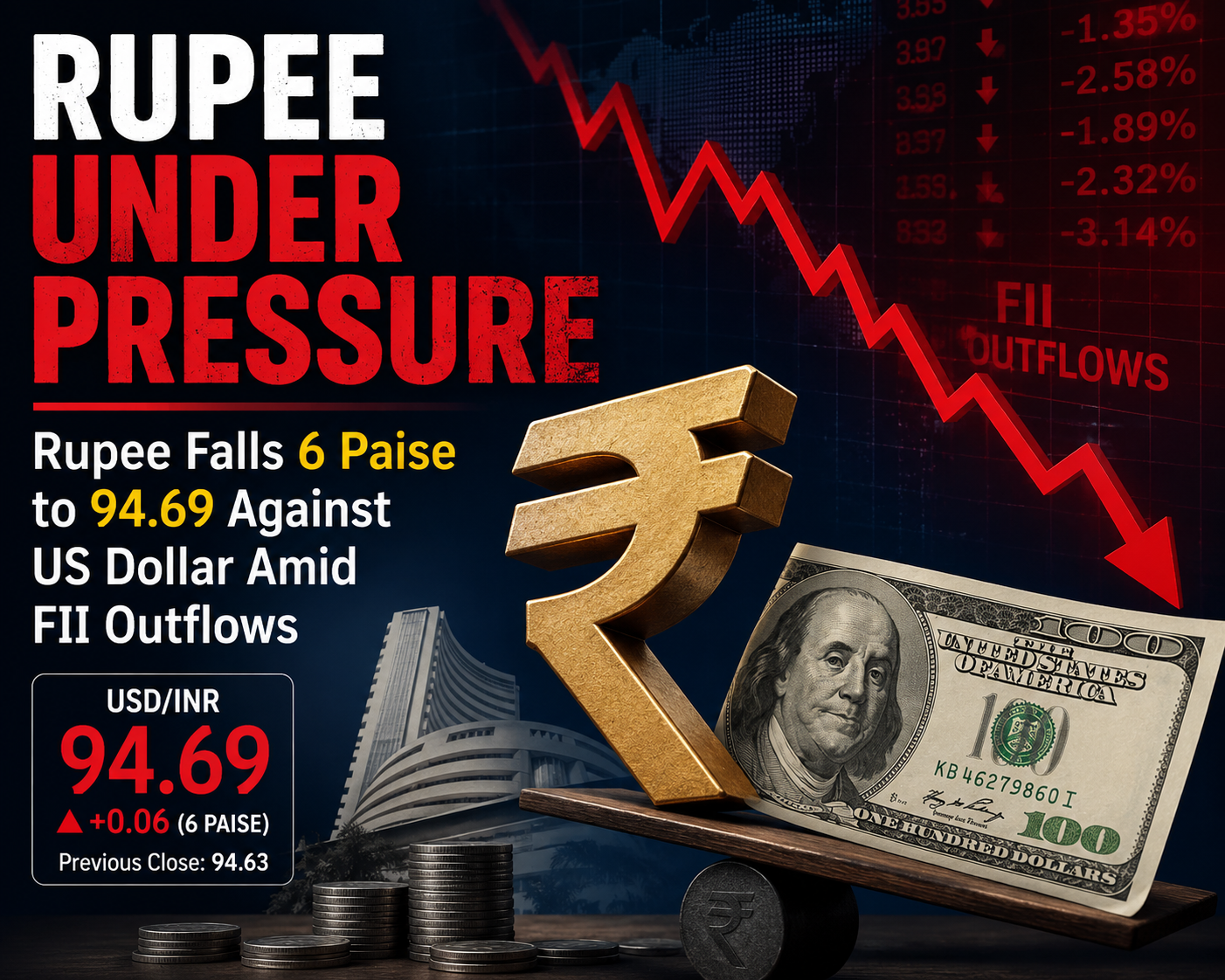
The Indian rupee witnessed a slight depreciation in early trade on Tuesday, June 23, 2026, breaking its recent momentum as a strengthening greenback and persistent foreign fund outflows weighed on sentiment. The rupee falls 6 paise to 94.69 against US dollar, tracking a sluggish start in domestic equity markets.
While global macroeconomic factors, including a soaring US dollar index hovering near a 13-month high, created strong headwinds for the local currency, a significant decline in international crude oil prices acted as a crucial safety valve, preventing a more drastic slide.
According to currency desk analysts, market participants are maintaining a highly cautious stance. The market lacks fresh domestic triggers, prompting traders to stay on the sidelines while closely monitoring central bank interventions and evolving geopolitical dynamics in the Middle East.
Technical Breakdown: Opening Volatility and RBI Intervention
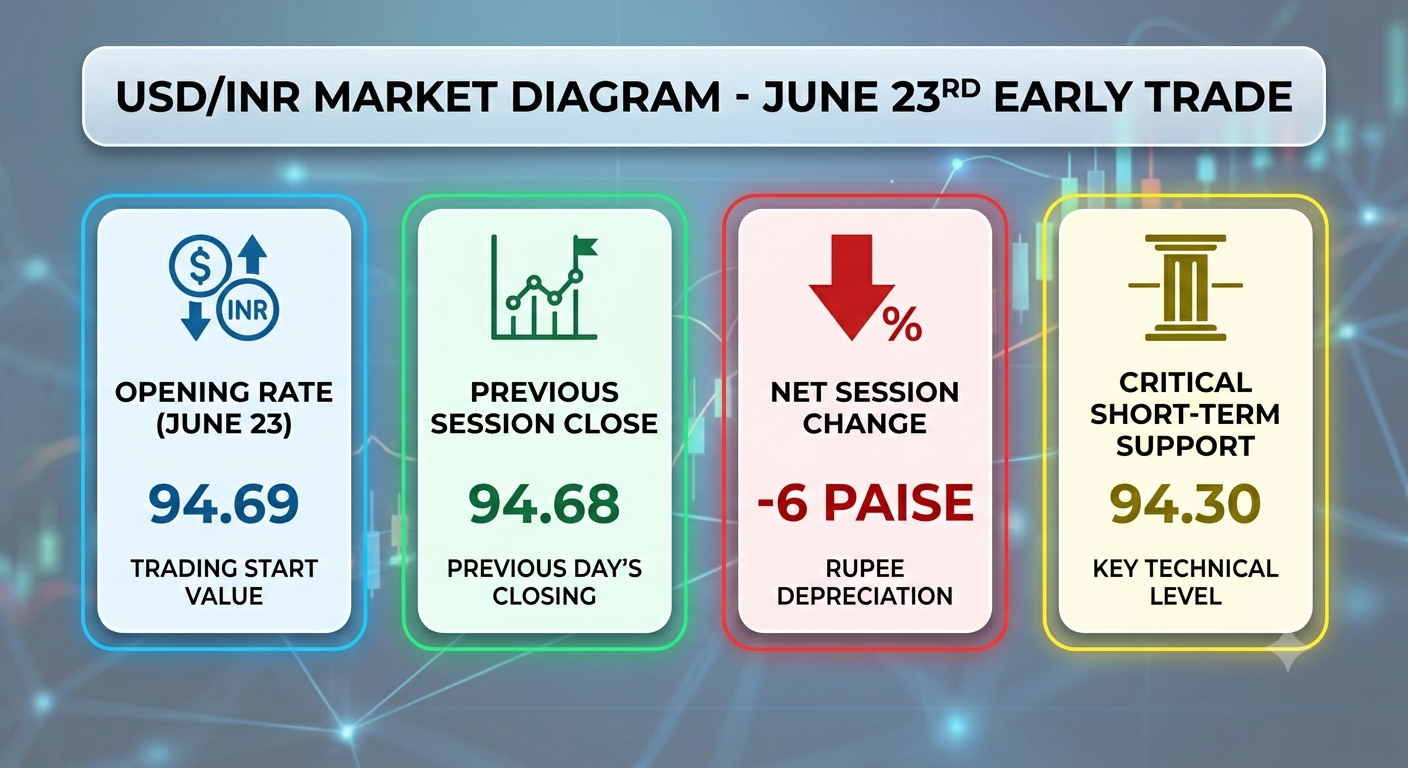
The local currency opened relatively flat on Tuesday morning at 94.69 per dollar, showing nearly zero variance from its previous close of 94.68. This flat opening came right after the rupee halted a strong six-session winning streak on Monday.
Forex traders highlighted that early trading sessions saw intense tug-of-war dynamics. On one side, exporter-related dollar demand emerged quickly, putting immediate pressure on the local currency. On the other side, the Reserve Bank of India (RBI) reportedly stepped in to smooth out excessive volatility.
Traders in public sector banks indicated that the central bank was actively buying dollars near Monday’s high marks. This strategic intervention effectively built a floor under the currency, absorbing excess dollar inflows and preventing sudden, erratic spikes in the USD/INR exchange rate.
Global Factors Driving the Greenback’s 13-Month High
The primary driver behind the pressure on emerging market currencies remains the absolute dominance of the US dollar on the global stage. The greenback has consistently gathered strength over recent weeks, consolidating its position near a 13-month high against a basket of major global currencies.
This sustained dollar strength is driven by robust macroeconomic data coming out of the United States, keeping global yields elevated and making dollar-denominated assets highly attractive to international investors. As capital flows back into safe-haven US assets, emerging market currencies like the rupee naturally experience short-term depreciation.
Furthermore, Foreign Institutional Investor (FII) outflows from Indian capital markets have accelerated the trend. High global interest rates mean foreign funds are trimming their exposure to domestic equities, creating a consistent demand for dollars during early morning trade clearings.
Crude Oil Dynamics and the Strait of Hormuz Negotiations
Despite the heavy pressure from a dominant US dollar and FII selling, India’s macro-economic fundamentals received substantial cushion from the energy markets. Brent crude oil prices managed to stay comfortably below the critical $80 per barrel threshold, despite a modest technical uptick during early Asian trading hours.
       [US Dollar Index Hits 13-Month High]
                       │
                       ▼
         [Puts Pressure on USD/INR Pair]
                       │
                       ▼
   [Rupee Falls 6 Paise to 94.69 Against US Dollar]
                       ▲
                       │
      [Cushioned by Brent Crude Below $80/bbl]
                       │
                       │
     [Supported by Ongoing US-Iran Peace Talks]
Energy analysts attribute this relative softness in crude prices to ongoing diplomatic developments. Negotiations between the United States and Iran are reportedly progressing well. Energy traders worldwide are keeping a very close eye on these diplomatic channels, looking for clear timelines regarding the complete stabilization and reopening of the Strait of Hormuz.
Given that the Strait of Hormuz is one of the world’s most critical maritime chokepoints for global energy supplies, any breakthrough or positive momentum in US-Iran talks directly reduces the geopolitical risk premium on crude oil. For a major oil-importing nation like India, crude remaining below $80 a barrel significantly lowers the nation’s import bill, reducing corporate dollar demand and protecting the rupee from a steeper downfall.
Capital Inflows and External Borrowings Offer Crucial Support
While equity markets are witnessing a temporary exodus of foreign funds, India’s broader capital account remains fundamentally resilient. The local currency continues to find a reliable safety net through alternative foreign currency inflows.
Overseas Non-Resident Deposits: Non-Resident Indian (NRI) deposit schemes have seen steady, recurring inflows due to competitive domestic interest rates.
External Commercial Borrowings (ECBs): Indian corporate houses are successfully securing long-term credit lines and commercial borrowings from overseas markets, ensuring a steady stream of dollars into the banking system.
Central Bank Reserves Strategy: The RBI’s massive foreign exchange reserves give it ample ammunition to run targeted market operations, neutralizing sudden capital flight shocks.
These structural inflows run parallel to routine market operations, providing deep liquidity that balances out the short-term volatile trading volumes seen in the daily spot markets.
Expert Market Outlook: Key Support and Resistance Zones
Market experts believe that while the domestic currency faces near-term volatility, its structural framework remains entirely intact. The combination of active central bank management and soft global commodity prices prevents any scenario of unanchored depreciation.
“While softer crude oil prices and improving capital inflows remain supportive for the rupee, a stronger US dollar may keep USD/INR volatile in the near term. The Rs 94.30 level continues to act as a key support zone, having held firm on multiple occasions in recent sessions.” — Amit Pabari, Managing Director at CR Forex Advisors
Looking forward into the upcoming trading weeks, forex desks expect the USD/INR pair to trade within a well-defined, tight consolidation range. If global dollar strength persists, the pair might test upper resistance levels near 94.85. However, as long as Brent crude avoids surging past the $80 mark and the RBI remains watchful, the strong technical support zone at 94.30 is highly unlikely to be breached.
Disclaimer
The information provided on this platform regarding the USD/INR exchange rate, forex market updates, and general financial trends is for informational and educational purposes only. While we strive to ensure that the data, analysis, and market metrics presented are accurate and up-to-date at the time of publication, currency markets are highly volatile and subject to rapid, unpredictable changes.