
The blockbuster Jio IPO is facing an unexpected and significant roadblock as geopolitical tensions and escalating war in Iran send shockwaves through global financial markets. Reliance Industries Ltd. (RIL), led by billionaire Mukesh Ambani, is reportedly slowing down its preparations and re-evaluating the structure of what was promised to be India’s biggest-ever initial public offering.
For months, the domestic capital markets were buzzing with anticipation over the mega listing of Reliance’s digital powerhouse, Jio Platforms Ltd. However, the sudden outbreak of conflict in the Middle East has completely altered the economic landscape. This unexpected geopolitical crisis has triggered severe market volatility, accelerated foreign capital flight, and forced a massive rethink at the top echelons of India’s largest conglomerate.
The Core Breakdown: Why the Jio IPO is Hitting a Wall
At its heart, the delay of the Jio IPO stems from a combination of macroeconomic pressures and intricate corporate structuring challenges. While the company remains committed to filing its draft paperwork and could theoretically launch the public issue at any time, insiders reveal that the lack of a firm timeline points to deep-seated concerns over valuation and timing.
1. Geopolitical Shocks and Global Market Volatility
The war in Iran has sent ripple effects across the globe, directly hitting emerging markets like India. When geopolitical stability cracks, investor sentiment is the first casualty. Institutional investors turn risk-averse, moving their capital out of volatile equity markets and parking it in safer havens like gold or US Treasuries. This massive flight of capital has drained liquidity from the Indian stock market, making the environment incredibly hostile for launching a historic, multi-billion-dollar public issue.
2. The Valuation Tightrope Walk
Launching a successful initial public offering requires a delicate balance: satisfying the high return expectations of early-stage investors while pricing the stock attractively enough to create a genuine retail and institutional buzz. In a booming market, achieving this premium valuation is relatively straightforward. In a market crippled by war panic, it becomes a monumental challenge.
Furthermore, Reliance faces a strategic risk: the current market downturn could lead to an underwhelming valuation that pegs Jio Platforms below its primary listed rival, Bharti Airtel Ltd. For a market leader boasting the largest subscriber base in the country, debuting at an deflated valuation is a scenario Mukesh Ambani would desperately want to avoid.
3. Delays in Stakeholder Decision-Making
A mega-listing of this scale is not a solo venture. Jio Platforms is backed by a star-studded lineup of global tech giants and sovereign wealth funds. The conflict in the Middle East has disrupted routine corporate operations, making it increasingly difficult for key stakeholders—particularly those based in the Gulf region—to push through essential procedural steps, coordinate board meetings, and grant formal approvals for the deal’s structure.
From Secondary Selldowns to Fresh Capital: The Structural Pivot
In response to the shifting economic landscape, Reliance Industries is not just delaying the timeline; it is radically changing the blueprint of the deal.
Initially, the Jio IPO was expected to feature a significant Offer for Sale (OFS) component. This setup would have allowed existing high-profile investors to sell down their stakes and cash in on their early bets. However, internal discussions indicate that the conglomerate has scrapped those plans, pivoting instead to an issue comprised entirely of new, fresh shares.
Old IPO Structure: Secondary Selldown / OFS] ──► Existing investors exit/reduce stakes
                                           (Shift due to War & Volatility)
   New IPO Structure: 100% Fresh Share Issue] ──► Injects new capital directly into Jio
This structural shift carries immense strategic weight:
Capital Retention: By offering entirely new shares, all the money raised from the public will flow directly into Jio Platforms’ balance sheet rather than going into the pockets of exiting venture partners.
Funding the Next Growth Engine: This fresh influx of capital can be directly deployed to accelerate Jio’s next-generation tech rollouts, including expanding its 5G network infrastructure, scaling enterprise cloud solutions, and deepening its artificial intelligence capabilities.
Boosting Investor Confidence: A 100% fresh issue signals to the market that the parent company and its backers retain absolute faith in Jio’s long-term value, choosing to grow the pie rather than slice it up for an early exit during a market slump.
The Star-Studded Roster of Global Investors at Risk
When Jio Platforms raised over ₹1.52 lakh crore in 2020, it pulled off one of the most remarkable fundraising sprees in global corporate history. It created a elite roster of international investors, all of whom are now watching the current market malaise with intense scrutiny.
| Investor Type | Institution / Global Tech Giant | Strategic Implications of the Delay |
| Silicon Valley Giants | Meta Platforms Inc. (Facebook), Alphabet Inc. (Google) | High stakes in deep integration with WhatsApp ecosystem and budget Android ecosystems. |
| Sovereign Wealth Funds | Saudi Arabia’s Public Investment Fund (PIF), Mubadala Investment Co., Abu Dhabi Investment Authority (ADIA) | Facing local procedural roadblocks and board approval delays directly caused by regional tensions. |
| Private Equity Titans | Silver Lake Management, KKR & Co., Vista Equity Partners, General Atlantic | Seeking concrete exit timelines and premium investment returns that match their initial high-valuation entries. |
The ongoing market downturn directly threatens to cut into the anticipated returns for these global powerhouses. Private equity funds operate on fixed investment lifecycles, and prolonged delays in a public listing tie up capital that could otherwise be reallocated. Meanwhile, sovereign wealth funds in the Middle East are dealing with the broader macroeconomic fallout of a conflict right on their doorstep, naturally slowing down their internal corporate governance and approval pipelines.
The Macroeconomic Backdrop: India’s Fight Against War FalloutThe roadblocks stalling the Jio IPO cannot be understood without examining the broader economic strain currently facing the Indian economy. The war in Iran has driven up international crude oil prices, dealing a heavy blow to India, which relies heavily on imports to meet its domestic energy needs.
Geopolitical Conflict (Iran) ──► Soaring Global Crude Oil Prices│ ▼Increased National Import Bill ──► Strain on Foreign Exchange Reserves│ ▼Capital Flight & Market Malaise ──► Mega Corporate IPOs Stalled (Jio)
In response to these mounting economic pressures, Prime Minister Narendra Modi has taken the proactive step of appealing directly to citizens to curb fuel consumption and limit non-essential foreign travel. The administration is working hard to defend its foreign-exchange reserves and stem the aggressive outflow of foreign institutional investor (FII) funds.
This domestic financial squeeze has taken a heavy toll on the country’s primary markets. Total listings in India so far this year have raised a modest $3.5 billion—a sharp decline from the record-setting pace observed over the past two years. A successful, $4 billion debut from Jio would single-handedly double the year’s total capital raised, acting as a crucial shot in the arm for an otherwise sluggish primary market.
The Syndicate Behind the Deal: Wall Street Meets Dalal Street
Despite the current pause in momentum, the advisory syndicate behind the scenes remains one of the most powerful financial lineups assembled for an Indian corporate event. Reliance has brought together an elite group of domestic and Wall Street investment banking giants to navigate this complex terrain.
The international advisory wing features global powerhouses well-versed in handling cross-border market turbulence:
Goldman Sachs Group Inc. and Morgan Stanley, bringing unmatched experience in pricing massive tech and telecom listings worldwide.
Bank of America Corp. and Citigroup Inc., offering deep global distribution networks to attract large-scale institutional bids.
On the domestic front, Reliance is leaning heavily on local market expertise to gauge retail sentiment and institutional appetite within India:
Kotak Mahindra Capital and JM Financial Ltd., both of which possess long-standing relationships with the Reliance conglomerate and an intimate understanding of Dalal Street’s unique dynamics.
This elite advisory team is tasked with the incredibly complex job of re-engineering the IPO’s structure, monitoring global oil prices, tracking FII fund flows, and advising Mukesh Ambani on the exact moment to pull the trigger when the geopolitical dust begins to settle.
Strategic Comparison: Jio Platforms vs. Bharti Airtel
A central factor weighing on the minds of Reliance decision-makers is how the market values Jio relative to its closest competitor, Bharti Airtel. Airtel’s resilient stock performance in recent quarters has set a high benchmark for the telecom and digital sector.
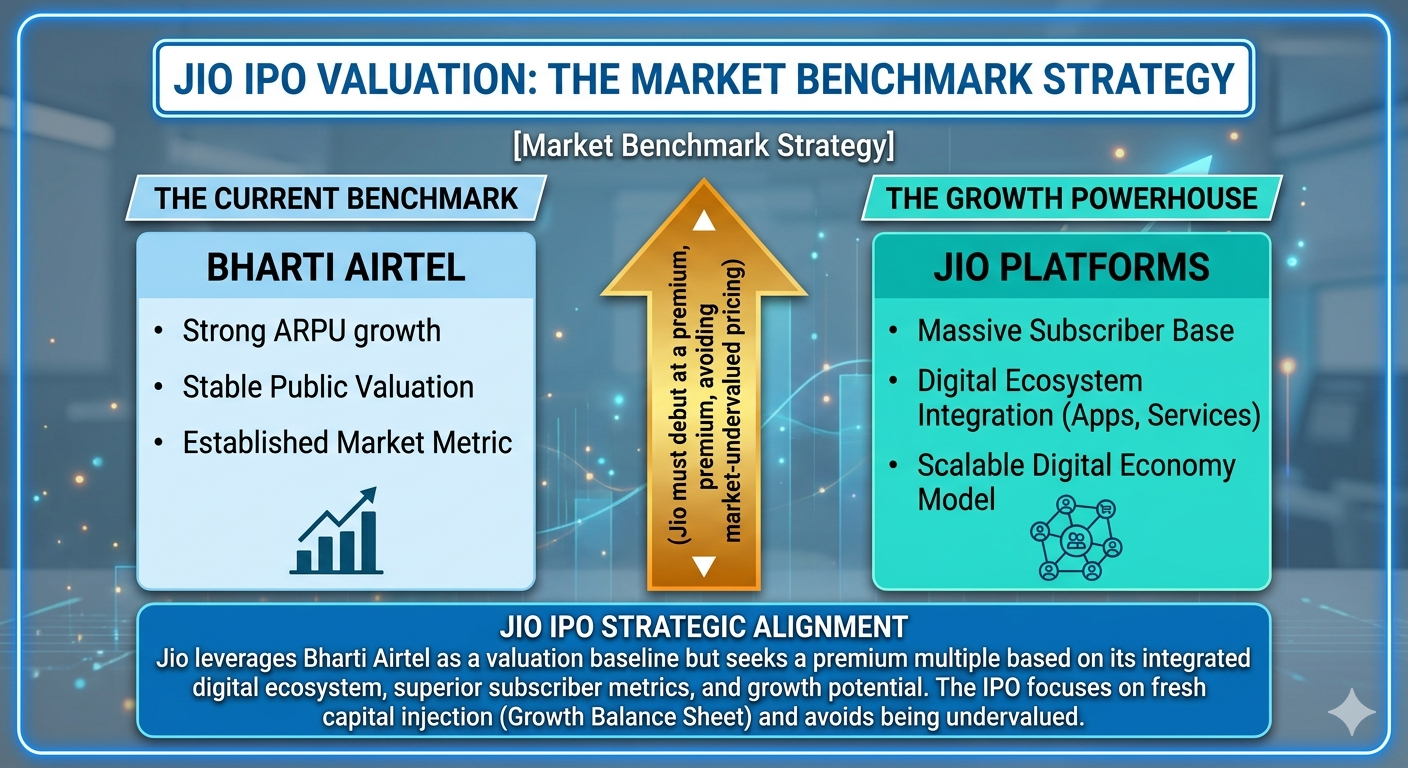
Jio cannot afford to debut at a discount. It commands the lion’s share of India’s telecom market and features a vast digital ecosystem encompassing e-commerce, cloud services, entertainment apps, and financial technology.
If Reliance launches the IPO during an intense market trough driven by the Iran conflict, institutional bidders might demand a “geopolitical risk discount.” This would result in an artificially depressed valuation that does not accurately reflect Jio’s market dominance and future growth runway. Waiting out the storm ensures that the company can demand the premium valuation it believes it deserves.
Government Policy Boost: A Silver Lining
While geopolitical realities have thrown a wrench in the short-term timeline, the structural and regulatory environment for the public listing has never been better. In March, the Indian government approved landmark changes to domestic listing requirements specifically designed to facilitate mega corporate deals.
These regulatory relaxations eased rules around minimum post-issue dilution and streamlined compliance tracking for ultra-large market capitalization companies. This policy shift was widely viewed as a direct nod to Reliance’s ambitions, paving the way for a record-breaking market debut. The regulatory path has been completely cleared; all that is missing now is a stable global economic environment.
Conclusion: Will the Market Wake Up?
The pivot toward a 100% fresh share issue proves that Reliance Industries is playing the long game. Mukesh Ambani’s pledge to pull off the deal in the first half of this year may be at risk due to the geopolitical roadblock in Iran, but the strategic value of the listing remains completely intact.
Whenever it arrives, the debut of Jio Platforms will mark a definitive turning point for India’s primary markets, potentially breaking the silence of a quiet IPO calendar and setting a historic benchmark for future tech listings across emerging economies. For now, global investors, domestic traders, and the leadership at Reliance can only watch the geopolitical chessboard, waiting for the perfect window of stability to launch India’s biggest corporate market debut.