
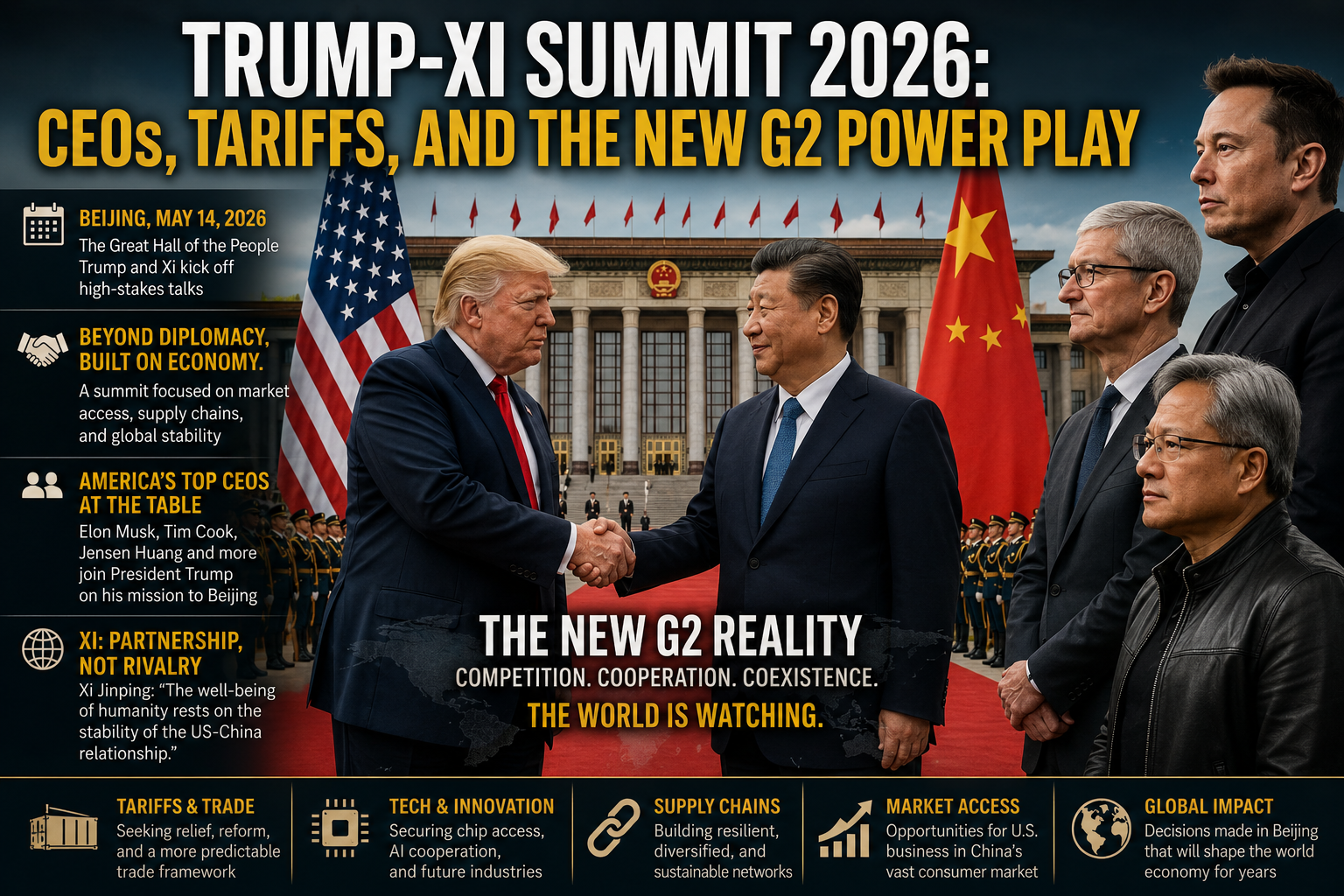
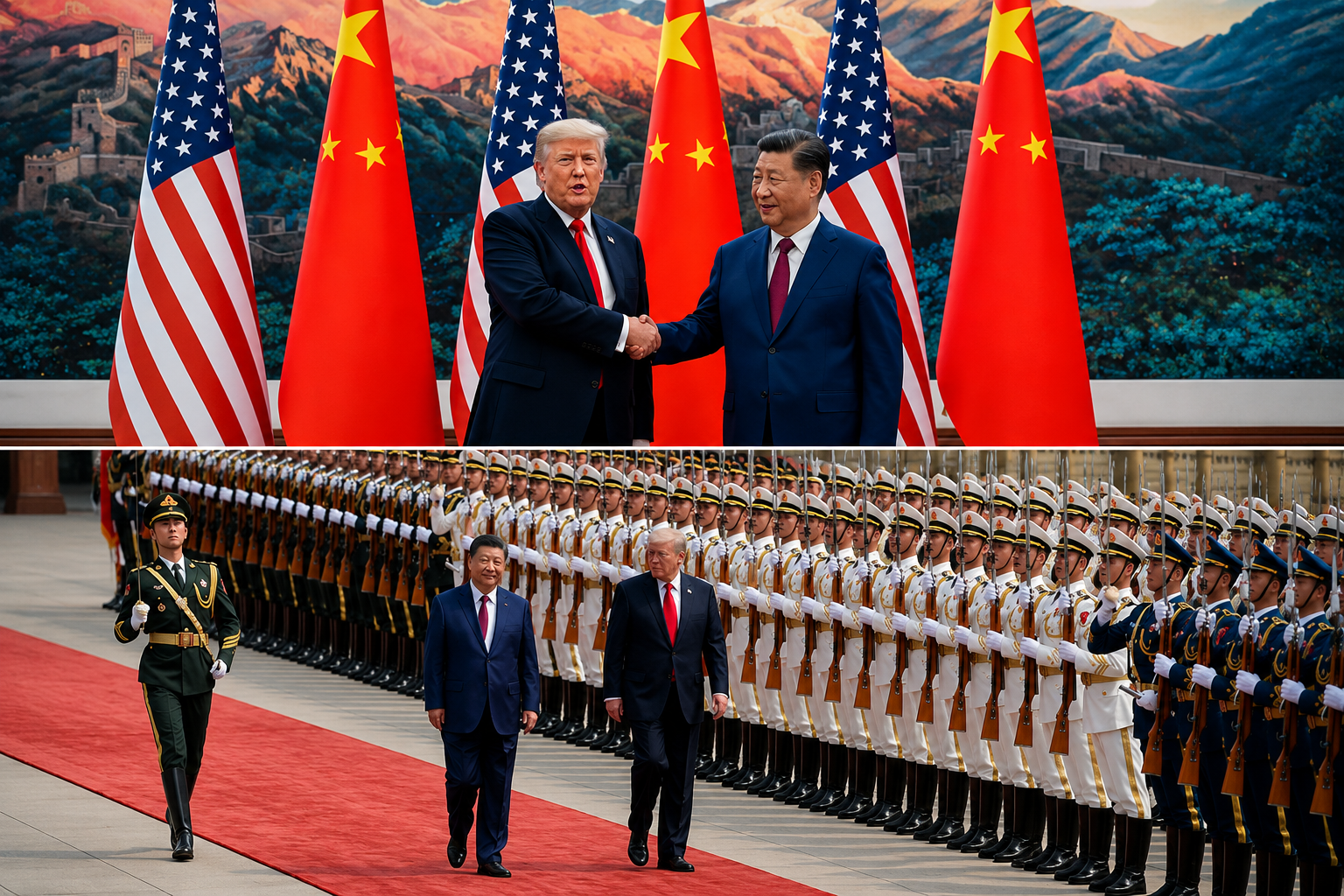
The eyes of the global market are fixed on the Great Hall of the People this Thursday, May 14, 2026, as Trump-Xi Summit negotiations officially kick off. US President Donald Trump has returned to Beijing for the first time in nearly a decade, but the atmosphere is far removed from his 2017 visit. This isn’t just a diplomatic handshake; it is a high-stakes corporate mission designed to prevent a total economic fracture between the world’s two largest superpowers.
Accompanied by a “who’s who” of American industry—including Elon Musk, Tim Cook, and Jensen Huang—Trump is seeking a “tangible handshake” that secures market access and stabilizes supply chains. Meanwhile, President Xi Jinping is calling for a partnership rather than a rivalry, emphasizing that the well-being of humanity rests on the stability of the US-China relationship.
The CEO Delegation: Boardroom Diplomacy
When President Trump walked into the Great Hall, he wasn’t backed just by diplomats, but by the engines of the American economy. The presence of these tech and finance titans signals that the Trump-Xi Summit is primarily a business negotiation.
Each executive on the plane arrived with a specific, high-priority “ask”:
Elon Musk (Tesla): Seeking the green light for Full Self-Driving (FSD) in China and clearance for nearly $3 billion in solar equipment imports.
Tim Cook (Apple): Looking for regulatory peace in Apple’s primary manufacturing hub.
Jensen Huang (Nvidia): Pushing for the approval of AI chip sales to Chinese firms.
Jane Fraser (Citi) & Mastercard/Visa: Aiming for deeper penetration into the massive Chinese domestic payments market.
Boeing & Cargill: Pursuing massive orders for aircraft and agricultural products like soybeans and meat.
This “backchannel diplomacy” suggests that the White House is using corporate leverage to secure a trade deal that markets can celebrate immediately.
The 100% Tariff Wall and the Quest for a Truce
The backdrop of this meeting is the scorched earth left by last year’s trade hostilities. With tariffs peaking at 100%, both nations have felt the sting. The US has battled rising inflation fueled by disrupted supply chains, while China has struggled with slowing exports and a cooling property market.
The central goal of the Trump-Xi Summit is the extension of the “South Korea Truce” signed last October. Both leaders are exploring a framework to ease tariffs on approximately $30 billion worth of goods. This is not a “Grand Peace” but a “Managed Trade” agreement—a way to ensure that the competition remains profitable rather than predatory.
Geopolitical Challenges: Iran, Taiwan, and Rare Earth Minerals
While trade is the engine, geopolitics is the steering wheel. Two major shadows loom over the talks:
The Iran Crisis: With the Strait of Hormuz in turmoil, global energy prices are at risk. China, as a primary buyer of Iranian oil, holds significant leverage. Trump is expected to ask Xi to use Beijing’s influence over Tehran to keep the shipping lanes open.
Taiwan and AI: In a departure from traditional protocol, Trump has indicated he will discuss US arms sales to Taiwan directly with Xi. Furthermore, the two leaders are looking to establish a formal dialogue on the existential risks of Artificial Intelligence.
The “weaponization” of supply chains is also a major sticking point. Trump wants guarantees that China will not restrict the export of rare earth minerals, which are vital for US defense and high-tech industries.
What This Means for the Global Order
President Xi’s opening remarks were measured, urging Washington to adopt a steadier approach. “Cooperation benefits both sides, while confrontation harms both,” Xi asserted. This reflects a shift in the balance of power; analysts suggest that China may currently hold the upper hand, given Trump’s domestic political pressures and the urgency of the US tech sector.
For India, the Trump-Xi Summit is a double-edged sword. While a de-escalation in the Strait of Hormuz would lower oil costs for New Delhi, a cozying up of US-China trade could slow the “China Plus One” momentum that has benefited Indian manufacturing. As the BRICS summit continues in New Delhi, Indian policymakers are watching Beijing with bated breath.
The outcome of this summit won’t just define the next four years of trade—it will determine if the “G2” can coexist as partners or if the world is headed for a permanent economic divide.
Detailed Analysis: The Three Pillars of the 2026 Beijing Talks
1.Obstacles in the Technology and Defense Sectors
The primary concern for the US delegation remains the “Critical Mineral Trap.” As the US moves toward a more electrified and AI-driven economy, the reliance on Chinese-processed minerals has become a national security vulnerability. At the Trump-Xi Summit, the US is seeking a “Non-Interference Treaty” regarding rare earth exports. In exchange, China wants a relaxation of the “Entity List” restrictions that have crippled firms like Huawei and slowed their own AI development.
2. Agricultural and Energy Commitments
For Trump, the “Blue Wall” and “Farm Belt” voters remain a priority. A win in Beijing must include multi-billion dollar commitments for US Liquefied Natural Gas (LNG) and soybeans. This would allow Trump to claim he is “rebalancing” the trade deficit, a core promise of his administration.
3. The “G2” Framework
President Xi’s message that the U.S. and China should be “partners, not rivals” is a strategic way to show that China is now just as powerful as America. By agreeing to this “G2” idea, the U.S. is finally recognizing China as a top-tier global leader.
The goal of this summit is not for the two countries to agree on everything. Rather, it is about creating a safety plan. They want to establish clear rules for trade and the military to prevent any mistakes that could lead to a fight or a financial disaster. It’s about keeping the relationship stable, even if they don’t always agree.
Key Takeaways from the Great Hall
| Stakeholder | Primary Objective | Potential Concession |
| Donald Trump | Trade Deficit Reduction | Easing Tech Export Bans |
| Xi Jinping | Economic Stability | Increased US Farm Purchases |
| Tech CEOs | Supply Chain Security | Compliance with Chinese Data Laws |
| Global Markets | Tariff Truce Extension | Acceptance of Managed Trade |
The Trump-Xi Summit continues through the weekend, with live updates expected as the corporate delegations begin their closed-door “Boardroom Diplomacy” sessions. While a “breakthrough” is unlikely, the avoidance of a “breakdown” is the goal that the entire world is rooting for.