
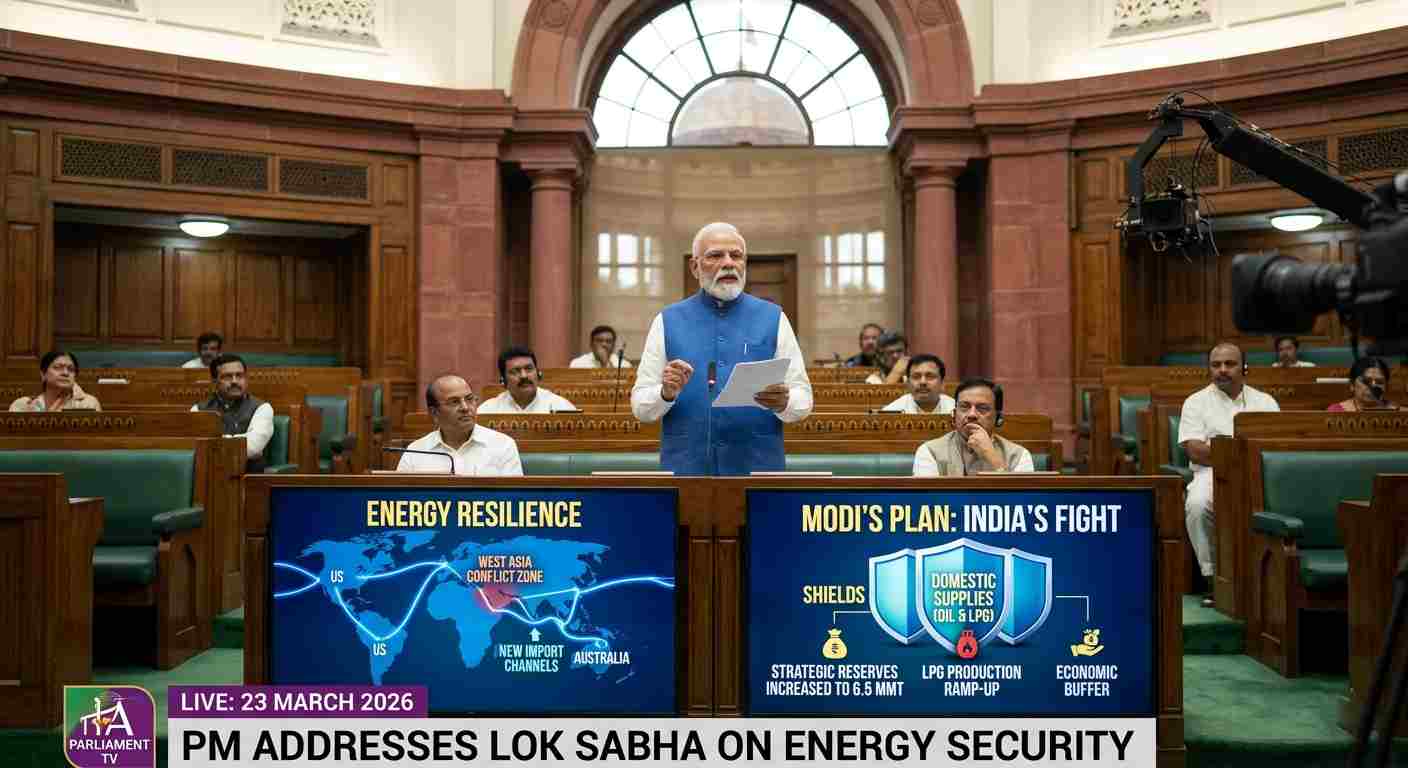
NEW DELHI –PM Modi’s Plan:In a high-stakes address to the Lok Sabha on Monday, March 23, 2026, Prime Minister Narendra Modi painted a sobering yet resolute picture of India’s standing amidst the escalating conflict in West Asia. Since the joint US-Israeli military operations against Iran commenced on February 28—a campaign that saw the death of Supreme Leader Ayatollah Ali Khamenei on its opening day—the world has watched with bated breath as the Gulf region slid into a state of unprecedented volatility.
With the Strait of Hormuz—a global energy artery responsible for nearly 20% of the world’s oil and a staggering 60% of India’s LPG imports—effectively choked by the conflict, the Prime Minister sought to reassure a nation grappling with rising energy costs and supply anxieties.
PM Modi’s Plan:Protecting the Indian Household
PM Modi’s Plan: How India is Fighting the Global Energy Crisis. The Prime Minister acknowledged the anxiety of “crores of Indians” who are worried about their monthly budgets. With fuel prices rising globally, the Indian government has taken proactive steps to ensure that the kitchen fire keeps burning.
LPG Priority: India imports nearly 60% of its LPG (cooking gas) needs. PM Modi confirmed that the government is ramping up domestic production to fill the gap.
Safe Passage: Despite the danger, India has successfully guided two LPG ships through the conflict zone this month, with two more currently on their way.
Price Control: “Our effort is to ensure that petrol, diesel, and gas supplies are not disrupted,” the PM said, promising that ordinary families should face as little trouble as possible.
PM Modi’s Plan:Securing the Indian Kitchen: The LPG Crisis
PM Modi’s Plan: How India is Fighting the Global Energy Crisis Perhaps the most immediate concern for the average Indian household is the availability of cooking gas. With 91% of India’s LPG traditionally sourced from the Gulf, the war has forced the government into emergency mode.
Domestic Prioritization: The government has invoked the Essential Commodities Act, ordering refiners to divert all Propane and Butane away from petrochemical production toward household LPG.
Supply Diversification: In a significant shift in trade routes, India has doubled its LPG imports from Argentina and stepped up long-term agreements with the United States to bridge the gap.
Price Monitoring: While domestic cylinder prices in New Delhi have seen a hike to approximately ₹913, the PM warned state governments to act strictly against black marketers and hoarders who are reportedly selling commercial cylinders at nearly double the normal rates.
The Hormuz Chokehold: A Global Energy Shockwave
The “Operation Epic Fury,” as dubbed by the U.S., has triggered a geopolitical earthquake. Iran’s retaliation against oil-exporting neighbors and the subsequent disruption of the Strait of Hormuz have sent Brent crude prices hovering between $110 and $120 per barrel. For India, the stakes are uniquely high.
“The situation in West Asia is worrisome,” the Prime Minister stated. “This conflict has been going on for more than three weeks. It has a severe impact on the global economy and the lives of the people.”
The closure of the Strait is not merely a diplomatic hurdle; it is a physical barrier to the 1.3 million barrels of oil India imported daily from the region prior to the war. The impact is already being felt across various sectors, from ceramic factories in Gujarat to the canteens of small-scale industries.
Strategic Reserves: India’s Economic Shield
Amidst the gloom, the Prime Minister highlighted India’s “strong economic fundamentals” as the primary cushion against this external shock. India currently holds 5.3 million metric tons (MMT) of strategic petroleum reserves—enough to provide a buffer for about 7 to 8 weeks of consumption.
| Feature | Current Status | Future Target |
| Strategic Oil Reserves | 5.3 MMT | 6.5 MMT |
| Import Sources | 41 Nations | Expanding |
| Refining Capacity | Significant Increase | Target 400 MMTPA by 2047 |
| Ethanol Blending | 20% Achieved | Reducing Crude Dependence |
The PM also noted that the Reserve Bank of India (RBI) is closely monitoring the Indian Rupee, which recently crossed the 92/USD mark, to limit adverse spillovers into the broader economy.
Humanitarian and Diplomatic Fronts
The crisis is not just one of oil and gas; it is human. With nearly one crore (10 million) Indians living and working in the Gulf, the safety of the diaspora is paramount.
Operation Safe Homecoming: Over 375,000 Indians have already returned safely since the conflict began, including 1,000 from Iran (mostly medical students).
Educational Safeguards: The CBSE has proactively cancelled Class 10 and 12 exams in Gulf-based schools to ensure the safety of students.
Maritime Security: The Indian Navy and diplomatic channels are working to ensure “safe transit” for Indian-flagged vessels. Two LPG tankers successfully transited the Strait earlier this month through high-level diplomatic coordination.
A Call for Unity and Preparedness
Drawing a parallel to the COVID-19 pandemic, PM Modi urged the nation to “be alert and stay united.” He cautioned against rumors and pointed out that the effects of this war—ranging from fertilizer shortages for the summer sowing season to increased shipping costs—might be felt for a long time.
“Dialogue and diplomacy are the only solutions,” Modi reiterated, confirming he has held multiple rounds of talks with West Asian heads of state to advocate for de-escalation.
As the Budget Session of 2026 continues, the government’s focus remains clear: shielding the Indian “thali” and the industrial engine from the flames of a distant, yet deeply impactful, war.
Next Step: Would you like me to draft a detailed analysis of how the 20% ethanol blending target is specifically helping India reduce its current dependence on Middle Eastern crude?
PM Modi’s address on the Middle East crisis and energy security
This video provides a visual and auditory breakdown of the Prime Minister’s concerns regarding the LPG shortage and the broader economic impact of the Strait of Hormuz blockade.
Disclaimer: This information is based on various inputs from news agency.