
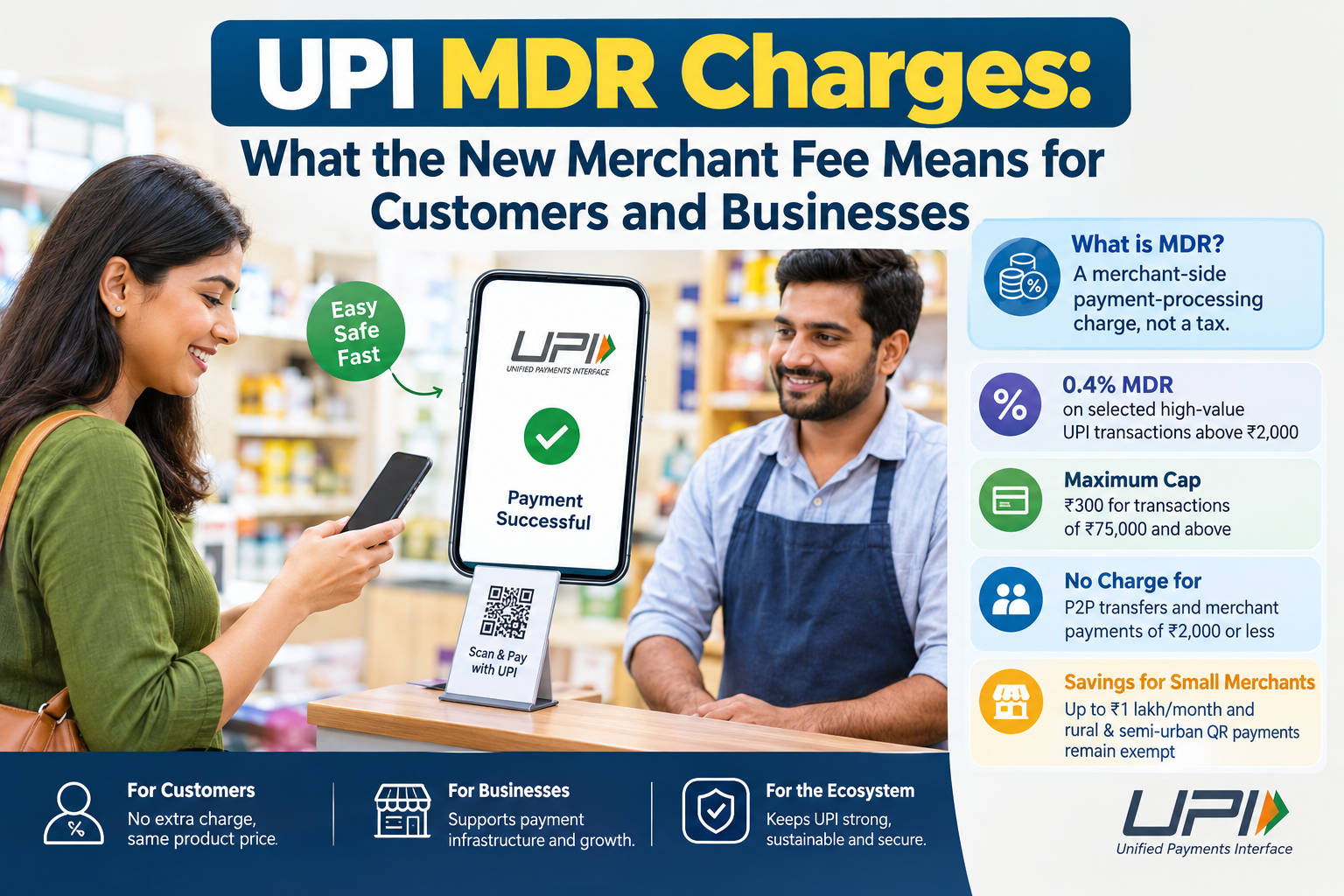
The UPI MDR Charges have become a topic of conversation after the government said it wants to set a merchant discount rate on certain big UPI payments starting on October 15. The new plan has made a lot of people wonder if using UPI to pay will cost more now.
The government and the National Payments Corporation of India which runs UPI have said the MDR is a charge for processing payments on merchant transactions. It is not a tax or a extra fee that the government collects.
Under the plan there will be a 0.4% MDR on certain person-to-merchant UPI payments that are over ₹2,000. The cost will not go over ₹300 for payments that’re ₹75,000 or more. At the time person-to-person transfers and payments to merchants that are ₹2,000 or less will still have no MDR.
The government says that 96% of UPI payments, to merchants will not be affected by the new rules. Customers are not supposed to pay the MDR. Banks have been told to make sure that merchants do not add this cost to what customers pay.
This news is coming at a time when UPI’s one of the most popular ways to pay in India. Many people use it for shopping. The new fee plan might affect merchants, banks, payment apps and the whole digital payment system.
This article explains the UPI MDR plan, how the charges are calculated which payments are included why the change is happening and what it could mean for people and businesses.
What Are UPI MDR Charges?
Merchant Discount Rate, commonly known as MDR, is a fee associated with processing digital payments made by customers to merchants.
When a customer pays a shopkeeper or business through a digital payment system, several participants may be involved in completing the transaction. These can include the customer’s bank, the merchant’s bank, a payment gateway, the payment application, and other payment service providers.
MDR is intended to compensate eligible participants for providing the infrastructure and services required to process a payment.
Under the proposed UPI framework, the charge would apply only to specified high-value person-to-merchant transactions. It would not apply to every UPI payment.
The government has also clarified that MDR is not a government tax. The amount collected would be distributed among participants in the payment ecosystem rather than being deposited into the Consolidated Fund of India.
This distinction is important because a payment-processing fee and a government tax serve different purposes. A tax is collected by the government under applicable laws, whereas MDR is a commercial charge associated with processing eligible transactions.
UPI MDR Charges: Key Highlights of the Proposed Rules
Here are the main details of the proposed merchant fee structure:
- Effective date: October 15, according to the supplied announcement.
- Standard MDR rate: 0.4% on specified eligible merchant transactions.
- Transaction threshold: Merchant payments above ₹2,000.
- Maximum MDR: ₹300 for transactions of ₹75,000 and above.
- Person-to-person transfers: Continue to carry zero MDR.
- Merchant payments of ₹2,000 or less: Remain free of MDR.
- Essential sectors: A flat ₹5 MDR for eligible transactions above ₹2,000 in specified sectors.
- Small merchants: Merchants collecting up to ₹1 lakh per month through UPI QR codes remain exempt under the proposed framework.
- Rural and semi-urban QR payments: Remain free under the framework described in the announcement.
- Consumer protection: Banks have been advised to prevent merchants from passing the fee on to customers.
The proposed structure is designed to distinguish between routine, low-value payments and selected higher-value commercial transactions.
Is UPI MDR a New Tax on Digital Payments?
I hear that many people are worried about whether the merchant discount rate’s a new tax on UPI users.
Government officials and NPCI say that MDR is a payment‑processing charge, not a tax, cess or surcharge.
Government says that money collected from MDR will stay inside the payments ecosystem. Money will not go into the government’s Consolidated Fund.
This means that the proposed fee supports institutions and service providers who process digital payments.
However it is important to see the difference between a fee on the merchant side and a cost that the consumer faces.
Even if a charge is placed on merchants businesses may look at their operating costs when setting prices for products and services. The proposed framework wants to stop merchants from passing MDR to customers. You might wonder how the real impact will play out. It will depend on how the framework is implemented and on compliance.
For consumers the main question is whether the amount paid at checkout will change. Under the stated framework customers should not see MDR as a charge.
How Will the 0.4% MDR Work on UPI Transactions?
The proposed standard MDR rate is 0.4% for transactions that are, above ₹2,000.
MDR is calculated on the transaction amount with a cap and exemptions that apply.
Here are a few examples that show how the standard rate would work.
| Transaction amount | Standard MDR at 0.4% |
|---|---|
| ₹2,000 | ₹0 |
| ₹3,000 | ₹12 |
| ₹5,000 | ₹20 |
| ₹10,000 | ₹40 |
| ₹25,000 | ₹100 |
| ₹50,000 | ₹200 |
| ₹75,000 | ₹300 |
| ₹1,00,000 | ₹300, subject to the stated cap |
I think these examples assume that the transaction qualifies for the MDR and does not fall under a special exemption or sector‑specific rate.
I believe the proposed structure also sets a MDR of ₹300 for transactions of ₹75,000 and more. Thus the fee will not keep rising in proportion once the cap is reached.
Example: A ₹5,000 UPI Payment
Imagine a customer buying a product that costs ₹5,000 from a merchant.
Under the proposed framework:
Purchase amount: ₹5,000
Standard MDR rate: 0.4%
Merchant‑side processing charge: ₹20
The calculation is simple:
₹5,000 × 0.4% = ₹20
I expect the merchant‑side MDR to equal ₹20 if the transaction meets the rate.
I understand that the government has stated that the customer must still pay ₹5,000 for the product while the merchant bears the processing charge.
For comparison a hypothetical credit‑card MDR of 2%, on the transaction would be ₹100. Real card‑processing rates may differ based on the merchant agreement and payment arrangement.
I see that the comparison shows how different payment methods can have processing costs even when the product price stays the same.
Which UPI Transactions Will Remain Free?
The proposed rules do not introduce a merchant discount rate on every UPI transaction.
Several categories are expected to remain outside the standard charge structure.
1. Person-to-Person Transfers
Transfers between individuals will continue to carry zero MDR under the announced framework.
For example, sending money to a friend, transferring funds to a family member, or splitting a shared expense between individuals will remain outside the proposed merchant fee.
This distinction separates personal money transfers from payments made to businesses for goods and services.
2. Merchant Payments of ₹2,000 or Less
Merchant transactions worth ₹2,000 or less will continue to carry zero MDR.
This means everyday purchases such as groceries, snacks, local transport payments, and other small transactions would remain unaffected by the standard merchant charge when they fall within the stated threshold and applicable rules.
The threshold is intended to preserve the existing zero-MDR arrangement for low-value merchant payments.
3. Eligible Small Merchants
Small merchants collecting up to ₹1 lakh per month through UPI QR codes are described as exempt from the proposed MDR.
This provision is intended to protect smaller businesses that rely on digital payments for routine sales.
For a small shop with limited margins, even a modest processing fee can affect operating costs. Exemptions can help such businesses continue accepting digital payments without taking on the proposed charge.
4. Rural and Semi-Urban QR Payments
The proposed framework also states that UPI QR payments to merchants in rural and semi-urban areas will remain free.
The stated objective is to preserve access to digital payments for businesses and customers outside major urban centres.
The exact application of these exemptions will depend on the final eligibility conditions and implementation guidelines.
What Is the Special ₹5 MDR for Essential Sectors?
The proposed framework provides a separate rate for certain essential sectors.
For eligible transactions above ₹2,000, sectors such as railways, telecommunications, insurance, fuel, and agricultural inputs will attract a flat ₹5 MDR, according to the supplied announcement.
This differs from the standard 0.4% rate.
The special rate is intended to distinguish these categories from other high-value merchant transactions.
For example, a qualifying payment of ₹10,000 in one of the specified sectors would attract a flat ₹5 MDR under the stated framework rather than the ₹40 charge calculated under the standard 0.4% rate.
However, the special rate should not be assumed to apply to every transaction in these sectors. Eligibility will depend on the specific classification and conditions established under the framework.
How Will MDR Be Distributed Among Payment Providers?
The proposed framework provides for the distribution of MDR among different participants in the payment ecosystem.
According to the supplied details, the proposed allocation is as follows:
| Payment ecosystem participant | Share of MDR |
|---|---|
| Issuing bank and customer’s bank | 40% |
| Merchant acquirer, merchant’s bank, or payment gateway | 30% |
| UPI application or third-party application provider (TPAP) | 20% |
| Payer PSP bank or sponsoring bank | 10% |
| Government of India | 0% |
The allocation is intended to compensate institutions that contribute to processing eligible merchant transactions.
The issuing bank supports the customer’s payment account, while the acquiring bank or payment gateway helps the merchant accept and process payments. UPI applications provide the interface through which users initiate transactions, and sponsoring banks support the payment application infrastructure.
The proposed distribution therefore spreads the processing revenue across several participants rather than directing it to a single institution.
The government has stated that it will not receive MDR as tax revenue.
Why Is the Government Considering MDR on UPI Transactions?
The main argument for introducing MDR is the growing cost of operating UPI at a national scale.
UPI has expanded from a digital payment option into a major part of India’s financial infrastructure. It supports transactions across retail stores, online businesses, service providers, and individual users.
Operating such a system requires substantial investment in technology and infrastructure.
These costs include:
- Payment servers and computing infrastructure.
- Network bandwidth and connectivity.
- Cybersecurity and fraud-prevention systems.
- Transaction processing and settlement infrastructure.
- Technical support and system maintenance.
- Infrastructure upgrades to accommodate growing transaction volumes.
According to the supplied report, NPCI CEO Dilip Asbe said that the cost of operating UPI at scale was approximately ₹21,000 crore annually, based on data submitted by the Reserve Bank of India about a year earlier.
Asbe reportedly said that the ecosystem could reasonably aim to recover around ₹13,000 crore to ₹15,000 crore in the first year to encourage continued investment and expansion.
This figure is lower than the estimated annual operating cost.
The proposed MDR is therefore presented as a way to create a revenue stream for payment service providers while retaining zero-MDR treatment for a large share of routine transactions.
UPI’s Growing Transaction Volume and User Base
The size of UPI is a reason that people talk about what UPI costs to process payments.
The report says UPI handled 24,508.96 million transactions in August 2026.
UPI’s total transaction value was about ₹29.82 lakh crore in August 2026.
These numbers show how big the activity on UPI is and how infrastructure UPI needs to run.
The report also says UPI had 55.49 crore users by June 2026 as the Ministry of Finance reports.
A larger user base and more transactions make it very important that UPI’s payment infrastructure is reliable. It also makes people wonder how the cost of keeping and growing UPI should be shared among the banks and other partners.
The proposed MDR framework is one way to solve that problem.
Why Has the Government Set a ₹2,000 Threshold?
The ₹2,000 threshold is meant to keep low‑value merchant transactions free while adding a fee to some higher‑value payments.
The government says that about 4% of person‑to‑merchant transactions were above ₹2,000.
Those higher‑value transactions made up a much bigger share of the money that goes through UPI.
The difference between how transactions there are and how much they are worth is key, to understanding the fee plan.
A payment system can handle small buys and fewer big buys. Charging only some big buys can make money without using the MDR on most everyday purchases.
The government says that 96% of merchant transactions will not be affected.
That number looks at the share of transactions not the share of all the money that moves through UPI.
The difference matters because a few high‑value payments can make up a part of the total value of all transactions.
Will UPI MDR Charges Affect Customers?
The government’s stated position is that consumers should not pay the proposed merchant discount rate directly.
Banks have been advised to ensure that merchants do not pass the charge on to customers.
Under the proposed framework, the merchant would bear the eligible processing fee.
For example, if a customer purchases a product priced at ₹5,000, the customer should pay the stated price of ₹5,000 rather than an additional ₹20 as MDR.
However, there are two separate issues to consider.
The first is the formal payment rule, which states that the merchant should bear the charge.
The second is the broader business impact. Merchants may consider payment-processing costs alongside rent, salaries, inventory expenses, and other operating costs when managing their businesses.
The government’s position is that the charge should not be passed on directly to customers. How effectively this is implemented will depend on merchant compliance, banking oversight, and the final operating guidelines.
For consumers, the practical point is that the proposed MDR is not intended to be an additional checkout fee.
Same MRP, Any Mode: Will Product Prices Change?
The proposed MDR does not change the Maximum Retail Price (MRP) of a product.
A product with an MRP of ₹5,000 will still be priced at ₹5,000. This price stays the same no matter if the customer pays using UPI, a debit card or any other allowed payment method.
The government says that merchants have always taken care of the cost of processing payments for card transactions. They include these costs in their pricing when they set the prices of products.
In the UPI framework the merchant-side MDR is seen as a payment-processing expense. It is not treated as a tax that gets added to the product itself.
This difference matters because the price of a product and the cost of accepting a payment are two things, in any business transaction.
The official policy makes it clear: the new charge should not lead to customers paying a MDR on top of the product price.
How will the proposed MDR affect businesses?
Small businesses play a vital role in India’s digital payment world.
Local shops, neighborhood service providers, street vendors and small retailers often use UPI QR codes to get paid.
For these merchants digital payments can cut the need for cash. Make transactions easier for customers.
These exemptions aim to keep the benefits for small merchants and for QR payments in rural and semi‑urban areas.
Businesses that do not meet the exemption rules might have to include the MDR in their payment‑processing costs.
When merchants take payments the effect of the MDR will hinge on how many transactions they handle the average size of each payment and the fee group that applies.
The plan also wants to send 5 % of all MDR revenue to a fund that will grow UPI use by small merchants.
NPCI CEO Dilip Asbe said that the fund could grow to, about ₹3,000 crore in three years depending on how the scheme’s designed and rolled out.
This MDR‑related fund is meant to help smaller businesses accept digital payments.
What Does the New Framework Mean for Banks and Payment Apps?
Banks and payment applications are important participants in the UPI ecosystem.
They provide the infrastructure and services that allow customers to initiate payments, merchants to receive funds, and transactions to be processed.
Under the proposed MDR structure, eligible payment-processing revenue would be distributed among several participants.
For banks, this could provide an additional source of revenue associated with eligible merchant transactions.
For payment applications, the proposed allocation could help support the cost of maintaining and expanding their services.
Payment gateways and merchant-acquiring institutions could also receive a share for their role in enabling merchants to accept payments.
At the same time, the proposed fee structure would require participants to follow the applicable transaction classifications, exemptions, and merchant-protection rules.
The longer-term impact will depend on the number of transactions covered by MDR, the costs incurred by payment providers, and the extent to which the revenue supports continued infrastructure investment.
Will MDR Cover the Entire Cost of Running UPI?
The proposed merchant discount rate or MDR is not expected to cover the cost of running UPI.
According to the report NPCI estimates the annual cost of operating the UPI system at scale is around ₹21,000 crore.
Asbe reportedly said the ecosystem could reasonably aim to recover between ₹13,000 crore and ₹15,000 crore in the year.
This means the proposed MDR is meant to recover a portion of the total operating cost.
The report also notes that about 10% of the total value of UPI transactions might face the risk of charges being passed on to consumers under the proposed plan.
Large corporations that already accept credit cards are expected to take on much of the merchant-side cost according to the report.
However the share of transaction value that could be affected should not be confused with the share of transactions that will be charged MDR.
These two metrics measure parts of the payment system.
The bigger question remains: Can the proposed fee structure generate revenue to support the payment infrastructure while still keeping access affordable, for small merchants and everyday users?
What Should UPI Users and Merchants Know Before October 15?
The proposed framework includes several conditions that consumers and businesses should understand.
For consumers:
- Person-to-person UPI transfers are expected to remain free of MDR.
- Merchant payments of ₹2,000 or less are expected to remain free.
- The merchant discount rate is not intended to be charged separately to customers.
- Product MRP is not supposed to change because of the merchant-processing fee.
- Consumers should distinguish between an official payment charge and any separate fee a merchant may attempt to impose.
For merchants:
- The standard 0.4% MDR applies only to specified eligible merchant transactions above ₹2,000.
- The maximum standard MDR is ₹300 for transactions of ₹75,000 and above.
- Eligible essential-sector transactions have a separate flat ₹5 rate.
- Qualifying small merchants and certain rural and semi-urban QR transactions are described as exempt.
- Businesses should confirm their eligibility and applicable transaction category before calculating payment-processing costs.
The final practical impact will depend on the detailed operating guidelines, merchant classification, and implementation of the proposed rules.
UPI MDR Charges: Key Questions Answered
1. What is the proposed UPI MDR rate?
The standard UPI MDR is 0.4% on UPI payments that are above ₹2,000. This UPI MDR rate is subject to a cap and some exemptions.
2. When will the proposed MDR framework begin?
The effective date for the UPI MDR framework is October 15.
3. Is MDR a tax collected by the government?
No. The government and NPCI say that UPI MDR is a payment‑processing fee, not a tax, cess or surcharge.
4. Will customers have to pay MDR
Merchants will pay the UPI MDR. Banks must ensure that this fee is not passed on to customers.
5. Will UPI payments below ₹2,000 remain free?
Yes. UPI payments of ₹2,000 or less will continue to have zero UPI MDR.
6. Will person‑to‑person UPI transfers attract MDR?
No. Person‑to‑person UPI transfers will remain free of UPI MDR.
7. What is the maximum MDR under the proposed framework?
The maximum UPI MDR is ₹300 for UPI transactions of ₹75,000 and above.
8. What is the special rate for sectors?
UPI transactions above ₹2,000 in sectors such as railways, telecommunications, insurance, fuel and agricultural inputs will have a flat ₹5 UPI MDR.
9. Will small merchants have to pay MDR?
Small merchants who collect up to ₹1 lakh per month through UPI QR codes are exempt, from UPI MDR.
10. Will the new fee change the price of products?
The new UPI MDR does not change a products MRP. The government says that the merchant should cover the UPI MDR not add it to the customer.
A New Funding Approach for India’s UPI Ecosystem
The proposed UPI MDR framework represents a change in how selected high-value merchant transactions may contribute to the cost of operating India’s digital payment infrastructure.
The standard 0.4% merchant discount rate would apply only to specified person-to-merchant transactions above ₹2,000, while person-to-person transfers and lower-value merchant payments would remain outside the charge.
The framework also includes exemptions for eligible small merchants and certain rural and semi-urban QR payments, along with a separate flat rate for specified essential sectors.
The government’s position is that MDR is a payment-processing charge, not a tax, and that customers should not be required to pay it separately. The proposed distribution of MDR is intended to support banks, payment gateways, payment applications, and other participants in the payment ecosystem.
At the same time, the estimated annual cost of operating UPI remains a central part of the discussion. The proposed fee is intended to recover part of that expense and encourage continued investment in the payment network.
For consumers, the key issue is whether everyday UPI payments remain convenient and free of additional charges. For merchants and payment providers, the focus will be on eligibility, processing costs, and the practical implementation of the proposed rules.
As the proposed October 15 date approaches, the detailed guidelines and implementation measures will be important in determining how the framework operates in practice.
The bottom line: The proposed UPI MDR charges are designed to apply to selected high-value merchant transactions, not every digital payment. The stated objective is to support the payment ecosystem while preserving free UPI transfers and protecting consumers from direct MDR charges.