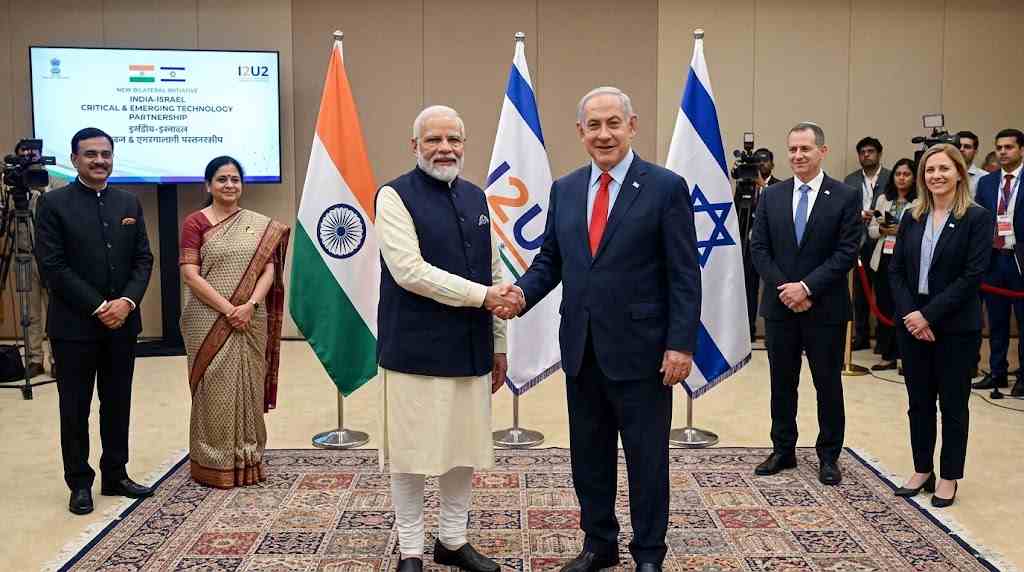
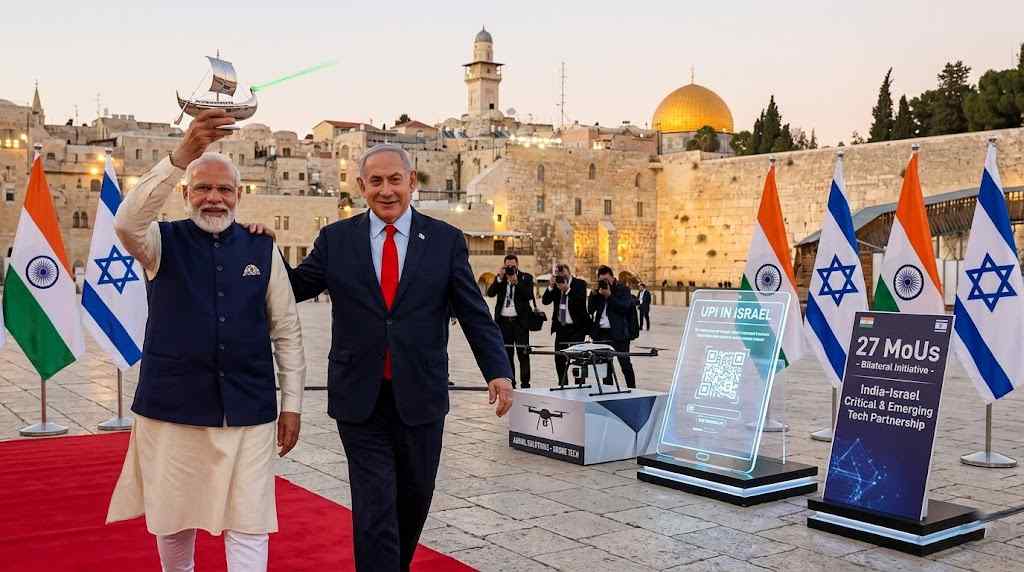
February 26, 2026 —India and Israel: Prime Minister Narendra Modi’s two-day state visit to Israel (February 25–26, 2026) has culminated in what diplomats are calling a “civilizational reset.” Exactly nine years after his historic first visit in 2017, the Prime Minister returned to a nation that has become one of India’s most critical allies.
The visit concluded with the formal elevation of ties to a “Special Strategic Partnership for Peace, Innovation, and Prosperity,” a designation that signals a shift from a transactional buyer-seller relationship to a futuristic alliance based on co-development and deep technological integration.
1.India and Israel The Elevation: What “Special Strategic” Means
While the 2017 visit established a “Strategic Partnership,” the 2026 upgrade is far more than a nomenclature change. This “Special” status institutionalizes a Government-to-Government (G2G) mechanism that will now oversee cooperation in highly sensitive areas.
- Shared Vision: The partnership is explicitly linked to India’s “Viksit Bharat 2047” vision and Israel’s “Israel 2048” goals.
- The “Minds and Hearts” Bond: Prime Minister Benjamin Netanyahu noted that the relationship has moved from “deeply emotional” to “extraordinarily productive,” describing the two nations as “vibrant democracies navigating a complex world.”
2.Defense: From Imports to “Make in India”
Defense remained a cornerstone, but the narrative shifted heavily toward joint production and technology transfer.
- The “Sudarshan Chakra” Shield: A major highlight was India’s interest in integrating elements of Israel’s Iron Dome and the Iron Beam (a 100kW high-energy laser system) into its own indigenous air defense shield, Sudarshan Chakra. This is designed to create a cost-effective interceptor system for drones and rockets.
- Aero-Tech & Drones: Discussions covered the joint development of miniaturized communication satellites and Synthetic Aperture Radar (SAR) systems by Israel Aerospace Industries (IAI) and Indian partners.
- MoU on November 2025: The leaders reviewed the roadmap created by the defense MoU signed late last year, focusing on making India a hub for the maintenance and repair of Israeli-origin systems in the Indo-Pacific.
3.The Digital Leap: UPI and Fintech
In a move that mirrors India’s digital diplomacy worldwide, UPI (Unified Payments Interface) is coming to Israel.
- NIPL and MASAV: An agreement was signed between NPCI International and Israel’s MASAV to implement UPI for cross-border remittances. This will facilitate easier financial transactions for the growing Indian diaspora and tourists.
- Fintech Hub: The IFSCA (Gujarat) and the Israel Securities Authority signed an MoU to collaborate on RegTech and Fintech, aiming to create a seamless investment corridor.
4.Technology & Innovation: The 27 MoUs
The visit saw a record 27 Agreements and MoUs signed across various frontier sectors.
Critical and Emerging Technologies (CET)
A new “Critical and Emerging Technology Partnership” was established, led by the National Security Advisors of both countries.
- Quantum Computing: Collaboration with firms like Quantum Machines to build the Israeli Quantum Computing Centre (IQCC) protocols in India.
- Horizon Scanning: A “Declaration of Intent” was signed to use AI for strategic risk detection and trend analysis.
- Semiconductors: Joint research on chip-level sensor technology, led by Israeli firms like Mobileye, to reduce road accidents in India.
Agriculture and Water: “Droplets of Life”
The partnership aims to bring Israeli technology to every Indian village.
- IINCA: The establishment of the India-Israel Innovation Centre for Agriculture (IINCA) at ICAR to develop satellite-based irrigation and precision farming.
- Sustainability: Innovations like WaterGen (producing water from air) and N-Drip (gravity-powered micro-irrigation) were showcased for large-scale deployment in water-stressed Indian states.
5.Labour Mobility: Powering the Israeli Economy
A significant protocol on Labour Mobility was signed to address Israel’s workforce needs.
- Expanded Sectors: Beyond construction and caregiving, the new protocols allow Indian workers to enter the Manufacturing, Restaurant, and Commerce/Services sectors in Israel.
- Scale: Reports suggest up to 50,000 additional workers could be recruited over the next five years through regulated, ethical channels.
6. Regional Diplomacy and the “Gaza Peace Initiative”
Amidst regional tensions, PM Modi’s visit was a delicate balancing act. He was the first leader to strongly back the Gaza Peace Initiative during his joint briefing.
“Humanity must never become a victim of conflict. Peace and stability in West Asia are directly linked to India’s security interests. New Delhi has always pitched for a peaceful solution through dialogue.” — PM Narendra Modi
The leaders also reaffirmed their commitment to the IMEC (India-Middle East-Europe Economic Corridor) and the I2U2 grouping, viewing Israel as a vital gateway for Indian goods into Europe.
7.Cultural and Historical Ties
The visit was laden with symbolic moments that resonated deeply with the Israeli public.
- Knesset Address: PM Modi’s address to the Israeli Parliament received a standing ovation. He was conferred the Speaker of the Knesset Medal, one of Israel’s highest parliamentary honors.
- Yad Vashem: The PM visited the World Holocaust Remembrance Center for the second time, honoring the victims and emphasizing shared values of human dignity.
- National Maritime Heritage Complex: An MoU was signed to help develop the Maritime Heritage Complex in Lothal, Gujarat, using Israeli expertise in maritime archaeology.
Summary of Key Outcomes
| Sector | Key Agreement/Discussion |
| Connectivity | Implementation of UPI for cross-border payments. |
| Strategic | Upgrade to Special Strategic Partnership status. |
| Defense | Roadmap for Iron Beam laser tech and Sudarshan Chakra integration. |
| Technology | CET Partnership covering AI, Quantum, and Semiconductors. |
| Labour | Protocols for Indian workers in Manufacturing and Restaurants. |
| Agriculture | 100 Centers of Excellence and the IINCA Innovation Center. |
The Verdict: A “Force Multiplier”
This visit has solidified India and Israel as a “technological and security axis” in the Indo-Pacific and West Asian regions. By focusing on joint research funding (increased to $1.5 million each) and secrecy agreements for intelligence sharing, the two nations have ensured that their bond is not just about today’s trade, but about tomorrow’s survival.
As PM Modi departed from Tel Aviv, seen off by the Netanyahus at the airport, the message was clear: India and Israel are no longer just friends; they are partners in a shared destiny.
During his visit to the Jerusalem Tech Exhibition, PM Modi engaged with high-level executives and startups that represent the “innovation bridge” between the two nations. Here is a short breakdown of the key tech interactions:
1.Quantum Computing & Deep Tech
- Quantum Machines: Discussed the integration of their OPX+ hardware with India’s National Quantum Mission. The focus is on providing a cloud-based quantum controller for Indian researchers.
- Classiq: Explored AI-driven quantum software development to help Indian engineers write quantum code without needing a PhD in physics.
2.Artificial Intelligence (AI) & Mobility
- Mobileye: A deep dive into Autonomous Driving and Advanced Driver Assistance Systems (ADAS). PM Modi expressed interest in using their vision-based mapping to improve road safety on Indian highways.
- AI21 Labs: Discussed Large Language Models (LLMs) tailored for Indian regional languages to enhance the “Bhashini” translation project.
3.Space and Ag-Tech
- SpacePharma: Interaction centered on “Lab-on-a-chip” technology for conducting medical experiments in microgravity—a key area for India’s Gaganyaan mission.
- SeeTree: Showcased “Intelligence for Trees,” using drones and AI to monitor the health of individual trees in orchards, which aligns with India’s goal for 100 Centers of Excellence.
4.Water & Clean Energy
- WaterGen: Reviewed the progress of “Atmospheric Water Generators” currently being deployed in Indian hospitals and remote villages to turn air into drinking water.
- H2Pro: Discussed high-efficiency Green Hydrogen production to help India meet its Net Zero goals by 2070.
Disclaimer: This information is based on various inputs from news agency.