
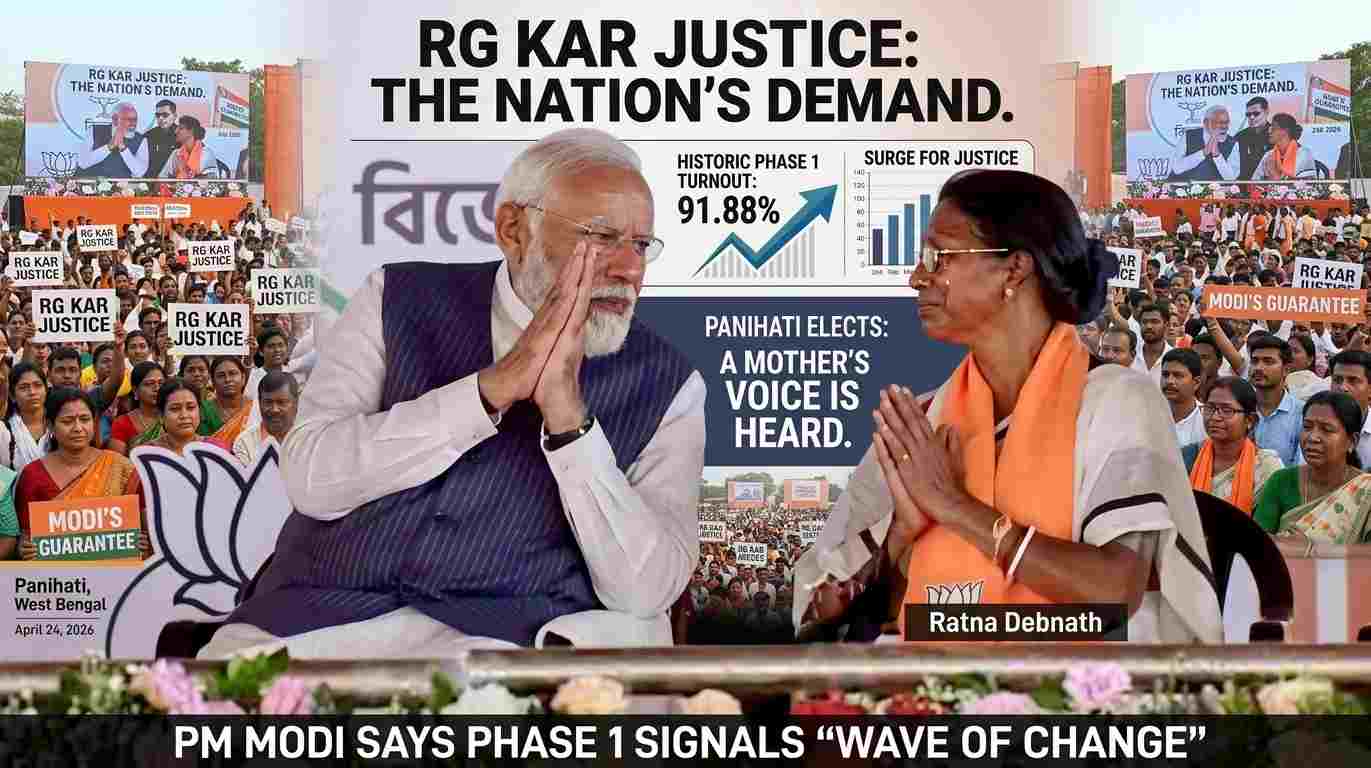
PM Modi Makes Emotional Appeal : The political landscape of West Bengal, already simmering with the heat of the 2026 Assembly Elections, reached a boiling point on Friday. In a move that has sent ripples across the nation, Prime Minister Narendra Modi shared a stage in Panihati with the mother of the RG Kar Medical College rape-murder victim. This wasn’t just a political rally; it was a high-stakes emotional indictment of the ruling Trinamool Congress (TMC).
Addressing a massive crowd in Dum Dum, the Prime Minister delivered what many are calling his most devastating critique of Mamata Banerjee’s tenure. By framing the tragic loss of a young doctor as a direct consequence of “TMC’s jungle raj,” Modi has placed women’s safety at the absolute center of the electoral battle.
A Mother’s Grief Becomes a Political Mandate
PM Modi Makes Emotional Appeal, The presence of Ratna Debnath, the mother of the 31-year-old trainee doctor who was brutally murdered in August 2024, added a somber and powerful weight to the rally. The BJP has taken the unprecedented step of fielding her as their candidate from Panihati, transforming her personal quest for justice into a public referendum on the state’s law and order.
“A mother worked tirelessly to help her daughter become a doctor, to serve the people of Bengal. That daughter was taken away from her by the TMC’s system,” PM Modi said, his voice echoing through the packed grounds. “We haven’t just given her a ticket; we have given a platform to every mother in Bengal who fears for her daughter’s life.”
The Prime Minister’s strategy is clear: he is directly challenging Mamata Banerjee’s core vote bank—women. For years, the “Ma, Mati, Manush” slogan has been the bedrock of the TMC’s strength. By highlighting the RG Kar tragedy, Modi is attempting to flip that narrative, suggesting that the “Ma” (Mother) of Bengal is no longer safe under the current regime.
The Shadows of RG Kar and Sandeshkhali
The rally served as a grim reminder of the events of August 9, 2024. The discovery of the trainee doctor’s body inside the seminar hall of a state-run hospital sparked nationwide outrage and months of protests by the medical fraternity. While the primary accused, Sanjay Roy, was handed a life term, the Prime Minister argued that the conviction is only a partial victory.
Modi accused the state administration of a cover-up and of silencing those who dared to speak out. He didn’t stop at RG Kar; he drew a direct line to Sandeshkhali, the region that became synonymous with allegations of institutionalized sexual assault and land grabbing in late 2024.
The Pattern of Protest: In both instances, the BJP has sought to institutionalize the survivors’ voices. Just as Rekha Patra was fielded in the 2024 Lok Sabha polls, Ratna Debnath is now the face of the 2026 Assembly battle.
The Accusation of Silence: “When the daughters of Bengal seek justice, the TMC tells them to stay indoors,” Modi alleged. “They don’t want the women of Bengal to dream because dreams lead to demands for rights and safety.”
“Modi’s Guarantee” and the Promise of May 4
As the first phase of polling concluded with a record-breaking turnout, the Prime Minister claimed the results are already a foregone conclusion. He described the high participation as a “wave of change” that would reconstruct the “temple of democracy” he claims the TMC has dismantled.
The most significant takeaway from the rally was Modi’s “Guarantee” for the future. He promised that a BJP government, if formed on May 4, would initiate a massive legal overhaul regarding crimes against women.
“On May 4, the files will be opened. Every atrocity committed against our sisters and daughters will be investigated. This is Modi’s guarantee—justice will not just be promised; it will be delivered.”
The Battle for the Female Vote
Historically, Mamata Banerjee has enjoyed a significant lead among female voters, largely due to social welfare schemes like Lakshmir Bhandar. However, the BJP’s focus on “Suraksha” (Security) over “Sarkari Sahayata” (Government Aid) is a calculated move to break this stronghold.
By standing next to a grieving mother who is now a candidate, the Prime Minister is forcing the electorate to choose between financial doles and physical safety.
The TMC’s Counter-Stance
The Trinamool Congress has consistently dismissed these allegations as “political tourism” and “vulture politics.” Party leaders argue that the state took swift action in the RG Kar case and that the BJP is simply using a tragedy to gain electoral mileage. They maintain that Bengal remains one of the safest states for women compared to BJP-ruled states like Uttar Pradesh or Madhya Pradesh.
A Defining Moment for Bengal’s Identity
The 2026 election is turning into more than just a change of guard; it is a battle over the soul and identity of West Bengal. PM Modi alleged that the TMC has destroyed the state’s cultural and democratic identity through “dictatorship.”
As the state moves toward the second phase of polling on April 29, the imagery of the Prime Minister and Ratna Debnath will likely remain the most potent visual of the campaign. Whether this emotional appeal translates into votes remains to be seen, but one thing is certain: the “daughters of Bengal” have become the ultimate deciders of this election.
Will the promise of “justice and security” outweigh the established welfare networks? The answer lies in the sealed EVMs, waiting for May 4.