

SEMICON India 2026 started today in New Delhi. It tells the world that India is not planning to build semiconductors but is already making them. The three‑day national meeting began at Yashobhoomi Convention Centre. Prime Minister Narendra Modi showed that India is the dependable choice for making semiconductors and for electronic supply chains.

Supply chains, around the world are stuck in conflicts are being blocked and Prime Minister Narendra Modi called it the “weaponisation” of key technology routes. India’s effort to become independent and keep supply lines safe comes at an important time.
1. De-risking Global Tech: India as a Trusted Manufacturing Hub
Prime Minister Modi speaking to an audience of industry leaders, CEOs and equipment manufacturers said that the modern digital economy cannot survive on volatile single-source supply networks. I think this point is very clear.
“When a country like ours succeeds in a critical industry, it strengthens the global supply chain—a fact that has become even more significant at a time when supply chains are being weaponised. The world is in dire need of new and reliable manufacturing hubs, and I say this with full responsibility: India is continuously preparing itself for this role.”
— Narendra Modi, Prime Minister of India
By inviting semiconductor toolmakers and material suppliers to set up deep operational bases, inside India India wants to reduce risk in the global hardware ecosystem and protect its domestic industries from international disputes. I feel this will bring safety to our businesses.
2. India Semiconductor Mission 2.0: Scaling Up to $13.5 Billion
The highlight of the event was the official roadmap for India Semiconductor Mission (ISM) 2.0. Building upon the baseline laid out during Phase 1, the government has significantly boosted its financial commitment.
Expanded Outlay: The government escalated the mission’s funding from an initial $8 billion budget to $13.5 billion.
Projects Approved: So far, 12 major semiconductor manufacturing and assembly projects have received official clearance.
Commercial Milestones: Commercial output has officially commenced at two critical facilities located in Mohali and Surat, proving that Indian-made chips are moving from test labs into actual market applications.
Union Minister for Electronics and Information Technology, Ashwini Vaishnaw, reinforced this momentum by explaining that while India sought a semiconductor footprint for decades, structured progress occurred once policy targeted every tier of the manufacturing supply chain.
3. Six Core Pillars of the Semicon 2.0 Vision
To ensure long-term stability rather than short-term assembly wins, ISM 2.0 focuses heavily on localized ecosystem depth. Minister Vaishnaw outlined six foundational pillars driving this phase:
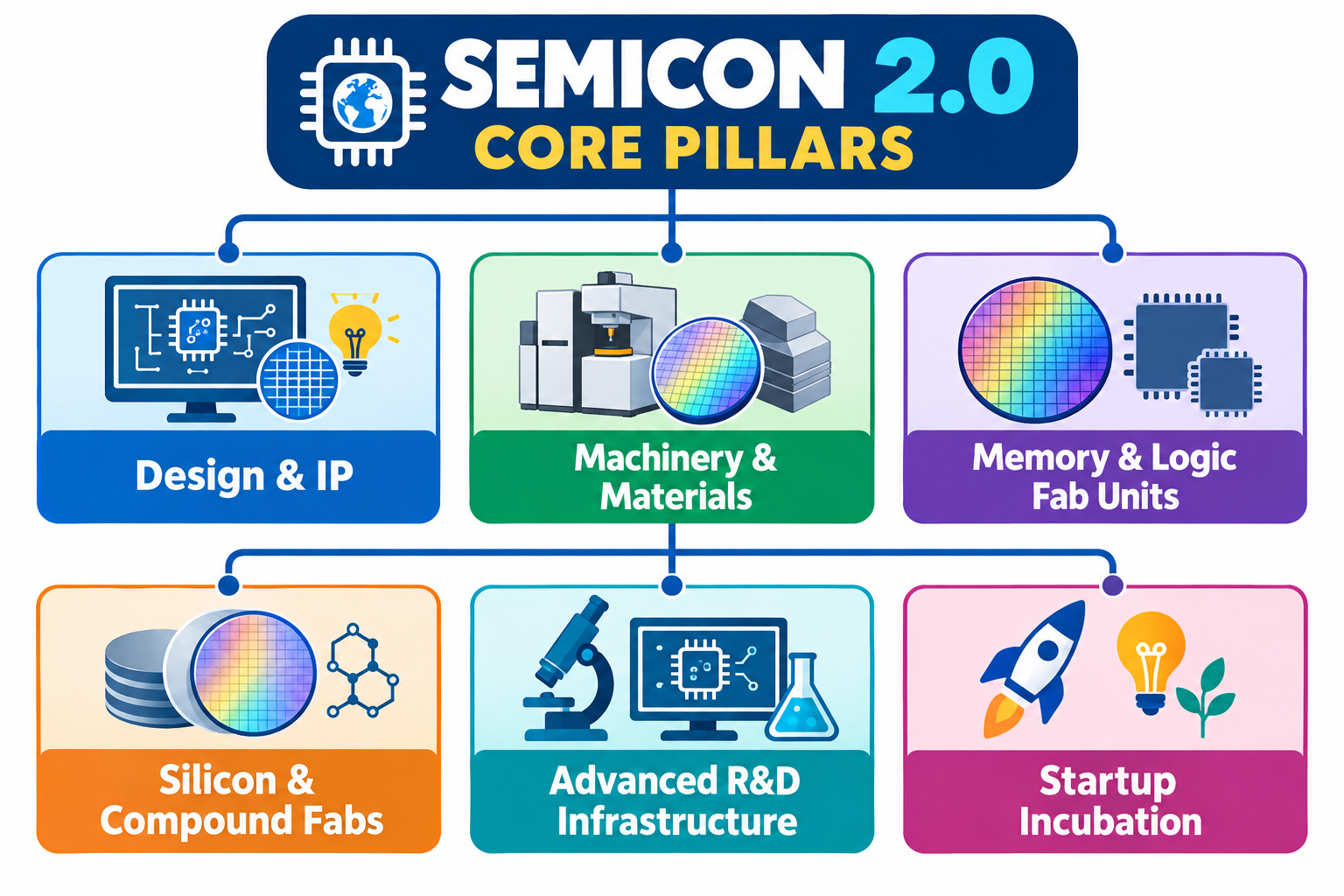
Design & Fabless Innovation: Funding early-stage architectural IP within domestic borders.
Machinery & Raw Materials: Encouraging local manufacturing of high-purity chemicals, gases, and silicon wafer cutting equipment.
Memory Solutions: Incentivizing dedicated memory architecture plants.
Silicon, Logic & Compound Fabs: Pushing commercial production in Gallium Nitride (GaN) and Silicon Carbide (SiC) alongside traditional silicon logic.
Research & Development: Building nationwide university-backed testing and prototyping labs.
Startups: Targeted support to back at least 200 chip-design startups across diverse consumer, automotive, and industrial applications.
4. Next-Gen Tech: Silicon Photonics and AI Infrastructure
The conference underlined that India isn’t just catching up to legacy nodes; it is actively preparing for future technologies required by artificial intelligence workloads.
PM Modi specifically urged global equipment makers not to miss out on the shift toward compound semiconductors and silicon photonics. As traditional silicon architectures hit power-efficiency limits, integrating optics directly onto silicon dies will form the backbone of next-generation AI data centers, high-speed telecommunications, and quantum systems. India’s early infrastructural investments aim to capture this high-margin transition early.
5. Building the World’s Largest Chip Talent Pool
A major bottleneck for semiconductor plants worldwide isn’t money or land—it is specialized engineering talent. India is tackling this shortage head-on through targeted curriculum changes and university partnerships.
Current Training Status: Over 70,000 engineering students have completed hands-on semiconductor design and fabrication training.
Target Goal: The initiative aims to deploy 1,000,000 (1 Lakh) industry-ready engineers and technicians into domestic and global fabs.
Global Talent Call: PM Modi extended a direct invitation to young Indian researchers and engineers working abroad to return or collaborate remotely, driving deep-tech breakthroughs directly from Indian software and hardware hubs.
6. Strong Macroeconomic Fundamentals & Diplomatic Leverage
The conference comes at a moment when India’s economic indicators demonstrate remarkable stability. Despite volatile global macroeconomic shifts, India recorded a solid 7.8% GDP growth rate, supported by an upgraded sovereign credit rating from major Japanese credit rating agencies.
Diplomatically, India’s tech ambitions are backed by growing geopolitical consensus. PM Modi cited the unanimous adoption of the ‘New Delhi Declaration’ at the recently concluded BRICS Summit as proof of India’s capability to bridge international divides and build trust across emerging economies and developed markets alike.
7. SEMICON India 2026 at a Glance
The fifth edition of this flagship convention highlights the sheer scale of international interest landing on Indian soil this week.
| Key Metric | Details & Numbers |
| Event Theme | Silicon to Systems: Building the Ecosystem |
| Dates & Venue | September 17–19, 2026 | Yashobhoomi, New Delhi |
| Exhibitor Count | 600+ active industry exhibitors |
| International Presence | 300+ global companies from 50+ countries |
| Dedicated Country Pavilions | Japan, South Korea, Malaysia, Netherlands, Singapore, Sweden |
| State Pavilions | 12 Indian State Governments offering land & incentive packages |
The Road Ahead: From Assembly to Autonomy
The energy at Yashobhoomi makes one thing obvious: India’s semiconductor journey has moved well past legislative policy announcements into factory break-grounds and commercial chip production. By combining massive capital subsidies under ISM 2.0, aggressive engineering talent creation, and an open platform for foreign equipment makers, India is steadily positioning itself as an indispensable hardware pillar for the global tech economy.