
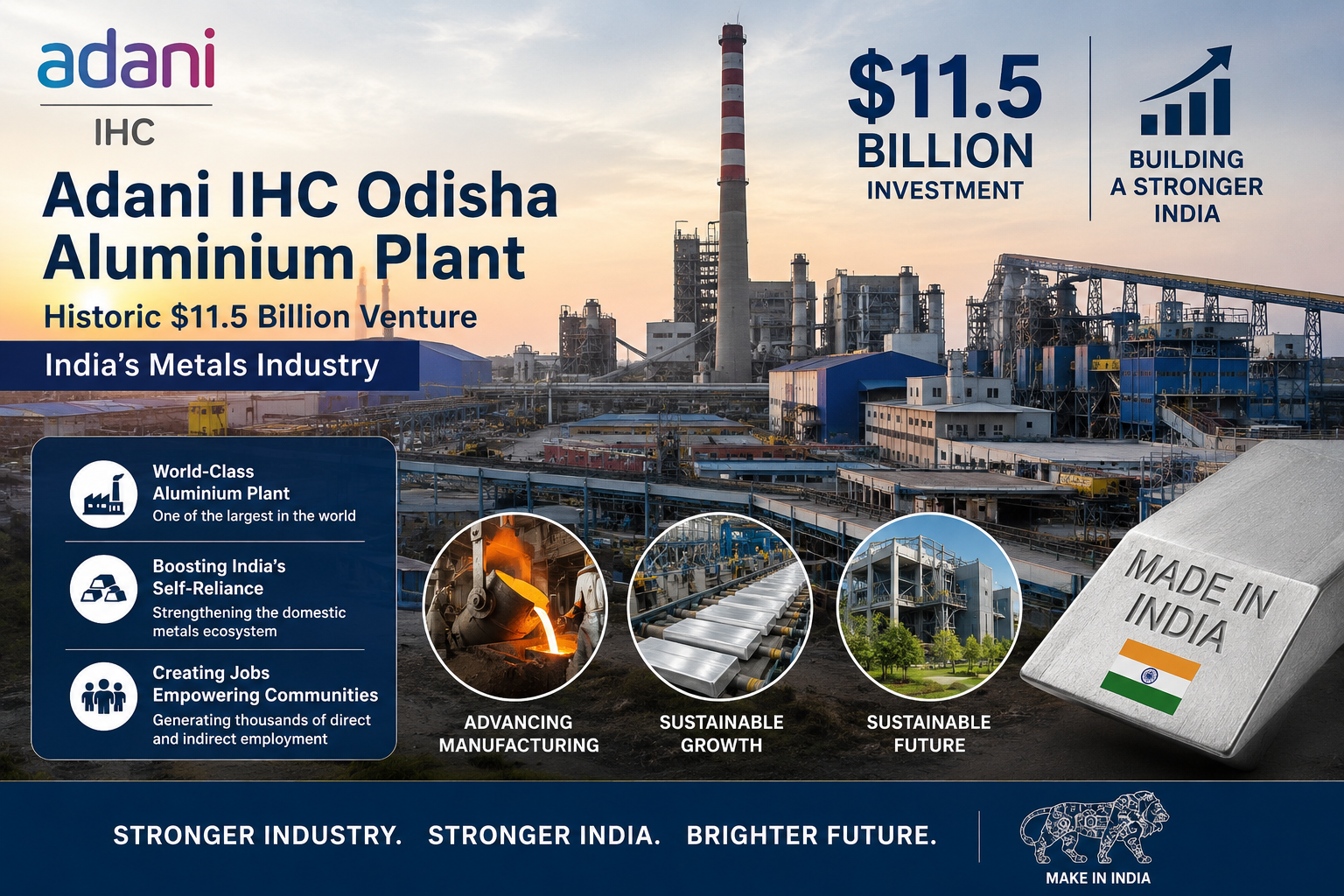
The Adani IHC Odisha aluminium plant is officially poised to become one of the most significant industrial developments in India’s recent economic history. In a massive move that could fundamentally reshape the dynamics of the global metals market, the Adani Group has teamed up with Abu Dhabi’s International Holding Company (IHC) to plan a joint investment of approximately $11.5 billion (around ₹95,000 crore) over the next few years. This landmark collaboration aims to construct a mega-scale, integrated aluminium manufacturing facility in the mineral-rich state of Odisha.
According to an impactful report by The Economic Times, which cited well-placed industry sources, this mega-project is designed to encompass both an aluminium smelter and a refinery unit, commanding an annual production capacity that exceeds 2 million tonnes. If successfully executed, this historic venture will single-handedly boost India’s total domestic aluminium production capacity by nearly 50%. Furthermore, it marks the single largest foreign direct investment (FDI) in India’s metals and mining sector to date, signaling unparalleled global confidence in India’s industrial growth trajectory.
The Anatomy of the $11.5 Billion Mega-Deal
The capital architecture for this massive project is slated to be structured through a calculated mix of debt and equity, allowing both entities to leverage their massive balance sheets. While the precise equity split and individual financial commitments between Gautam Adani’s conglomerate and Sheikh Tahnoon bin Zayed Al Nahyan’s IHC remain undisclosed, the sheer scale of the $11.5 billion pipeline highlights the long-term vision of both corporations.
This is not a standalone assembly unit; it is designed as a completely integrated facility. This means the complex will handle everything from the initial processing of raw bauxite into alumina (refining) to the final electrochemical reduction process that yields pure aluminium metal (smelting).
To support the energy-intensive nature of aluminium smelting, the project will feature its own dedicated captive power plant. This ensures an uninterrupted, highly controlled supply of electricity, which is the single most critical cost component in aluminium manufacturing.
Why Odisha is the Strategic Epicenter for Aluminium
Choosing Odisha as the destination for the Adani IHC Odisha aluminium plant is a deliberate, highly strategic geographical play. Odisha sits firmly atop India’s mineral map, holding over half of the country’s total bauxite reserves. Bauxite is the essential raw ore needed to produce alumina, which is then processed into finished aluminium.
By setting up operations directly within Odisha, the joint venture minimizes raw material transit distances, drastically cutting down on inland logistics costs. The state has historically served as the manufacturing hub for India’s primary metal giants, including Hindalco Industries and Vedanta Aluminium. The presence of established supply chains, an experienced industrial workforce, and proactive state government policies focused on heavy industrialization make Odisha the ideal launchpad for a multi-billion-dollar metals ecosystem.
Logistics and Infrastructure: The Dhamra Port Edge
A project of this magnitude requires robust logistical connectivity to import specialized equipment and export finished products efficiently. The joint venture intends to fully leverage the Adani Group’s existing infrastructure footprint in eastern India, specifically targeting the Dhamra Port.
Located on the Bay of Bengal in the Bhadrak district of Odisha, Dhamra Port is owned and operated by Adani Ports and Special Economic Zone (APSEZ). As a deep-draft, all-weather port, Dhamra can easily handle massive Capesize vessels.
[Odisha Smelter/Refinery Complex] ──(Heavy Rail/Road link)──> [Dhamra Deep-Water Port] ──> Global & Coastal Markets
This structural synergy offers the project a massive competitive advantage:
Direct Maritime Access: Eliminates reliance on third-party port operators, ensuring streamlined supply chains.
Bulk Handling Efficiency: Seamlessly handles the intake of raw materials and coal alongside the export of heavy aluminium ingots, billets, and wire rods.
Cost Optimization: Reduces freight and demurrage costs, directly boosting the operational margins of the facility.
Decoding Adani’s Aggressive Metals Expansion
For the Adani Group, this massive foray into aluminium represents a calculated step forward in its broader industrial diversification strategy. Historically recognized for its dominance in ports, logistics, thermal power, and green energy, the conglomerate is rapidly building a formidable presence in core metallurgy.
This project marks Adani’s second major venture into the metals sector. It follows the successful launch of its massive copper smelter complex in Mundra, Gujarat, which commenced operations last year. By expanding from copper into aluminium, Adani is positioning itself as a foundational supplier for the world’s clean energy transition. Both metals are absolutely vital for modern infrastructure, electric vehicle (EV) manufacturing, electrical grids, and renewable energy installations.
Who is IHC? Abu Dhabi’s Strategic Investment Powerhouse
International Holding Company (IHC) is not a newcomer to the Indian economic landscape, nor is it a stranger to the Adani Group. Based in Abu Dhabi, IHC stands as one of the fastest-growing and largest conglomerate investment holding companies globally. It is deeply backed by Abu Dhabi’s ruling family and is chaired by His Highness Sheikh Tahnoon bin Zayed Al Nahyan, who also serves as the UAE’s National Security Advisor.
IHC’s global portfolio spans across critical sectors including real estate, healthcare, food technology, and advanced digital systems. This proposed $11.5 billion project will significantly deepen the strategic alliance between IHC and Adani. Back in 2022, IHC executed a major $2 billion investment across three primary Adani portfolio companies: Adani Enterprises, Adani Green Energy, and Adani Energy Solutions. Investing heavily in primary metals demonstrates a mutual long-term commitment to capturing industrial market share within India’s rapidly growing economy.
The Indian Aluminium Market: Current Production vs. Surging Demand
To truly grasp why a 2-million-tonne facility is a game-changer, one must look at the current demand-supply dynamics of the Indian metals sector.
During the financial year 2024-25 (FY25), India produced approximately 4.2 million tonnes of primary aluminium, securing its rank as the world’s second-largest producer, trailing only China. However, domestic consumption during the exact same period surged to 5.5 million tonnes. This clear deficit highlights India’s growing reliance on imports and recycled scrap to fulfill its domestic industrial requirements.
| Market Metric (FY25) | Indian Market Value | Global Average Comparison |
| Total Domestic Production | 4.2 Million Tonnes | Ranked 2nd globally (Behind China) |
| Total Domestic Consumption | 5.5 Million Tonnes | Ranked 3rd globally as a consumer |
| Per Capita Consumption | 3.4 to 3.9 kg | Global average sits at 8 to 12 kg |
Despite being a top global consumer in absolute terms, India’s per capita consumption of aluminium remains incredibly low at just 3.4 to 3.9 kg, compared to the global average of 8 to 12 kg. As India undergoes massive urban migration, expands its railway networks, upgrades its electrical grids, and accelerates EV adoption, its per capita consumption is projected to catch up rapidly with global benchmarks.
Road to 2047: Analyzing India’s Ambitious Aluminium Vision
The Indian government’s official industry vision document outlines an extraordinary, steep growth curve for domestic aluminium demand over the next two decades.
Projected Indian Aluminium Consumption:
FY30: █ 8.5 MT
FY40: ████ 18.0 MT
FY47: ███████ 28.0 MT
According to the official projections:
By FY30: Domestic consumption is estimated to reach 8.5 million tonnes.
By FY40: Demand is expected to scale up to 18 million tonnes.
By FY47: Consumption is anticipated to peak around 28 million tonnes.
The national vision document emphasizes that if India plays its cards right, the country can realistically aim for a dominant 10% share of the entire global aluminium market by 2047—a massive leap from its current global market share of roughly 3.8%. To achieve this highly ambitious 10% global market target while comfortably meeting domestic demand, India’s total production capacity must scale up drastically to 37 million tonnes per annum (MTPA) by FY47. The introduction of the 2-million-tonne Adani IHC Odisha aluminium plant provides a significant structural building block toward meeting these national targets.
Competitive Landscape: How Incumbents are Responding
The entry of a heavily capitalized joint venture consisting of Adani and IHC will undoubtedly intensify competition within India’s core metals sector. The domestic market has historically been led by established players who are already executing their own aggressive expansion roadmaps to defend their market share:
Vedanta Aluminium: As India’s largest producer, Vedanta has been actively working to expand its smelting capacities in Jharsuguda and Lanjigarh in Odisha, aiming to scale its overall production capabilities to 3 MTPA.
Hindalco Industries (Aditya Birla Group): A global leader in downstream aluminium rolling and recycling, Hindalco is consistently investing heavily in expanding its downstream capacities while focusing on high-value, specialized alloys tailored for the aerospace, automotive, and rail sectors.
Global Alliances: International miners are also keeping a close eye on the Indian market. Global mining giant Rio Tinto has previously explored opportunities for an integrated aluminium blueprint in India alongside local entities like AMG Metals and Materials.
Rather than creating an oversupply, the addition of Adani and IHC’s capacity will likely help absorb the massive upcoming demand from India’s real estate, manufacturing, and green energy sectors, while transforming India into a major net exporter of primary metal.
Macro-Economic Impact and the Global Picture
Aluminium is frequently labeled as the “metal of the future” because it is highly recyclable, lightweight, and incredibly durable. It is an irreplaceable element in solar panel frames, wind turbine structures, high-voltage transmission lines, and the lightweight chassis of modern electric vehicles.
From a macroeconomic perspective, the Adani IHC Odisha aluminium plant provides several key advantages for India:
Import Substitution: By adding more than 2 million tonnes of local capacity, India can drastically reduce its foreign exchange spending on imported primary metals.
Job Creation: A multi-billion-dollar integrated plant will generate thousands of direct engineering and construction jobs in Odisha, alongside tens of thousands of indirect opportunities within the regional supply chain.
Strengthening Indo-UAE Ties: This project serves as a highly visible, concrete outcome of the Comprehensive Economic Partnership Agreement (CEPA) signed between India and the UAE, paving the way for deeper cross-border industrial co-investment.
While China continues to dominate global primary aluminium production, it faces increasingly strict environmental caps and power rationing constraints. A massive, state-of-the-art, logistically optimized facility in India provides global supply chains with a highly reliable, alternative source of high-quality aluminium.
Forward Outlook
The proposed $11.5 billion partnership between the Adani Group and Abu Dhabi’s IHC highlights a profound shift in how mega-scale infrastructure is executed in India. By combining Adani’s localized execution capabilities, port infrastructure, and regulatory expertise with IHC’s massive capital reserves, the project is structured to move smoothly from paper to ground execution.
As the partners advance through environmental clearances, land acquisition phases, and structural financial closures, the industry will be watching closely. If executed efficiently, this facility will not only secure Adani’s position as a premier global metals player but will also provide the heavy industrial foundation required to power India’s economic journey toward its 2047 centenary goals.