
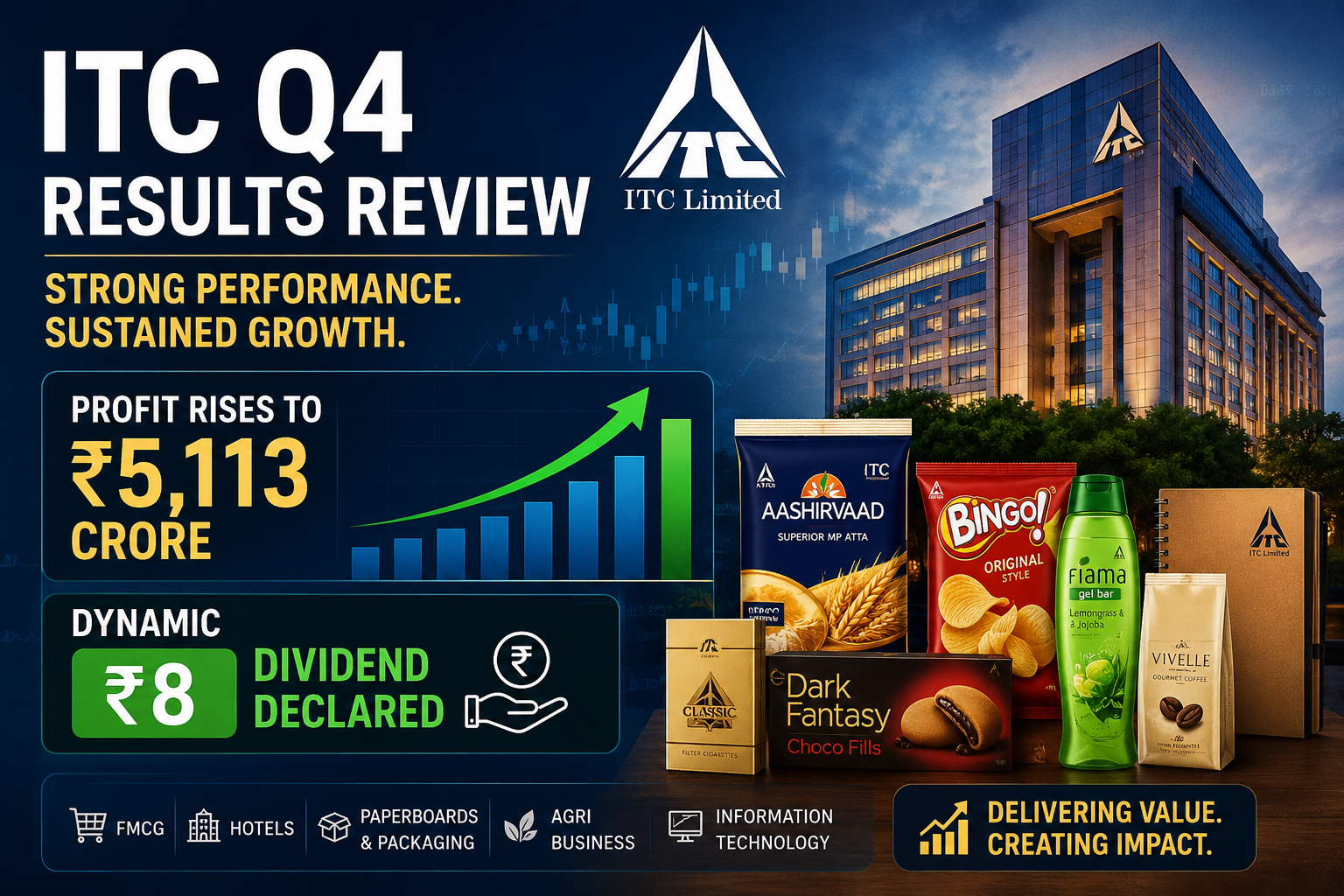
ITC Q4 Results are officially out, bringing a wave of critical financial clarity for investors, market analysts, and retail shareholders alike. In its regulatory filing on Thursday, May 21, 2026, the diversified Indian conglomerate reported a standalone net profit from continuing operations of ₹5,113.36 crore for the fourth quarter ended March 31, 2026. This marks a steady 5% year-on-year growth compared to the ₹4,874.93 crore posted in the corresponding quarter of the previous financial year.
Alongside the financial statements, the Board of Directors has recommended a significant final dividend of ₹8 per share, driving immense retail interest across the domestic stock exchanges.
However, the corporate filing also generated heavy headlines due to an initial, dramatic data point: the headline net profit appeared to drop by 74% year-on-year when measured against a massive, base-inflated ₹19,562 crore in Q4 of FY25. This structural anomaly stems entirely from exceptional items and discontinued operations recorded in the previous fiscal year. When adjusting the lens exclusively to continuing business operations, ITC’s operational resilience shines through. The corporate giant successfully navigated a chaotic macroeconomic landscape defined by severe West Asia logistical crises, localized supply chain disruptions, and an unprecedented domestic tax hike on its core tobacco portfolio.
Understanding the Core Financials: Revenue, EBITDA, and Profit Metrics
To unpack the true health of ITC Limited, one must look closely at the operational core of the company rather than the surface-level statutory net profit fluctuations.
Robust Revenue Acceleration
The company’s revenue from operations showcased phenomenal double-digit momentum. For the January–March 2026 quarter, headline revenue climbed to ₹21,695 crore, scaling up by a massive 17% year-on-year from the ₹18,495 crore recorded in the same period last year. Gross revenue growth was even more striking, jumping 17.5% YoY, powered primarily by an exceptional performance in the non-cigarette FMCG segment and an impressive structural recovery in the paperboards, paper, and packaging business.
Stable EBITDA Growth
The earnings before interest, taxes, depreciation, and amortization (EBITDA) grew by 7% year-on-year, arriving at ₹6,426 crore for Q4 FY26, compared to ₹5,987 crore in Q4 FY25. If we peel back the layers and isolate the performance by excluding the agribusiness—which faced temporary export timing friction due to geopolitical border blockades—the underlying core EBITDA actually grew by a robust 9% year-on-year.
Margin Compression Realities
While revenue and absolute EBITDA numbers expanded, profitability margins faced intense inflationary pressure. The standalone EBITDA margin for the fourth quarter contracted by 275 basis points, slipping to 29.62% as opposed to the stellar 32.37% maintained in the year-ago quarter. This margin compression highlights a sharp, late-quarter surge in critical input materials, alongside structural adjustments within the cigarette tax frameworks that went into effect mid-quarter.
The Cigarette Segment: Navigating the New Tax Structure
The foundational engine of ITC’s profitability—its cigarette business—encountered a complex operational environment during the final two months of the financial year.
According to the official management statement, the cigarette business was significantly impacted by an unprecedented increase in domestic taxes effective February 1, 2026. This tax hike coincided with an intricate transition to a newly revised central tax structure, forcing the company to rapidly alter its distribution networks, adjust street-level retail pricing, and optimize its manufacturing pipelines.
Cigarette Segment Financial Matrix (Full Year vs. Q4 FY26)
┌──────────────────────────────────────┬──────────────────────┐
│ Metric Dimension                     │ Performance Growth   │
├──────────────────────────────────────┼──────────────────────┤
│ FY26 Full Year Segment Net Revenue   │ ▲ 8.2% YoY           │
│ FY26 Full Year Segment PBIT          │ ▲ 5.1% YoY           │
│ Q4 FY26 Segment PBIT Only            │ ▲ 7.2% YoY           │
└──────────────────────────────────────┴──────────────────────┘
Up until January 2026, the tobacco portfolio delivered stellar volume and premiumization growth. This was strongly anchored by targeted market interventions, localized brand extensions, and precise channel management.
Despite the post-February tax disruptions, the segment managed a notable recovery by the end of March. Q4 Profit Before Interest and Taxes (PBIT) for the cigarette segment rose by a resilient 7.2% YoY, indicating that consumers absorbed the pricing changes without triggering severe volume destruction. For the complete twelve months of FY26, the cigarette business closed with an 8.2% expansion in net revenue and a 5.1% increase in segment PBIT.
FMCG-Others: Driving 15% Growth via Scale and Premiumization
ITC’s non-cigarette fast-moving consumer goods (FMCG-Others) business continued its steady transformation into a high-margin growth engine. The segment delivered an outstanding 15% year-on-year revenue growth during Q4 FY26, heavily outperforming many rural-exposed consumer staple peers in the Indian market.
Category-Wise Execution
Growth was comprehensive, cutting across both essential household staples and discretionary consumption lines:
Staples & Packaged Foods: The Aashirvaad wheat flour brand and Sunfeast biscuits experienced strong premium market-share gains.
Snacks & Convenience Food: Bingo! snacks and Yippee! noodles registered consistent volume traction, bolstered by the expansion of small-ticket consumer packs in semi-urban belts.
Dairy & Frozen: The company’s value-added dairy portfolio and frozen snack varieties achieved deep distribution penetration across major quick-commerce platforms.
Personal Care & Homecare: Premium personal wash lines (such as Fiama and Vivel) along with home hygiene and Mangaldeep agarbattis saw strong consumer retention, despite local brands attempting aggressive price undercutting.
Input Cost Pressures and Mitigation Strategies
The final month of the fiscal year brought significant commodity inflation. As conflicts intensified in West Asia, global shipping routes choked, sparking a sudden surge in the prices of foundational raw materials:
Edible Oils: Prices rose sharply, squeezing processed food margins.
Soap Noodles: Palm-oil derivatives saw sudden spikes, directly affecting the personal wash portfolio.
Packaging Inputs: Crude oil volatility pushed up plastic, polymer, and corrugated box costs.
To combat these challenges, ITC deployed a multi-pronged mitigation strategy. The corporate management highlighted its focus on cost optimization and supply chain agility. Rather than passing the entire cost burden to the end consumer, the company implemented targeted pricing actions alongside hyper-local procurement setups to cushion margins without hurting volume momentum.
Paperboards, Paper, Packaging, and Agribusiness PerformanceBeyond consumer products, ITC’s heavy industrial and raw material segments showcased distinct operational trends, heavily influenced by global supply lines.
The Paper and Packaging Turnaround
The Paperboards, Paper, and Packaging segment emerged as a significant operational highlight for the quarter. Following several quarters of global overcapacity and cheap Chinese imports depressing domestic prices, the division marked a notable structural recovery.
Profits for the paper segment surged by 21% year-on-year. On a sequential quarter-on-quarter basis, profits advanced by a brilliant 24%. This revival was driven by higher internal domestic demand for sustainable packaging, specialized value-added boards, and localized operational efficiencies.
Agribusiness Faced Geopolitical Roadblocks
In contrast, the Agribusiness segment experienced near-term turbulence. Revenue and profit metrics were impacted by complex timing differences. These disruptions arose from the temporary deferral of major export shipments amid ongoing maritime conflicts and supply chain blockades in West Asia.
Because ITC prioritizes margin safety over high-risk transit, multiple grain and value-added agri-shipments were intentionally pushed into the subsequent quarters. Despite these export delays, the base domestic agri-sourcing mechanisms remained highly efficient, providing a solid foundation for the company’s internal consumer food brands.
Full-Year Standalone Performance Breakdown
Looking at the broader financial landscape across the full twelve months of FY26 reveals a deeply resilient corporate trajectory. For the full fiscal year ended March 31, 2026, ITC reported:
Gross Revenue Expansion: An increase of 10.1% year-on-year, proving that brand equity and consumer demand for the company’s product lines remained solid despite retail inflation.
EBITDA Momentum: Overall annual EBITDA climbed by 4.9% YoY.
Core EBITDA Strengths: When stripping away the capital-intensive and cyclical paperboards division, the full-year EBITDA growth stood at an impressive 6% YoY.
This steady performance confirms that ITC’s multi-pronged corporate strategy—balancing stable cigarette cash flows with rapid FMCG expansion and asset-right diversification—continues to deliver reliable value to shareholders.
Consolidated Performance: Subsidiaries and Group Synergy
On a consolidated basis, ITC Limited benefited immensely from its integrated corporate structure. The wider group performance was strongly supported by robust contributions from key subsidiaries and strategic joint ventures.
Consolidated Performance Indicators (Q4 FY26)
┌──────────────────────────────────────┬──────────────────────┐
│ Financial Parameter                  │ Consolidated Growth  │
├──────────────────────────────────────┼──────────────────────┤
│ Q4 Gross Revenue Growth              │ ▲ 17.1% YoY          │
│ Q4 Consolidated EBITDA Growth        │ ▲ 6.9% YoY           │
│ Core EBITDA Growth (Excl. Agri)      │ ▲ 8.0% YoY           │
└──────────────────────────────────────┴──────────────────────┘
For the full financial year, consolidated gross revenue advanced by 10.3% YoY, while consolidated annual EBITDA tracked a 5.4% expansion (touching 6% when excluding the paperboards business).
ITC Infotech India Limited
The technology subsidiary delivered resilient performance by securing mid-sized digital transformation deals across the banking, financial services, and manufacturing sectors. It successfully offset broader slowdowns across the global tech landscape by focusing heavily on specialized automation, enterprise architecture, and cost-effective cloud migration.
Surya Nepal Private Limited
The international subsidiary continued to dominate its localized FMCG and tobacco markets, contributing stable, high-margin revenue streams back to the parent organization.
ITC Hotels Limited
Benefiting from a historic surge in domestic business travel, luxury wedding celebrations, and premium tourism, the hospitality arm delivered stellar room-rate configurations (ARR) and strong occupancy metrics. This performance underscored the structural benefits of the group’s asset-right management strategy.
The Dividend Breakdown: Comprehensive Guide for ShareholdersFor long-term institutional investors and retail shareholders, the main highlight of the ITC Q4 Results announcement was the official dividend update. The Board of Directors recommended a final dividend of ₹8 per ordinary share of face value ₹1 each for the financial year ended March 31, 2026.
The ITC Dividend Timeline & Value Guide
┌───────────────────────────┬──────────────────────────────────────────┐
│ Event / Metric Dimension  │ Official Value / Date Details            │
├───────────────────────────┼──────────────────────────────────────────┤
│ Interim Dividend Paid     │ ₹6.50 per share (Declared Jan 29, 2026)  │
│ Final Dividend Proposed   │ ₹8.00 per share (Declared May 21, 2026)  │
│ Total Cumulative FY26     │ ₹14.50 per ordinary share (Face Value ₹1)│
│ Dividend Record Date      │ Wednesday, May 27, 2026                  │
│ Annual General Meeting    │ Thursday, July 23, 2026                  │
│ Expected Payout Window    │ Between July 24 and July 29, 2026        │
└───────────────────────────┴──────────────────────────────────────────┘
Complete Dividend Timeline
This newly announced final dividend remains subject to formal shareholder approval at the company’s upcoming Annual General Meeting (AGM), scheduled for Thursday, July 23, 2026.
According to the official regulatory filing submitted to the National Stock Exchange (NSE) and Bombay Stock Exchange (BSE), the company has set Wednesday, May 27, 2026, as the strict Record Date. This date determines which shareholders are legally entitled to receive the dividend payment.
If approved at the AGM, the final dividend will be disbursed directly into the bank accounts of eligible members between July 24 and July 29, 2026.
Cumulative Annual Yield
When this final ₹8 per share dividend is combined with the interim dividend of ₹6.50 per share declared earlier on January 29, 2026, the total cumulative dividend for FY26 stands at an impressive ₹14.50 per ordinary share.
Given that ITC stock closed the trading session at ₹308.05, this brings the stock’s trailing annual dividend yield close to a highly attractive 4.7%. This solid yield reinforces the company’s reputation as a dependable cash-generating anchor for long-term defensive equity portfolios.
Market Reaction: How ITC Stock Responded on the NSEDespite the highly complex earnings report—which featured a drop in raw net profit but solid underlying operating growth—the stock market reacted with calm stability. Following the afternoon announcement on the National Stock Exchange (NSE), shares of ITC Limited experienced mild volatility before settling with modest gains.
The stock closed the day at ₹308.05 per share, ticking up by 0.16% over its previous close.
ITC Share Price Intraday Performance Data
* Previous Close: ₹307.55
* Post-Earnings Closing Price: ₹308.05
* Net Intraday Change: +₹0.50 (+0.16%)
* 52-Week Trading Range: ₹395.00 – ₹298.00
Market analysts noted that institutional brokerages had already priced in the margin compression from higher commodity prices and the February cigarette tax hike.
The steady, positive close indicates that institutional investors view the 17% revenue surge and the consistent ₹14.50 total dividend payout as clear evidence of the company’s fundamental operational health. This performance helps insulate the stock from sharp market drawdowns.
Strategic Forward Outlook: Navigating FY27 and Beyond
As ITC enters the new financial year (FY27), its management faces a distinct mix of structural challenges and clear growth opportunities. The strategic roadmap for the corporate giant will likely focus on three core operational pillars.
Managing the Inflation of Goods
The ongoing geopolitical friction in West Asia shows no signs of slowing down, meaning that global supply lines will likely remain volatile. ITC plans to lean heavily into its localized agri-sourcing networks (ITC e-Choupal 4.0) to secure direct raw materials, bypassing expensive international intermediaries and protecting its FMCG product margins.
Sustaining Volume Growth After Tax Adjustments
With the updated cigarette tax structure fully active, the company will focus on strategic product packaging and targeted portfolio adjustments. Historically, ITC has shown strong pricing power; within 2 to 3 quarters of a tax adjustment, the company has typically optimized its product mix to restore historical segment profitability.
Expanding the Reach of Quick Commerce
As urban consumer behavior shifts rapidly toward ultra-fast delivery options, ITC is aggressively customizing its supply chains to cater directly to quick-commerce dark stores. By offering exclusive product sizes, high-margin multipacks, and premium personal care variations tailored for digital buyers, the company is positioning its FMCG-Others division to achieve sustainable profitability over the long term.
Conclusion: A Balanced View for Long-Term Investors
The latest ITC Q4 Results highlight a company that remains exceptionally steady under pressure. While a glance at the headline numbers might spark questions due to base-effect adjustments and complex tax transitions, a deeper look reveals robust operational performance.
With revenue climbing 17% to ₹21,695 crore, the non-cigarette FMCG segment expanding by 15%, and the paper division making a strong recovery, the company’s core businesses are executing well.
For the everyday shareholder, a total annual dividend of ₹14.50 per share reinforces the company’s position as a reliable cash generator. Navigating input cost inflation and changing tax frameworks is always a challenge. However, ITC’s robust market execution, unmatched distribution reach, and deep brand equity ensure it remains an essential pillar of the Indian corporate landscape.
Frequently Asked Questions (FAQs)
What was the standalone net profit for ITC in Q4 FY26?
ITC reported a standalone net profit from continuing operations of ₹5,113.36 crore for the fourth quarter ended March 31, 2026. This represents a steady 5% growth year-on-year compared to the ₹4,874.93 crore recorded in Q4 FY25.
Why do some news headlines state that ITC’s profit dropped by 74%?
The apparent 74% drop is a statistical base-effect anomaly. It compares this quarter’s net profit against a massive, base-inflated ₹19,562 crore recorded in Q4 FY25, which included significant exceptional items and gains from discontinued operations. Looking strictly at continuing operations, profit actually grew by 5%.
What is the final dividend announced by ITC, and when is the payment date?
ITC’s Board has recommended a final dividend of ₹8 per ordinary share. If approved at the Annual General Meeting on July 23, 2026, the dividend will be paid out to eligible shareholders between July 24 and July 29, 2026.
When is the Record Date to qualify for the ITC final dividend?
The company has fixed Wednesday, May 27, 2026, as the official Record Date. Investors must hold ITC shares in their Demat accounts by this date to be eligible for the final ₹8 per share dividend.
How did the non-cigarette FMCG segment perform during the quarter?
The FMCG-Others segment delivered strong performance, posting a 15% year-on-year revenue expansion. This growth was driven by solid category performance across staples, biscuits, convenience foods, and premium personal care items.
What impacted ITC’s core cigarette business in Q4 FY26?
The cigarette segment faced an unprecedented domestic tax hike that took effect on February 1, 2026, alongside a complex transition to a revised central tax framework. Despite these challenges, targeted market interventions helped the segment achieve a resilient 7.2% year-on-year growth in Q4 PBIT.
Disclaimer : Financial markets are subject to high risk. Please consult with a certified financial advisor before making any investment decisions.