
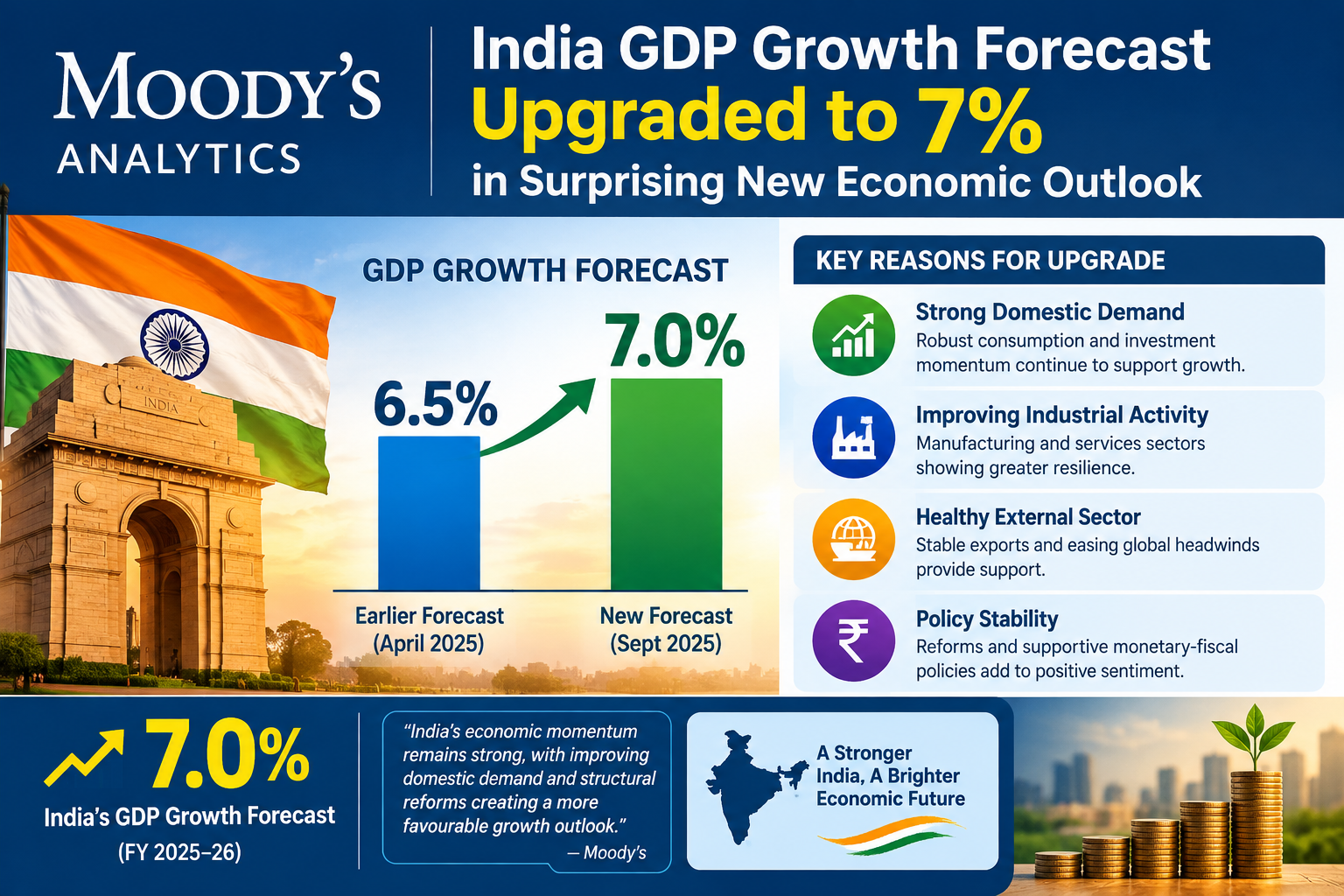
Moody’s India GDP Growth Forecast has taken an upward turn and Moodys India GDP Growth Forecast shows strong economic momentum even while global markets face ongoing geopolitics. In its periodic review released on Friday the global credit rating agency Moody’s Ratings revised India’s real GDP growth prediction for the fiscal year 2026–27 (FY27) to 7 percent, up, from the previous projection of 6 percent. This one-percentage-point jump shows that the economy is handling pressures better than expected. Moodys India GDP Growth Forecast indicates that while much of the world deals with supply chain disruptions, energy market volatility and a slow recovery India’s domestic setup has kept its economic engine running smoothly.
Moodys India GDP Growth Forecast says that India’s domestic setup has kept its engine running smoothly.
Why Moody’s Changed the FY27 GDP Prediction
The main reason for this change in the prediction is Indias ability to handle outside problems, especially those coming from the fight happening in West Asia (Middle East). Early worries said that more problems in that area would hurt emerging markets that need to buy energy.. Indias economy did well for the last two quarters making experts change their thinking.
According to Moody’s report Indias real GDP went up by a 8.2% compared to the same period last year during the first six months of the year 2026. This follows a 7.3% increase that happened throughout the year 2025.
Main Reasons for the Improvement
Strong Investment in Capital: Spending by the government on roads, bridges and other projects along with money from businesses keeps the economy growing.
Stable Buying Power at Home: People in cities are still buying things, which helps the economy even when less is being traded with countries.
Good Performance in Services: IT, banking, health care and other professional jobs are all growing quickly.
Manufacturing Activity: Efforts by the government to help factories and steady production lines are making up for drops, in mining and stores that sell things directly to customers.
Performance Snapshot: First Quarter and Beyond
The statistical ground for this revision was laid earlier when official government data pointed to a strong 7.8% GDP growth rate for the April-June quarter. That expansion comfortably topped consensus forecasts, largely because investment spigots stayed open and core industrial output remained healthy.
| Economic Indicator | Metric / Growth Rate |
| First Half 2026 Real GDP Growth | 8.2% YoY |
| Calendar Year 2025 Real GDP Growth | 7.3% |
| April-June Quarter GDP Growth | 7.8% |
| Updated FY27 Growth Forecast | 7.0% (Previous: 6.0%) |
While mining and a few sub-sectors faced operational headwinds during the quarter, heavy manufacturing, logistics, and real estate construction compensated for those soft spots.
Domestic Strengths vs. External Vulnerabilities
after this upgrade Moody’s emphasized that India is not fully protected from global problems. The agency said that although India will grow faster than any G‑20 economy and other emerging markets with the same rating a number of macroeconomic risks must be watched closely for the next twelve to eighteen months.
Inflationary Pressures and Energy Prices: Energy security remains a concern. A long‑lasting conflict in West Asia keeps crude oil prices high. Because India imports a share of its crude oil needs ongoing price spikes could raise input costs for manufacturing, transport and freight companies.
Climate and Agricultural Risks: Outside of energy El Niño weather patterns threaten crop output. Unpredictable monsoons and unexpected temperature swings can quickly cause food inflation. Because food and fuel make up a part of everyday household spending long‑term price increases could reduce the money people have for non‑essential purchases.
Fiscal. Subsidy Spreads: Moody’s highlighted that the Indian government has handled the West Asia oil shock with discipline and caution. However if energy prices stay high for a time the government might feel political pressure to raise fuel and fertilizer subsidies.
Higher subsidy bills, with increasing defense spending and ongoing infrastructure projects could make it harder to cut the fiscal deficit in the coming years.
How India Outperforms Its G-20 Peers
Despite these headwinds, India’s core macroeconomic indicators remain among the healthiest across major developing and developed economies.
G-20 Growth Leaderboard (FY27 Projections)
------------------------------------------------
1. India       [████████████████████] 7.0%
2. Emerging    [███████████         ] 4.1% (Average)
3. Advanced    [█████               ] 1.8% (Average)
------------------------------------------------
Compared to other major economies struggling with stagnant demographic growth, high debt burdens, or structural real estate slowdowns, India benefits from:
A Young Working Demographic: Continual labor force growth keeps domestic production capacity rising.
Digital Financial Infrastructure: Widespread adoption of digital payments (UPI) and streamlined banking services reduce friction across retail trade.
Strategic Energy Sourcing: Diversified crude sourcing strategy has helped insulate domestic pump prices from extreme global volatility.
What Is Coming Next for Investors and Investors and Businesses?
For businesses and global investors the updated outlook from Moody’s gives a positive message. Predictions of growth usually mean more money coming into the country lower costs for borrowing for big companies and more trust in stock markets.
Business leaders must be ready for difficult prices for materials and watch costs closely. It will be important to look at inflation numbers decisions by banks about interest rates and how much food is being grown to handle the rest of the year.
For now the new forecast shows an idea: even though the global economy is still hard to predict the strong local market, in India keeps offering a safe place to fall back on when outside problems happen.