
Xiaomi has just flipped the entire smartphone industry on its head. For years, we have watched brands obsess over making phones as thin as a slice of cardboard, completely ignoring the fact that most users are desperately looking for a wall charger by 6 PM. But with the newly announced Chinese launch of the latest Note lineup, those days are officially dead.
If you are looking for the definitive breakdown of the Redmi Note 17 Pro specifications, you are in the right place. Xiaomi skipped an entire generation to bring this monster to light, choosing to launch it alongside a giant 7-inch vanilla sibling. But it is the Pro variant that steals the show. It is smaller, tougher, packed with a mind-boggling 9,000mAh silicon-carbon battery, and comes with a bulletproof 5-year warranty program that sounds too good to be true. Let’s dive deep into exactly what this device brings to the table.
The Complete Redmi Note 17 Pro Specifications Table
Before we break down every single architectural layer of this phone, let’s layout the hardware sheet in full detail so you can see the raw numbers instantly.
| Hardware Feature | Official Specification Details |
| Processor | Qualcomm Snapdragon 6s Gen 4 (4nm Samsung 4LPX Node) |
| CPU Architecture | Octa-core (4x Cortex-A78 @ 2.4GHz + 4x Cortex-A55 @ 1.8GHz) |
| Graphics Processing Unit | Qualcomm Adreno 710 |
| RAM Configurations | 8GB / 12GB LPDDR4X |
| Internal Storage Tiers | 128GB (UFS 2.2) / 256GB & 512GB (UFS 3.1) |
| Display Panel | 6.83-inch 1.5K (2772×1280) 12-bit OLED Panel |
| Refresh & Sampling Rates | 120Hz Refresh / 240Hz Touch / 3200Hz Instant Touch |
| Display Brightness | 3,500 nits Peak Brightness (Dimming floor down to 1 nit) |
| Eye Protection Technology | 3840Hz High-Frequency PWM Dimming + DC Dimming |
| Rear Camera Setup | 50MP Main (f/1.8, 1/2.76″ sensor) + 2MP Depth Sensor (f/2.4) |
| Front Selfie Camera | 8MP Sensor with 1080p @ 30fps Video Recording |
| Battery Capacity | 9,000mAh Silicon-Carbon Battery |
| Charging Capabilities | 67W Wired Fast Charging / 22.5W Wired Reverse Power Bank Mode |
| Water & Ingress Safety | Certified Quad Protection: IP66 + IP68 + IP69 + IP69K |
| Chassis Build Quality | Gorilla Glass Victus 2 (Front/Back), 3-meter Drop Resistant |
| Audio Ecosystem | Dual Stereo Speakers with Dolby Atmos Support |
| Biometrics & Sensors | In-display Fingerprint, Ultrasonic Proximity, IR Blaster, NFC |
| Software Platform | Android 16 skinned with Xiaomi HyperOS 3 |
| Physical Dimensions | 163.45mm × 78.27mm × 8.46mm |
| Total Device Weight | 226 grams |
| Color Variants | Sky Blue, Nebula Purple, Black, White |
Design, Build, and Structural Durability
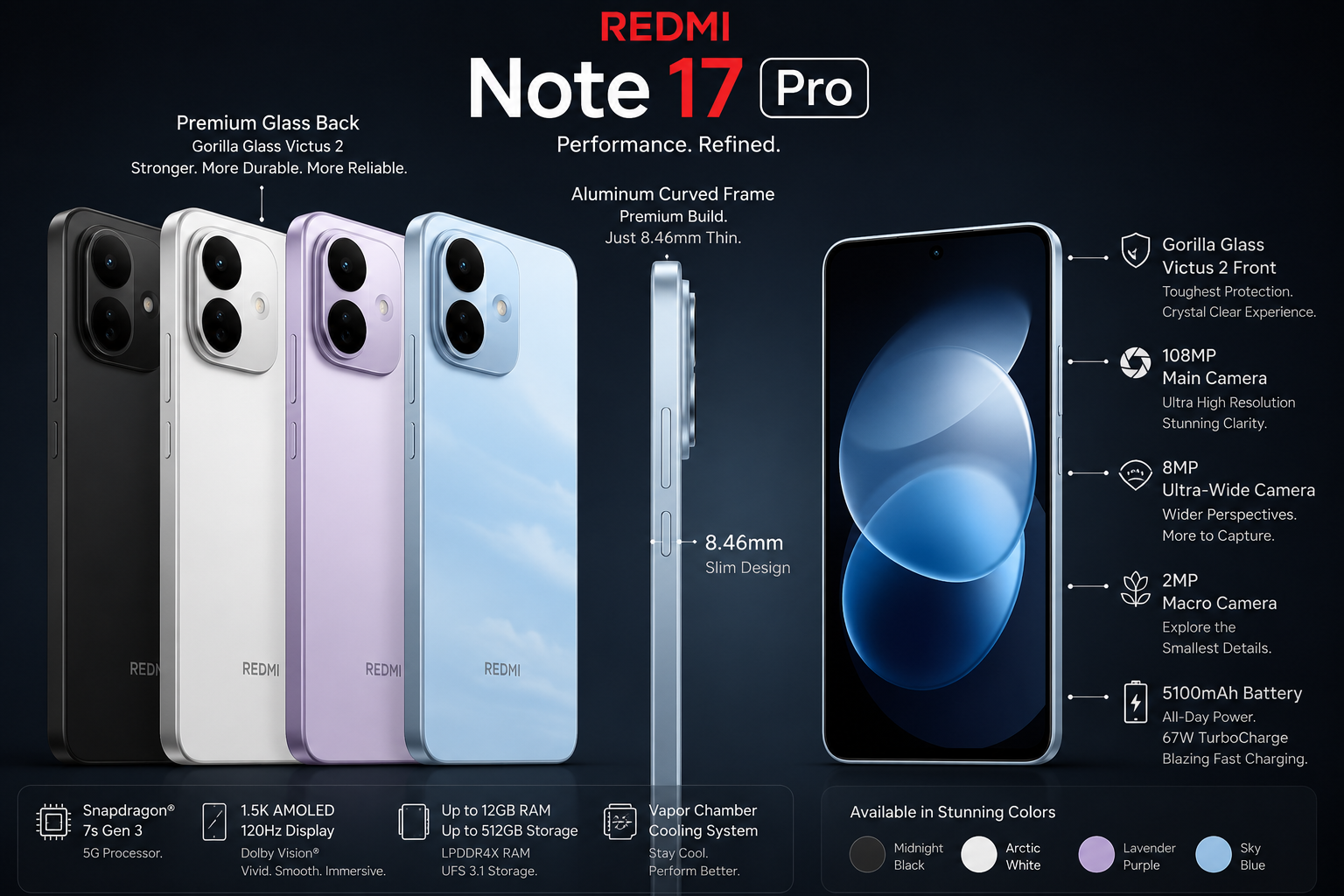
Let’s address the most surprising physical aspect of this release: the Pro model is actually the smaller device in the lineup. While the base variant stretches out to a massive, mini-tablet style 7-inch frame, the Pro settles at a more manageable 6.83 inches.
Xiaomi went with a premium design choice here, opting for a four-micro-curved wraparound side frame. This contours cleanly into the hand, which is crucial because a phone with a battery this big can easily feel clumsy. By curving the edges, the phone manages to hide its thickness beautifully, measuring just 8.46mm at its spine. It weighs 226 grams—noticeable, yes, but remarkably light considering the internal power reserves.

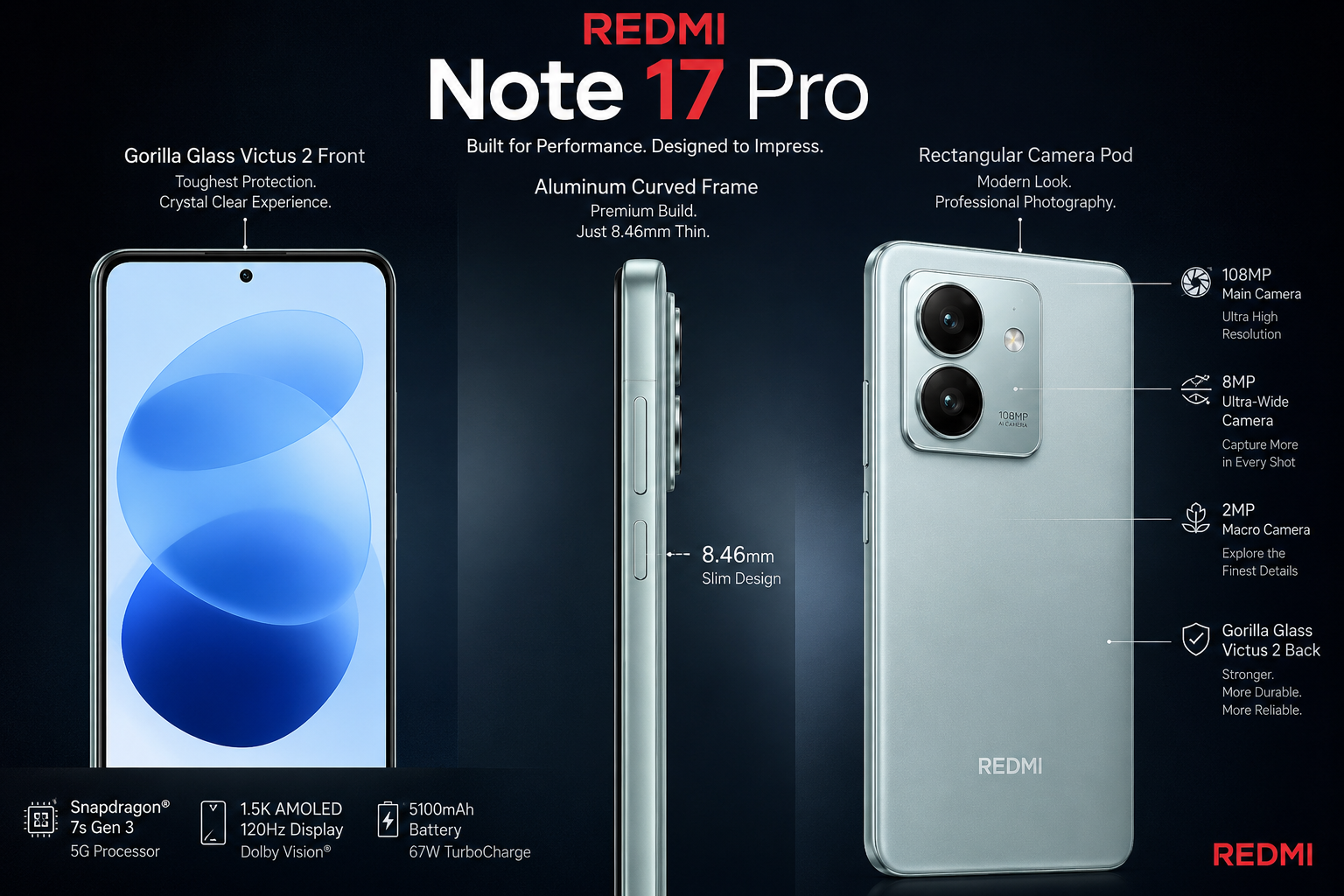
When it comes to survival features, this phone is built like a military bunker. Most rugged flagships offer an IP68 rating, but the Pro features combined IP66, IP68, and IP69/IP69K certifications. What does this mean in plain English?
IP66: Protects against heavy seas or powerful jets of water.
IP68: Allows full submersion in deep water for extended periods.
IP69 / IP69K: The holy grail of safety. It means the phone can withstand high-pressure, high-temperature steam cleaning jets. You can literally wash mud off this phone under a boiling kitchen tap without destroying the logic board.
The exterior glass surfaces are wrapped completely in Corning Gorilla Glass Victus 2 on both the front and back panels. Xiaomi has officially put the chassis through rigorous 3-meter drop tests on hard surfaces, making it highly resilient against accidental drops.
The Display: A 3,500-Nit Eye Protection Visual Canvas
The screen panel on the device is an absolute masterpiece for media consumption. It features a 6.83-inch 1.5K OLED matrix rendering a pin-sharp resolution of 2772×1280 pixels. Unlike the standard edition which utilizes a standard 8-bit color display, the Pro features a true 12-bit color depth panel, capable of shifting smoothly across millions of distinct color shades. It also brings full HDR10+ support right out of the box.
For outdoor visibility under direct midday sun, the display pushes out a massive 3,500 nits of peak brightness. But what makes this screen truly special is how it behaves when the lights go out.
Integrated directly with Xiaomi’s new “Green Mountain” eye protection system, the display uses an aggressive 3,840Hz high-frequency PWM dimming system alongside DC dimming. This lets the display brightness drop all the way down to a microscopic 1 nit. If you are someone who scrolls through news feeds or reads ebooks late at night in a pitch-black bedroom, this technology eliminates the invisible screen flickering that causes dry eyes and morning headaches.
Processing Architecture and Storage Speeds
Powering the device is the Qualcomm Snapdragon 6s Gen 4 mobile processor. This is an efficient 4nm system-on-chip manufactured on Samsung’s refined 4LPX node process.
Instead of using a low-end cluster layout, the chip relies on a balanced 4+4 core configuration: four high-performance ARM Cortex-A78 cores clocked at 2.4GHz to handle heavy operations, and four energy-saving Cortex-A55 cores running at 1.8GHz to handle passive tasks, background processes, and music streaming without draining your battery.
Qualcomm Snapdragon 6s Gen 4 (4nm Node)
  ├── 4x Performance Cortex-A78 Cores (@ 2.4GHz)
  ├── 4x Efficiency Cortex-A55 Cores (@ 1.8GHz)
  └── Qualcomm Adreno 710 Graphics Engine
Graphics and gaming are managed smoothly by the integrated Adreno 710 GPU. While it isn’t an elite tier gaming chip designed for heavy 3D rendering at 4K resolutions, it handles mainstream multiplayer titles effortlessly.
The device can be configured with either 8GB or 12GB of LPDDR4X RAM. Storage configurations range from 128GB up to a spacious 512GB tier.
Storage Warning: Be mindful of the storage tier you choose! The base 128GB version uses slower UFS 2.2 read/write speeds, while the 256GB and 512GB variants use high-speed UFS 3.1 flash memory. Furthermore, unlike the standard model, the Pro does not include a microSD card slot, so you cannot expand your storage later.
The 9,000mAh Battery Monster and the 5-Year Warranty
The true crowning glory of the phone is the unprecedented 9,000mAh silicon-carbon battery pack. Traditional lithium-ion phone batteries are bulky; if you tried putting a standard 9,000mAh pack inside a smartphone a couple of years ago, the device would have ended up looking and feeling like a heavy construction brick.
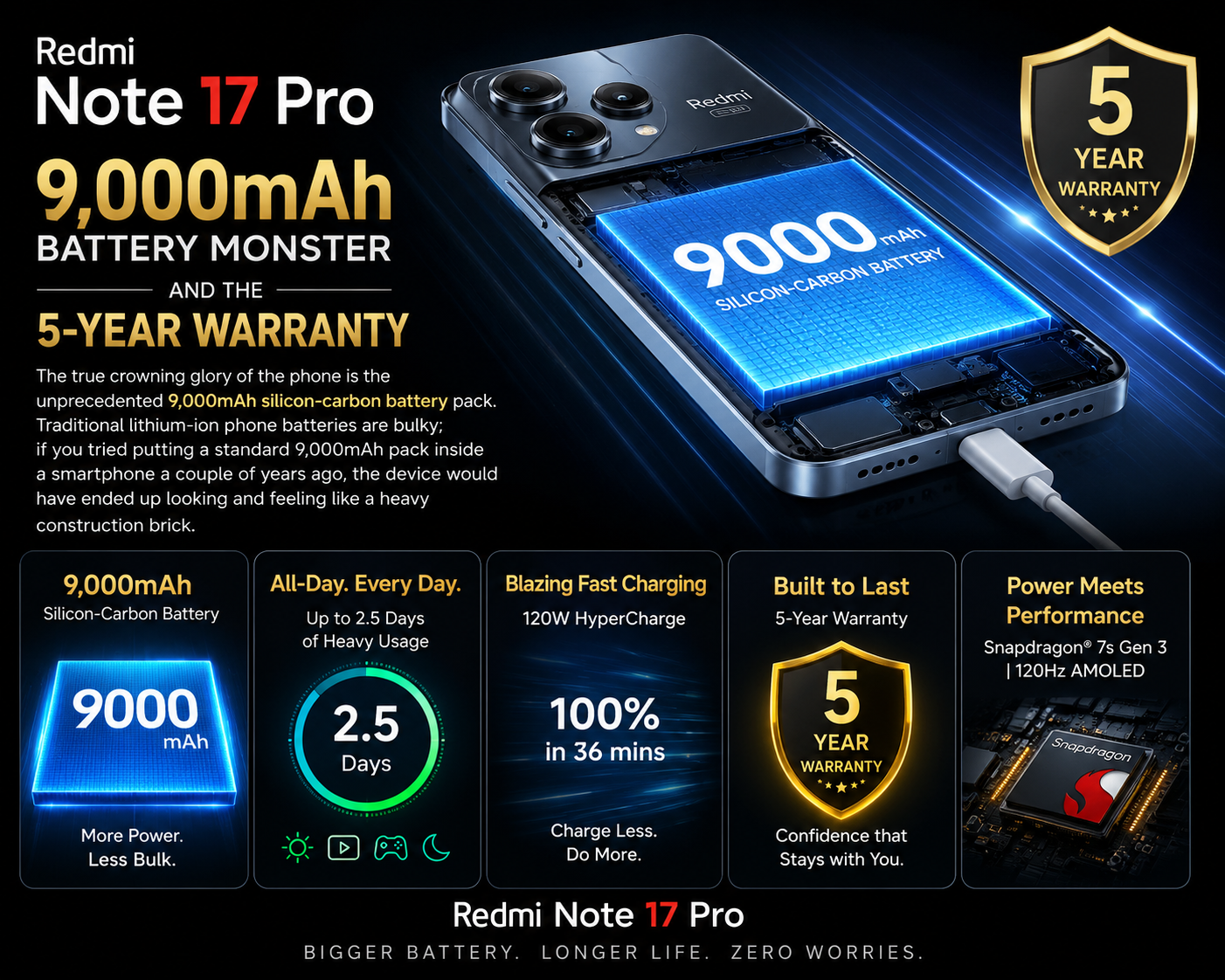
By switching to silicon-carbon chemistry, Xiaomi has managed to pack a massive capacity inside an 8.46mm chassis. The energy density reaches a top-tier level of 821Wh/L, giving the device incredible endurance.
[ 9,000mAh Silicon-Carbon Battery ]
  ├── 67W Wired Fast Charging (Full charge in ~85 Mins)
  ├── 22.5W Wired Reverse Charging (Power Bank Mode)
  └── Lifespan: Certified for 1,600 Full Charge Cycles
When the power reserve finally runs dry, you don’t have to wait half a day to fill it back up. The phone supports 67W wired fast charging, which replenishes the entire 9,000mAh tank in roughly 85 minutes.
Additionally, the phone features a highly practical 22.5W wired reverse charging system. By plugging a simple USB-C to USB-C cable into the phone, it turns into a fully certified portable power bank, allowing you to easily recharge your smartwatches, wireless earbuds, or a friend’s dying smartphone on the go.
The 5-Year Strategic Battery Incentives Program
To remove any customer worry regarding the long-term degradation of this new battery chemistry, Xiaomi has introduced an industry-first 5-year battery upgrade warranty program for early buyers in China:
Years 1 through 4: If your phone’s internal battery health metric drops anywhere below the 80% boundary line within the first 48 months of daily operation, Xiaomi authorized service hubs will replace the pack with a factory-new battery completely free of charge.
Year 5: If the battery percentage drops below the 80% line during the fifth year of ownership, Xiaomi will upgrade your handset to an even larger capacity battery option at zero out-of-pocket cost.
Let’s Talk Realistically About the Cameras
Let’s be completely honest here: if you are an aspiring mobile photographer looking to shoot cinematic short films or take professional portrait shots, this is probably not the device for you. To include a massive 9,000mAh battery, premium glass, and IP69K sealing while keeping the price highly competitive, Xiaomi had to cut corners somewhere—and they chose the cameras.
The rear camera pod houses a 50MP main camera sensor. However, it is built on a very tiny 1/2.76” sensor size with small 0.64µm native pixels and a standard f/1.8 aperture lens. The secondary lens on the back is just a basic 2MP depth sensor meant to assist with portrait mode background blurring.
Around the front, you get an 8MP selfie shooter hidden inside a punch-hole cutout. Both the front and back main sensors max out at 1080p video recording capped at 30 frames per second. There is no 4K recording, no high-speed 60fps smoothing, and no optical image stabilization (OIS). The setups are fine for quick scanning of documents, daytime snapshots, and casual video calls, but they won’t win any photography awards.
Audio, Connectivity, and Extra Software Details
Unlike the base model which only features a single bottom-firing speaker, the Pro comes equipped with physical dual stereo speakers backed by full Dolby Atmos tuning. The audio profile is loud, full, and clear, making it a great device for watching movies or playing games without headphones.
On the connectivity front, the Snapdragon chip brings full 5G dual-mode SA/NSA support, dual 4G VoLTE lines, dual-band Wi-Fi 5 (802.11 ac), Bluetooth 5.1, and an integrated multi-directional NFC chip for contactless payments.
Xiaomi has also included an optical in-display fingerprint scanner for quick biometric unlocking, along with their classic signature feature: a physical IR blaster sitting on the top frame to control home appliances like TVs and AC units. The phone ships running Android 16 customized with the clean, snappy animations of Xiaomi’s new HyperOS 3 system.
Chinese Launch Price Tiers and Global Market Outlook
The phone is currently on sale across mainland China in Sky Blue, Nebula Purple, Black, and White color variants. Xiaomi is offering introductory launch discounts ranging from 100 to 200 Yuan off the standard manufacturer suggested retail prices.
Here is exactly how the retail pricing tiers convert globally:
8GB RAM + 128GB Storage (UFS 2.2): 1,599 Yuan (Approx. USD 235 / INR 22,690)
8GB RAM + 256GB Storage (UFS 3.1): 1,899 Yuan (Approx. USD 280 / INR 26,945)
12GB RAM + 256GB Storage (UFS 3.1): 2,199 Yuan (Approx. USD 324 / INR 31,200)
8GB RAM + 512GB Storage (UFS 3.1): 2,299 Yuan (Approx. USD 339 / INR 32,620)
Final Verdict on Availability
As of right now, Xiaomi has not shared official launch dates for international markets outside of China. However, historical release schedules suggest that a global version will follow within the coming months.
One important thing to keep in mind for global buyers: Xiaomi frequently changes internal hardware configurations when moving devices from the Chinese market to the international stage. It is highly likely that the global version will see a significant camera upgrade, though this might mean a slight reduction in the massive battery capacity to make room for larger camera sensors. Either way, this phone marks a massive win for battery longevity.